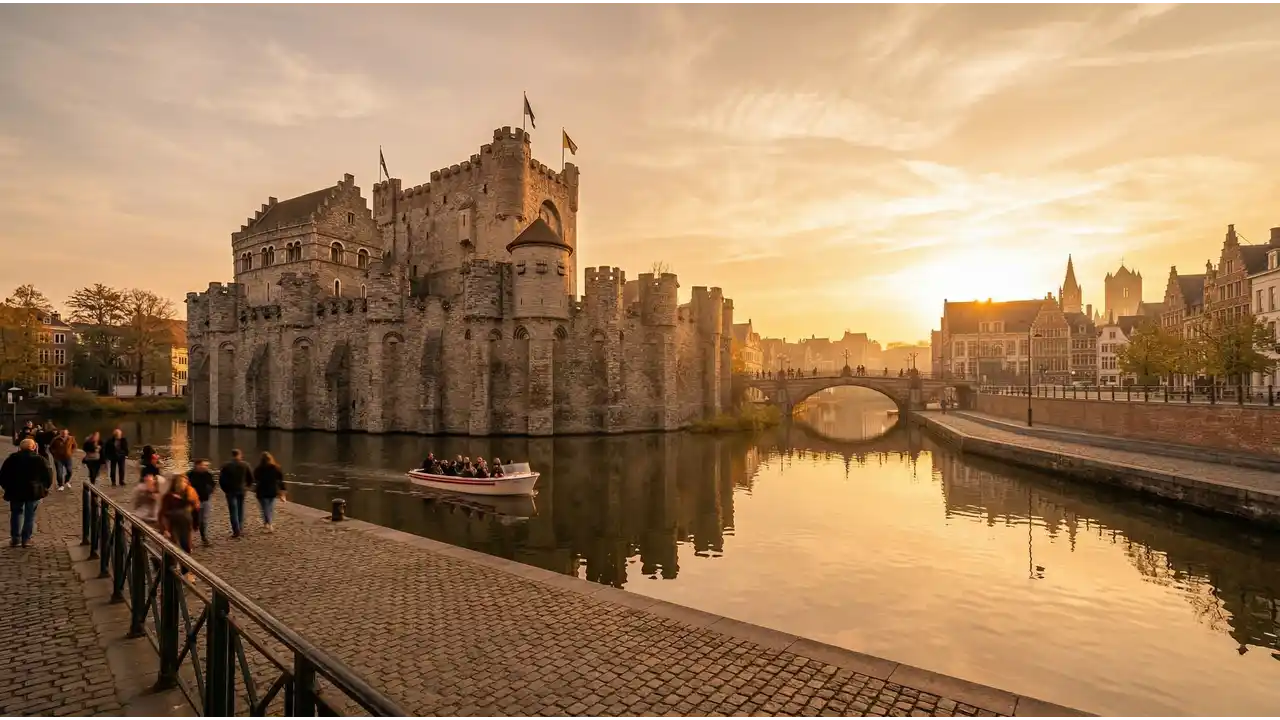
Belgium sits at the crossroads of Western Europe, with three official languages (Dutch, French, German) and a population split between Flanders in the north and Wallonia in the south. Daily life centers on efficient public transit, excellent cycling infrastructure, and proximity to the Netherlands, France, and Germany. The climate is temperate maritime, with frequent rain and mild winters. Work culture emphasizes efficiency and work-life balance. Food is serious business: beer, chocolate, and frites are not tourist attractions but everyday facts. Brussels draws diplomats and international professionals; smaller cities like Ghent, Bruges, and Antwerp offer lower costs and tighter communities.
💡 Local Insights
Belgium · 2026
Belgium's cost of living sits in the middle-European range. Housing dominates the budget at $976/month, with wide variation by city and neighborhood. Brussels apartments in popular areas like Ixelles or Saint-Gilles run $1,100 to $1,400 for a one-bedroom; smaller cities like Ghent or Bruges cost $750 to $950. Groceries average $379/month for one person buying at supermarkets like Carrefour or Delhaize. Belgian food is relatively affordable: a kilogram of chicken costs around $7, bread $1.50 per loaf, and local cheese $12 per kilogram. Eating out is moderate, with lunch menus around $12 to $15 and dinner mains $14 to $22. Public transit is excellent and cheap: a monthly pass in Brussels costs $65. Car ownership adds insurance, fuel, and parking costs, making transit preferable for most residents. Expats report that salaries often compensate for higher taxes (top marginal rate around 50 percent), so purchasing power depends heavily on employment sector. Local wages and international salaries can create two-tier pricing for housing and services.
Frequently Asked Questions
How much does it cost to live in Belgium per month?
A moderate lifestyle in Belgium costs around $2,150/month for one person. This breaks down roughly as: housing $976/month, groceries $379/month, utilities and transport $400 to $450/month, and dining out and entertainment $300 to $400/month. The budget tier runs $1,290/month (minimal housing, no dining out, public transit only). A comfortable lifestyle with more spacious housing, frequent dining out, and travel costs around $3,333/month. Costs vary significantly by city. Brussels is the most expensive; smaller Flemish cities are cheaper.
What is the average rent in Belgium?
Average rent is approximately $976/month. In Brussels, one-bedroom apartments in central neighborhoods like Ixelles or the Marais rent for $1,150 to $1,350; studios run $850 to $1,050. Outlying Brussels areas and commuter suburbs cost $800 to $1,000. In Ghent or Bruges, one-bedroom apartments rent for $750 to $950. Antwerp sits between Bruges and Brussels at $850 to $1,100. Utilities (heating, water, electricity) add $100 to $150/month depending on season and efficiency. Most leases require three months deposit and proof of income. Furnished rentals command a premium of 10 to 20 percent over unfurnished.
Is Belgium cheap to live in for expats?
Belgium is moderately priced for expats, not cheap but not expensive by Western European standards. It sits between the Netherlands (costlier, especially Amsterdam) and Poland (much cheaper). For expats on international salaries, Belgium offers good value: housing is manageable, public services are reliable, and taxes are transparent. However, expats on local Belgian wages or limited budgets find it tight. The expat community is large enough that English works in Brussels and university cities, but you will pay expat premiums for certain services. Tax residency and social security rules are complex; most expats use accountants, adding $500 to $1,500/year in costs. Quality of life and stability make the cost worthwhile for many.
How much does food cost per month in Belgium?
Groceries for one person average $379/month at mainstream supermarkets. Specific prices: chicken breast $7 per kilogram, ground beef $10 per kilogram, eggs $2.50 per dozen, milk (1 liter) $1.20, bread $1.50 per loaf, cheese $12 per kilogram, apples $2 per kilogram. Discount chains like Aldi or Lidl save 15 to 25 percent. Eating out costs $12 to $15 for lunch menus (plat du jour), $14 to $22 for dinner mains. Belgian beer in a cafe runs $3 to $5. Markets in Brussels, Ghent, and Bruges offer seasonal produce at lower prices than supermarkets. Imported or specialty items (non-European brands, organic) add significantly to costs.
What salary do you need to live comfortably in Belgium?
A comfortable lifestyle costs approximately $3,333/month. Gross salary needed depends on tax bracket, but roughly $4,200 to $4,800/month (net after tax) covers comfortable living for one person in Brussels or larger cities, allowing for spacious housing, frequent dining out, travel, and savings. In smaller cities like Ghent or Bruges, $3,500 net is sufficient. For couples or families, proportional increases apply. Belgian top marginal tax rate is around 50 percent (combined federal and regional), so gross income must be roughly double net income at higher brackets. Many expats earning $50,000 to $70,000/year find themselves comfortably placed. Salary expectations vary by sector: IT and finance pay higher; education and nonprofits pay lower.
How does the cost of living in Belgium compare to other places?
Belgium sits in the middle of Western European pricing. A moderate lifestyle in Belgium runs $2,150 per month, with housing at $976 monthly. France, a peer economy, comes in slightly cheaper at $2,050 for a full moderate budget and $914 for housing, so you're looking at minimal difference between the two.
If you're coming from elsewhere in Europe, Latvia is substantially cheaper at $1,475 monthly for a moderate lifestyle, though that reflects a different economic tier. By contrast, Ireland is significantly dearer, requiring $3,100 monthly for the same lifestyle and $1,796 for housing alone.
Belgium's costs align with broader Western European standards. You'll pay more than Central or Eastern European countries, but less than premium destinations like Ireland. For most expats from North America or Australia, these figures feel reasonable for the quality of services, infrastructure, and stability you receive.
Yes, but with tight constraints. The budget tier of $1,290/month assumes shared or very small housing around $600 to $700/month, groceries of $300 to $350/month, minimal dining out, and public transit. This works in Ghent, Bruges, or Antwerp better than Brussels. It requires cooking almost all meals at home, using discount supermarkets, avoiding leisure travel, and having no car. Many students and young professionals live this way. It is sustainable long-term but leaves little room for emergencies, medical costs, or social activities. Expat retirees or remote workers with stable income find it manageable; those on volatile incomes or with dependents face real risk. Budget housing is often in less central neighborhoods, requiring longer commutes.