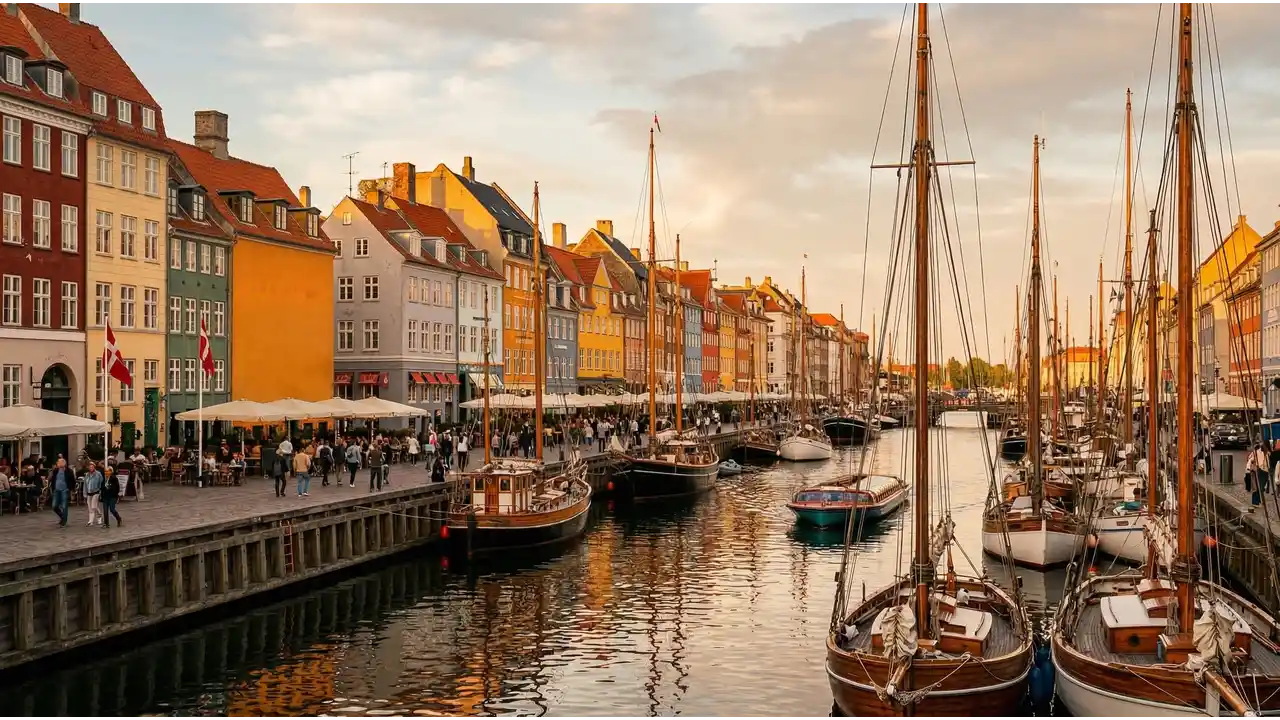
Copenhagen is Denmark's capital and largest city, home to about 800,000 people with another 1.4 million in the metro area. The city sits on the east coast of Zealand island, defined by flat terrain, extensive cycling infrastructure, and a temperate maritime climate with cold, dark winters and mild summers. Daily life centers on cycling, public transit, and compact neighborhoods where residents live close to work and schools. The population is ethnically Danish majority with growing communities of expats, particularly from other Nordic countries, Germany, and Asia. Food culture emphasizes fresh produce, open-faced sandwiches, and restaurant dining as a regular social activity. Weather and darkness in winter shape how people organize their lives around hygge (cozy togetherness) and outdoor activities during brief summer months.
💡 Local Insights
Copenhagen · 2026
Copenhagen's cost structure reflects high Nordic income taxes, strong labor unions that push wages and service costs upward, and a small geographic area with concentrated demand for housing. Rent dominates the budget at $1,579 per month for a moderate lifestyle. A one-bedroom apartment in central neighborhoods like Vesterbro or Nørrebro typically runs $1,200 to $1,800; outer areas like Amager or Rødovre offer options closer to $1,000. Groceries cost $458 monthly, significantly higher than southern Europe due to Denmark's food import dependency and value-added tax of 25 percent on most goods. Eating out is expensive: a casual dinner costs $18 to $28 per person. However, cycling is free after purchasing a used bike ($80 to $150), and public transport through the S-train and metro system is comprehensive, costing about $65 monthly with a subscription. Expats often face higher rents from landlords unfamiliar with tenant protections, so working through formal rental agencies or long-term platforms reduces risk. Local wages support these costs; most jobs pay $3,200 to $4,800 monthly after taxes for skilled work.
Frequently Asked Questions
How much does it cost to live in Copenhagen per month?
A moderate lifestyle in Copenhagen costs $3,000 per month. This breaks down roughly as housing at $1,579, groceries at $458, transport at $65 to $80, utilities at $120 to $150, and dining out and entertainment at $600 to $800. The budget tier, with roommates and minimal dining out, runs $1,800 monthly. A comfortable lifestyle, including a private apartment, regular dining out, and leisure activities, costs $4,650 monthly. These figures assume you're paying in US dollars or have equivalent purchasing power; actual costs in Danish kroner vary with exchange rates.
What is the average rent in Copenhagen?
Average rent is $1,579 per month for a moderate one-bedroom apartment. Central neighborhoods like Vesterbro, Nørrebro, and Frederiksberg range from $1,200 to $1,800 per month. Outer areas like Amager, Rødovre, or Glostrup offer more affordable options around $950 to $1,200. Shared apartments or rooms in shared flats run $600 to $900. The rental market is tight; landlords can be selective, and foreign renters sometimes face discrimination or requests for deposits equal to 3 months rent. Lease terms are typically 12 months minimum. Tenant protections are strong under Danish law, but finding availability requires patience and networking.
Is Copenhagen cheap to live in for expats?
No. Copenhagen is expensive by global standards but moderate within Northern Europe. Compared to London or Oslo, costs are similar or slightly lower. Compared to US cities like New York or San Francisco, housing and groceries are higher, but not drastically. The real expense for expats comes from dining out regularly (a meal costs $18 to $28), fitness memberships ($70 to $120 monthly), and childcare if applicable. International schools charge $12,000 to $20,000 annually. Expats with Scandinavian salaries find it manageable; those relocating from lower-cost regions often experience sticker shock. Tax rates are high (35 to 56 percent for top earners), affecting net income. If your employer offers relocation packages or housing allowances, costs become significantly easier to manage.
How much does food cost per month in Copenhagen?
Groceries average $458 per month for a moderate diet. A liter of milk costs $1.20, a kg of chicken breast $8 to $10, eggs $2.20 per dozen, and fresh bread $1.80 to $2.50. Supermarkets like Netto and Aldi offer budget options; Føtex and Bilka are midrange. Organic markets and premium chains cost 30 to 50 percent more. Eating out is expensive: a casual sandwich shop meal runs $12 to $16, a restaurant dinner $25 to $45 per person. Weekend brunches are popular and cost $20 to $30. Alcohol in bars is particularly costly, $8 to $12 for a beer. Many residents cook at home regularly and treat dining out as a social occasion rather than daily habit.
What salary do you need to live comfortably in Copenhagen?
A comfortable lifestyle costs $4,650 per month, requiring a gross salary of approximately $7,000 to $7,500 monthly before Danish taxes (which take 35 to 50 percent depending on income level). This assumes you're a Danish tax resident; foreign workers on temporary visas may qualify for lower tax rates (13 to 22 percent) in the first few years. Most skilled jobs in tech, finance, engineering, and healthcare pay $3,200 to $4,800 monthly after taxes, which allows a moderate lifestyle. To live comfortably with savings, couples often both work, pooling income. Freelancers and self-employed people face higher tax complexity and must navigate VAT obligations. A pension contribution of 10 to 15 percent is standard; employers typically match.
How does the cost of living in Copenhagen compare to other places?
Copenhagen sits in the middle-to-upper range for European cities. A moderate lifestyle here costs $3,000 per month, with housing at $1,579 per month. That puts it noticeably more expensive than Hamburg, where a moderate lifestyle runs $2,075 per month and housing $901 per month. Copenhagen is roughly comparable to Milan, which costs $2,700 per month overall with housing at $1,442 per month, though Milan edges slightly cheaper on both counts. The real outlier is Monte Carlo, which is substantially dearer at $4,025 per month for a moderate lifestyle and $2,323 per month for housing. For a major Nordic capital, Copenhagen's costs are typical, but you'll find significantly lower prices in smaller German cities and genuinely cheaper alternatives further south or east in Europe.
Yes, but with constraints. The budget tier of $1,800 requires roommates or a shared apartment in outer areas (rent $700 to $900), minimal dining out (cooking most meals), cycling or public transit only, and cutting entertainment spending. A one-bedroom alone is not viable at this budget. Food costs stay at $458 monthly through disciplined grocery shopping at discount chains. This budget works if you receive free or subsidized healthcare and childcare through employment or residency status. International students and young expats often live this way. It's tight but possible, and many do it successfully. The trade-off is location (further from central Copenhagen), social dining (rare), and new clothes or travel (minimal). After 6 to 12 months, most people either increase income or spending as they settle in.