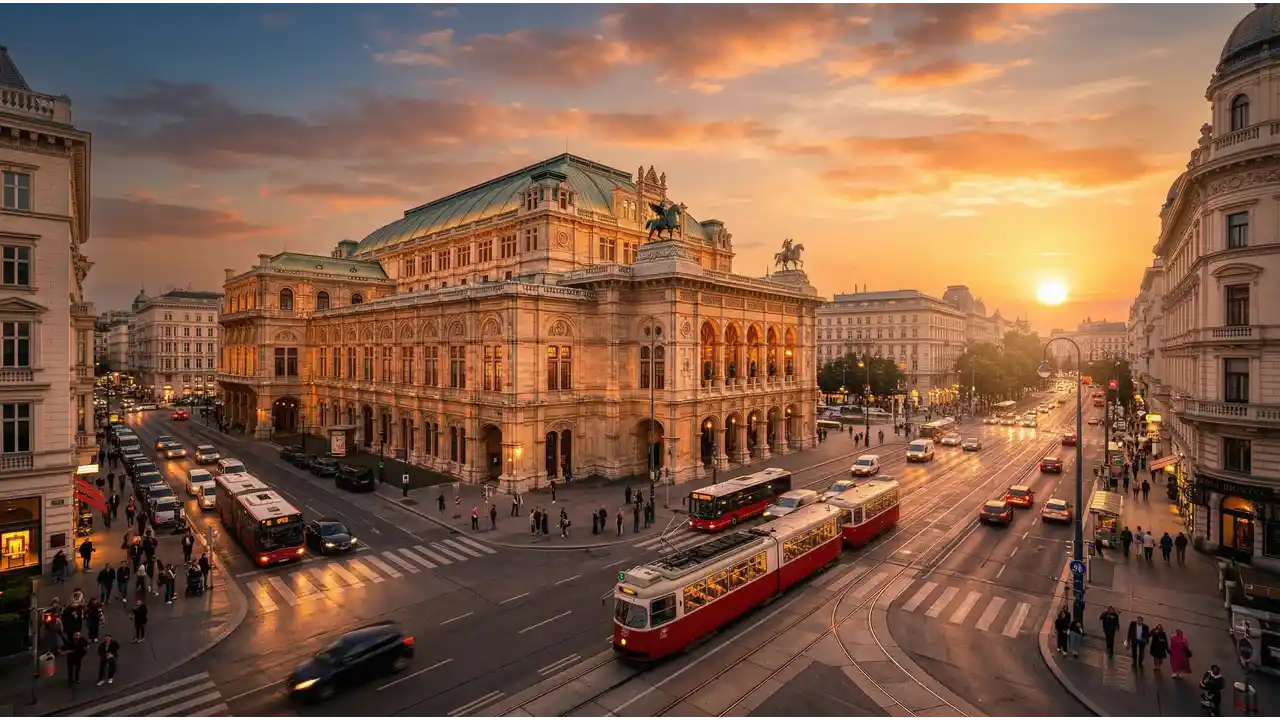
Vienna is Austria's capital and largest city, home to 1.9 million people in the metro area. The city sits on the Danube in northeastern Austria, with a continental climate (cold winters, warm summers). Daily life centers on excellent public transport, strong cafe culture, and high-quality public services. The population is roughly 60 percent Austrian, with significant communities from the Balkans, Turkey, and Eastern Europe. Most residents live in compact apartment blocks rather than houses. Work culture is formal; English is widely spoken in professional settings but German is essential for daily life. The city maintains a reputation for quality of life and safety, though it is notably colder and less cosmopolitan than Berlin or Prague.
💡 Local Insights
Vienna · 2026
Vienna costs roughly 15 to 20 percent less than Zurich and Geneva, but sits above many Eastern European capitals. Housing dominates the budget at $1,001 per month for a moderate lifestyle. Rental prices vary sharply by district: outer zones (Favoriten, Floridsdorf) run $700 to $900 for a one-bedroom; inner districts (Mariahilf, Wieden, Alsergrund) reach $1,200 to $1,600. Purchase prices are high, making rental the norm even for long-term residents. Groceries at $403 monthly are reasonable by Western European standards. Local markets and discount chains (Hofer, Penny) offer better value than supermarkets. Eating out is moderately priced: a cafe coffee costs $2 to $3, lunch at a casual restaurant $8 to $12. The U-Bahn and tram network is extensive and efficient; a monthly pass costs $57. Expats often pay slightly more for unfurnished rentals and may face deposits of two to three months' rent. Gas and electricity add $100 to $150 monthly in winter.
Frequently Asked Questions
How much does it cost to live in Vienna per month?
A moderate lifestyle costs $2,250 per month. This covers rent ($1,001), groceries ($403), utilities ($120 to $150), public transport ($57), and discretionary spending on dining, entertainment, and personal items. The budget tier is $1,350 per month (minimal housing, no eating out, basic transport). A comfortable lifestyle with dining out regularly, private transport, and cultural activities runs $3,488 per month. Actual costs depend heavily on neighborhood choice and lifestyle preferences.
What is the average rent in Vienna?
Average rent is around $1,001 per month for a one-bedroom apartment in a moderate neighborhood. Prices vary significantly by district. Outer zones (Floridsdorf, Favoriten, Simmering) range from $700 to $900 monthly. Central districts (Innere Stadt, Alsergrund, Mariahilf) run $1,200 to $1,600. Furnished apartments cost 20 to 30 percent more than unfurnished. Deposits typically equal two to three months' rent. Utilities (heating, water, electricity) add $120 to $150 monthly, higher in winter. Long-term renters (over one year) may negotiate lower rates than newcomers.
Is Vienna cheap to live in for expats?
Vienna is moderately priced for Western Europe but not cheap. Expats comparing to North America will find it affordable; those from Berlin or Budapest will find it expensive. Rent is the largest cost burden and has risen steadily over the past decade. Utilities, particularly heating, spike in winter. Groceries and transport are reasonable. Administrative hurdles (registering residence, obtaining permits) can add costs. Healthcare is subsidized for residents with legal status, making it cheaper than the US. Language barriers may initially limit access to cheaper local markets and services, pushing costs up for newly arrived expats.
How much does food cost per month in Vienna?
Groceries average $403 monthly for one person on a moderate diet. A loaf of bread costs $1.50 to $2; milk $1 per liter; eggs $2.50 per dozen; chicken $6 to $8 per kilogram. Budget chains like Hofer and Penny undercut supermarkets by 15 to 25 percent. Weekly markets (Naschmarkt, Karmelitermarkt) offer competitive produce prices. Eating out is moderate: coffee $2 to $3, lunch entree $8 to $12, dinner at a casual restaurant $12 to $20. Fine dining and tourist-area restaurants are significantly pricier. Alcohol (wine, beer) is cheap; a bottle of wine runs $5 to $10 at retail.
What salary do you need to live comfortably in Vienna?
A comfortable lifestyle requires approximately $3,488 per month, or roughly $42,000 annually before tax. This covers rent in a desirable neighborhood ($1,200 to $1,400), regular dining out, cultural activities, and modest savings. Austrian income tax is progressive, ranging from 0 percent on the first $12,500 to 55 percent on income above $90,000. Actual net income after taxes and social contributions will be lower. EU citizens can work freely; non-EU citizens need an employment visa and work permit. Professional salaries in Vienna average $2,500 to $4,000 monthly, depending on sector and experience. Freelancers should budget for higher taxes and health insurance costs.
How does the cost of living in Vienna compare to other places?
Vienna sits in the middle of Central Europe's cost spectrum. A moderate lifestyle here runs $2,250 per month, with housing at $1,001 per month. That makes it slightly pricier than Dusseldorf, where a moderate lifestyle costs $2,175 monthly and housing runs $952. Budapest is notably cheaper, at $1,650 for a moderate lifestyle and $795 for housing, making it a real alternative if you want the same Central European feel on a tighter budget. Amsterdam, by contrast, is substantially more expensive at $3,150 monthly overall and $1,802 for housing alone. So Vienna offers you decent value for a Western European capital, especially compared to major Western cities, though you'll pay more than you would in Hungary's capital.
Yes, but with serious constraints. The budget tier of $1,350 per month covers minimal housing ($600 to $700 in outer districts), groceries ($300 to $350), utilities ($100 to $120), and public transport ($57). It leaves almost nothing for eating out, entertainment, or emergencies. This budget works only for highly disciplined individuals or students with subsidized housing. You must live far from the center (20+ minutes by U-Bahn), cook all meals at home, and skip paid entertainment. Healthcare is covered for residents, but personal spending is non-existent. Most long-term residents find this unsustainable and save for the moderate budget of $2,250 per month.