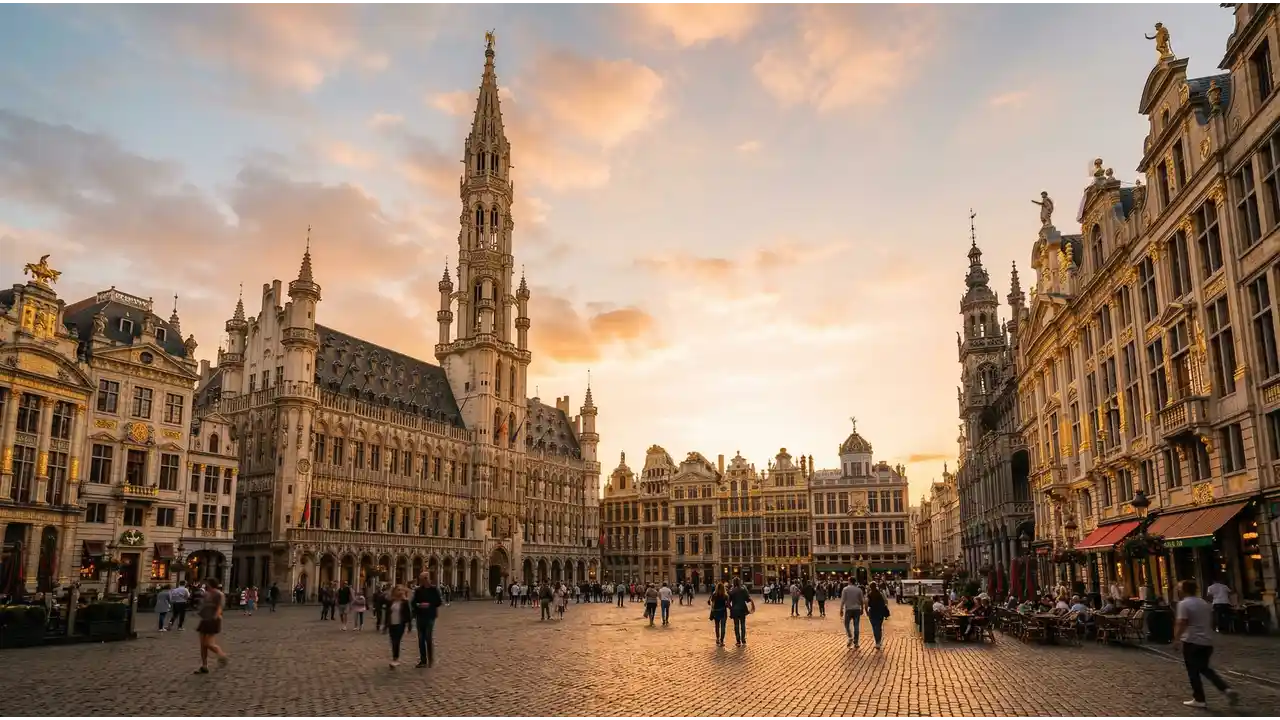
Brussels is Belgium's capital and home to roughly 1.2 million people in the metro area. The city functions as a multilingual hub: Dutch, French, and English are widely spoken, especially among younger residents and professionals. Daily life centers on compact neighborhoods accessible by tram, metro, and bike. The climate is temperate oceanic, with gray winters and mild summers. EU institutions and international organizations employ a large expat workforce, which shapes the character of certain neighborhoods like Ixelles and Etterbeek. The city moves at a moderate pace compared to London or Paris, with strong coffee culture, weekend market habits, and a food scene split between Michelin restaurants and casual Belgian beer halls.
💡 Local Insights
Brussels · 2026
Brussels costs less than major Western European capitals but more than Eastern European cities. Housing at $1,259/month reflects a mix of neighborhoods: outer areas like Anderlecht or Saint-Gilles run $900-1,100 for a one-bedroom apartment, while central Ixelles or Etterbeek average $1,300-1,500. Expats often pay more for furnished or English-friendly listings. Groceries at $376/month assume supermarkets like Carrefour or Delhaize; eating out adds 30-40 percent to food costs. Public transport (STIB/MIVB) costs about $45/month for a pass and covers the entire metro, tram, and bus network efficiently. Utilities (heating, electricity, water) average $120-150/month. Expats sometimes pay 10-15 percent premiums on furnished rentals or through agencies. Local markets and discount chains like Lidl or Aldi cut grocery costs significantly. Winter heating bills spike October through March.
Frequently Asked Questions
How much does it cost to live in Brussels per month?
A moderate lifestyle in Brussels costs around $2,425/month. This breaks down roughly as: housing $1,259/month, groceries $376/month, utilities and household supplies $140/month, transport $45/month, and dining out, entertainment, and personal care making up the remainder. A budget tier lifestyle runs about $1,455/month (minimal housing, no dining out, minimal recreation), while comfortable living with more dining flexibility, larger housing, and regular entertainment averages $3,759/month. Individual costs vary by neighborhood, lifestyle choices, and whether you use transit passes or own a car.
What is the average rent in Brussels?
Average rent in Brussels hovers around $1,259/month for a moderate one-bedroom apartment in accessible neighborhoods. Studio apartments in outer areas like Anderlecht, Molenbeek, or Saint-Gilles typically run $850-1,000/month. One-bedroom apartments in central zones like Ixelles, Etterbeek, or the Marais average $1,200-1,400/month. Furnished rentals through agencies cost 15-25 percent more. Two-bedroom apartments range from $1,400-1,800/month depending on location. Expats should expect premium prices on furnished or short-term leases. Long-term unfurnished rentals from local landlords offer better rates. Many buildings lack elevators and central heating is common but not universal.
Is Brussels cheap to live in for expats?
Brussels is moderately priced for expats compared to London, Paris, or Amsterdam, but more expensive than Prague or Budapest. Housing and groceries are the main cost drivers. Expats benefit from efficient public transit and lower restaurant costs than Western European capitals. However, furnished rentals (which many expats require initially) carry premiums of 20-30 percent. Salary expectations for expat roles, especially in EU institutions and NGOs, are often lower than comparable London or Paris positions, which can offset the cost advantage. EU professionals and family expats find Brussels affordable relative to alternatives. Solo budget travelers or those avoiding furnished rentals find better value in Eastern Europe.
How much does food cost per month in Brussels?
Grocery shopping costs approximately $376/month for one person on a moderate budget. A typical weekly shop at Carrefour or Delhaize includes bread ($1-2), milk ($1.20), cheese ($3-5 per item), eggs ($2.50 per dozen), chicken ($6-8 per kg), vegetables ($2-4 per item), and staples like rice and pasta ($1-3 per package). Discount chains like Lidl and Aldi cut costs by 15-20 percent. Eating out averages $12-18 for casual lunch, $25-40 for dinner at a mid-range restaurant. Belgian beer ($3-5 at bars) and coffee ($2-3) are social staples. Weekend markets in Matonge or Sablon offer fresh produce and lower prices than supermarkets.
What salary do you need to live comfortably in Brussels?
A comfortable lifestyle in Brussels requires approximately $3,759/month or roughly $45,000 annually after tax. This supports larger housing (one or two-bedroom apartment or townhouse), regular dining out 4-5 times weekly, gym membership, entertainment, and savings. For a couple, $5,500-6,000/month provides comfortable space, flexibility with restaurants and travel, and modest savings. Expat salaries for professional roles (EU institutions, international organizations, tech companies) typically range $50,000-80,000 annually, which places comfortable living well within reach. Housing costs at $1,259/month leave room for quality of life without tight budgeting. Local salaries are lower; entry-level positions run $25,000-35,000 annually, making moderate living at $2,425/month the realistic target for locals.
How does the cost of living in Brussels compare to other places?
Brussels sits in the middle band of Western European cities. A moderate lifestyle costs $2,425/month here, with housing running $1,259/month. That puts it just above Rome, where a moderate lifestyle costs $2,350/month and housing costs $1,339/month. Both cities offer similar affordability for the region.
Step up to Amsterdam, and you're looking at $3,150/month for a moderate lifestyle, with housing at $1,802/month. That's a real jump. On the flip side, Zagreb is noticeably cheaper at $1,675/month overall and $779/month for housing, though it's a different market entirely.
Within Belgium, Brussels is pricier than smaller towns but more affordable than you might expect for a capital. Your money stretches further here than in most major Western European centers, which is why many expats and remote workers base themselves here.
Yes, but with significant constraints. A budget of $1,455/month requires housing in outer neighborhoods (Anderlecht, Molenbeek, or Uccle) at $750-900/month for a small one-bedroom or studio. Groceries at $376/month leaves $379 for utilities, transport, and everything else. This cuts out regular dining out, entertainment, travel, and limits flexibility. You can manage basics: public transit, supermarket meals, occasional coffee, minimal social spending. Unfurnished rentals from local landlords are essential; furnished rentals are unaffordable at this budget. Young professionals or students relocating to Brussels for EU internships or entry-level roles often live on this budget by sharing apartments or accepting longer commutes. Unexpected costs (repairs, medical, travel home) require backup funds. It is possible but not comfortable.