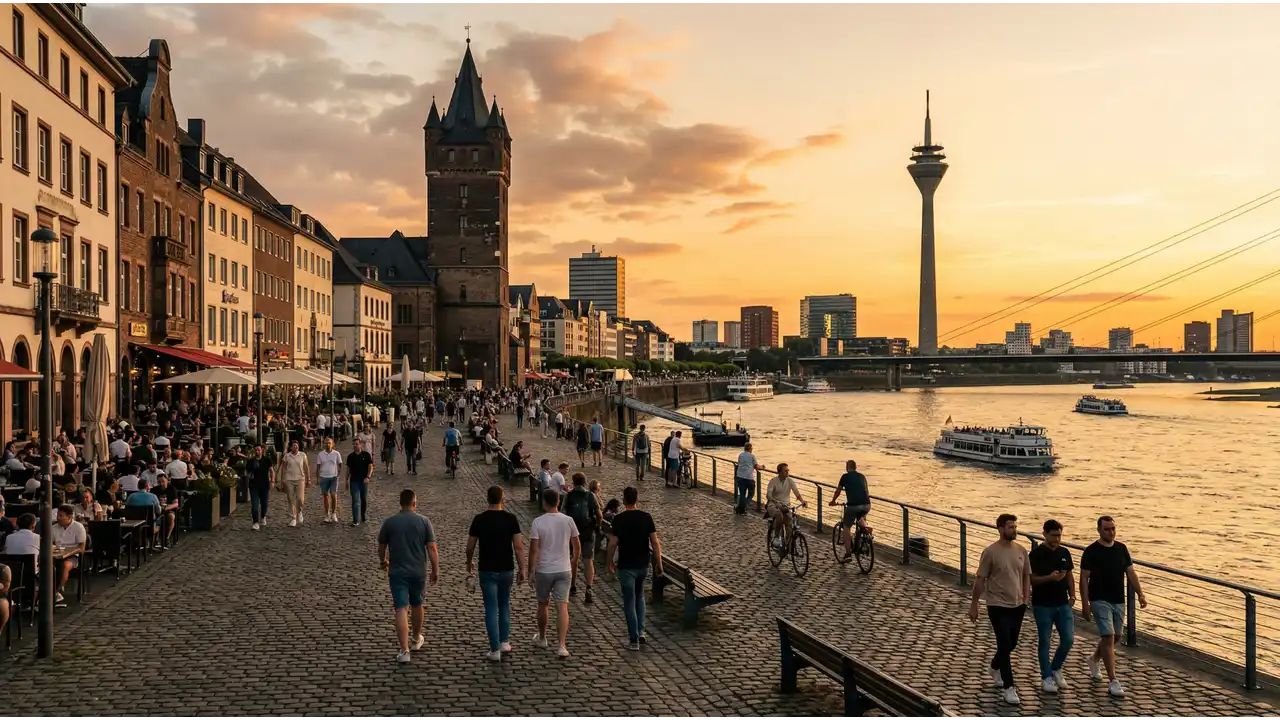
Dusseldorf is a Rhine-side commercial and fashion hub in western Germany with about 630,000 residents. The city functions as a business center (major pharmaceutical, advertising, and finance presence) rather than a tourist capital, which shapes its character. Winters are gray and cold; summers moderate. Daily life centers on efficient public transit, strong work culture, and proximity to cafes and restaurants rather than nightlife. The old town (Altstadt) sits on the river; newer districts like Pempelfort and Flingern attract younger residents and creatives. Most expats work in corporate or tech roles; English is common in professional settings but German dominates daily interactions.
💡 Local Insights
Dusseldorf · 2026
Dusseldorf costs more than many German cities because of its financial sector and real estate competition. Housing costs around $952/month for a one-bedroom apartment in outer neighborhoods or shared flats; central locations (Altstadt, Carlstadt) run higher. Groceries total around $395/month for one person buying at supermarket chains like Rewe, Edeka, or discount outlets (Lidl, Aldi). Eating out is expensive relative to groceries: a meal at a casual restaurant costs $12 to $18. Public transport (U-Bahn, S-Bahn, trams, buses) is integrated and reliable; a monthly pass costs around $110. The biggest expat pitfall is overpaying for furnished short-term rentals; staying longer unlocks unfurnished flats at lower monthly rates. Winter heating adds $50 to $100 per month to utility bills. English speakers may face slightly higher prices in tourist-facing areas but negotiate normal rates in residential neighborhoods.
Frequently Asked Questions
How much does it cost to live in Dusseldorf per month?
A moderate lifestyle costs $2,175/month for a single person. That breaks down roughly as: housing $952, groceries $395, transport $110, dining out and entertainment $400, utilities and miscellaneous $318. A budget lifestyle (cutting dining out and choosing cheaper housing options) runs $1,305/month. A comfortable lifestyle with more dining out, better housing, and leisure spending reaches $3,371/month. These figures assume you are renting, not buying property. Costs are lower in outer districts like Gerresheim or Benrath; higher in central Altstadt and Carlstadt.
What is the average rent in Dusseldorf?
Average monthly rent is $952 for a one-bedroom apartment. In outer neighborhoods (Garath, Lierenfeld, Gerresheim), expect $700 to $850. Inner-ring residential areas (Pempelfort, Flingern, Oberbilk) run $950 to $1,150. Altstadt and Carlstadt (riverside, old town) command $1,200 to $1,600. These figures are for unfurnished rentals on a 12-month lease. Furnished short-term apartments via platforms can be 30 to 50 percent higher. Utilities (heating, electricity, internet) add $150 to $200/month depending on apartment size and season. Always negotiate: landlords sometimes reduce rent for longer leases or immediate availability.
Is Dusseldorf cheap to live in for expats?
Dusseldorf is moderately priced for Germany but expensive by global standards. It costs more than Munich, Hamburg, or Berlin because of its financial sector and real estate demand. Expats with euro salaries find it manageable; those earning in weaker currencies struggle. Housing is the biggest adjustment: furnished short-term flats are overpriced ($1,200 to $1,600 for one bedroom), but unfurnished leases offer better value. Groceries, public transit, and gym memberships cost less than equivalent US or UK cities. Healthcare is excellent and affordable under German insurance. The real savings come from planning a 12+ month stay rather than month-to-month housing.
How much does food cost per month in Dusseldorf?
Groceries for one person total around $395/month buying at Rewe, Edeka, or Aldi. Bread runs $1 to $2, milk $0.80 to $1.20, cheese $2 to $5 per 200g, eggs $2 to $3 per dozen, chicken $4 to $6 per pound, vegetables $0.50 to $2 each depending on season. Eating out is expensive: lunch specials (Mittag) at casual spots cost $8 to $12; dinner at a normal restaurant $15 to $25. Supermarket wine and beer are cheap (bottles $2 to $4). Turkish and Vietnamese food offer better value than German restaurants. Farmers markets in Carlstadt and Oberbilk offer fresh produce but cost more than supermarkets.
What salary do you need to live comfortably in Dusseldorf?
A comfortable lifestyle costs $3,371/month, requiring a gross monthly income of roughly $5,000 to $5,500 (accounting for German income tax, church tax, and social insurance). That supports better housing ($1,200 to $1,400), regular dining out (3 to 4 times weekly), hobbies, travel within Europe, and a buffer. Net salaries in Dusseldorf for mid-level corporate or tech roles range from $2,800 to $4,500/month depending on experience and sector. Finance and pharmaceutical roles pay higher. Expats on expat packages often earn $4,000 to $6,500 net. Couples earning combined $4,500 to $5,500 net have comfortable margins. Part-time or freelance income below $520/month is tax-exempt (Minijob threshold).
How does the cost of living in Dusseldorf compare to other places?
Dusseldorf sits in the middle of Western Europe's cost spectrum. A moderate lifestyle there costs $2,175 per month, with housing running $952 monthly. That makes it slightly pricier than Lyon, where a comparable budget is $2,075 per month and housing costs $865. You'll find Dusseldorf considerably more affordable than Oslo, which runs $3,025 monthly for the same lifestyle, with housing alone at $1,434. If you're coming from Eastern Europe, though, expect to pay roughly 45 percent more than Sofia, where $1,500 covers moderate living expenses and $705 covers rent. Dusseldorf's position reflects its role as a major business and cultural hub. It's cheaper than Scandinavian capitals but noticeably costlier than Central or Eastern European alternatives.
Yes, but only with discipline and compromises. Budget rent of $600 to $750 in outer districts (Garath, Reisholz, Lierenfeld) leaves $350 for food and $155 for transport and utilities. Groceries stretch to $300 to $350/month by shopping at Aldi and Lidl, cooking at home, skipping dining out. That leaves little buffer for emergencies, clothes, or entertainment. Most budget-livers are students (accessing cheaper dorm housing) or receiving family support. Working remotely while living in a cheaper German city and visiting Dusseldorf occasionally is a common workaround. Solo travelers or digital nomads find this tight; established residents with higher incomes should plan for $2,175/month as realistic.