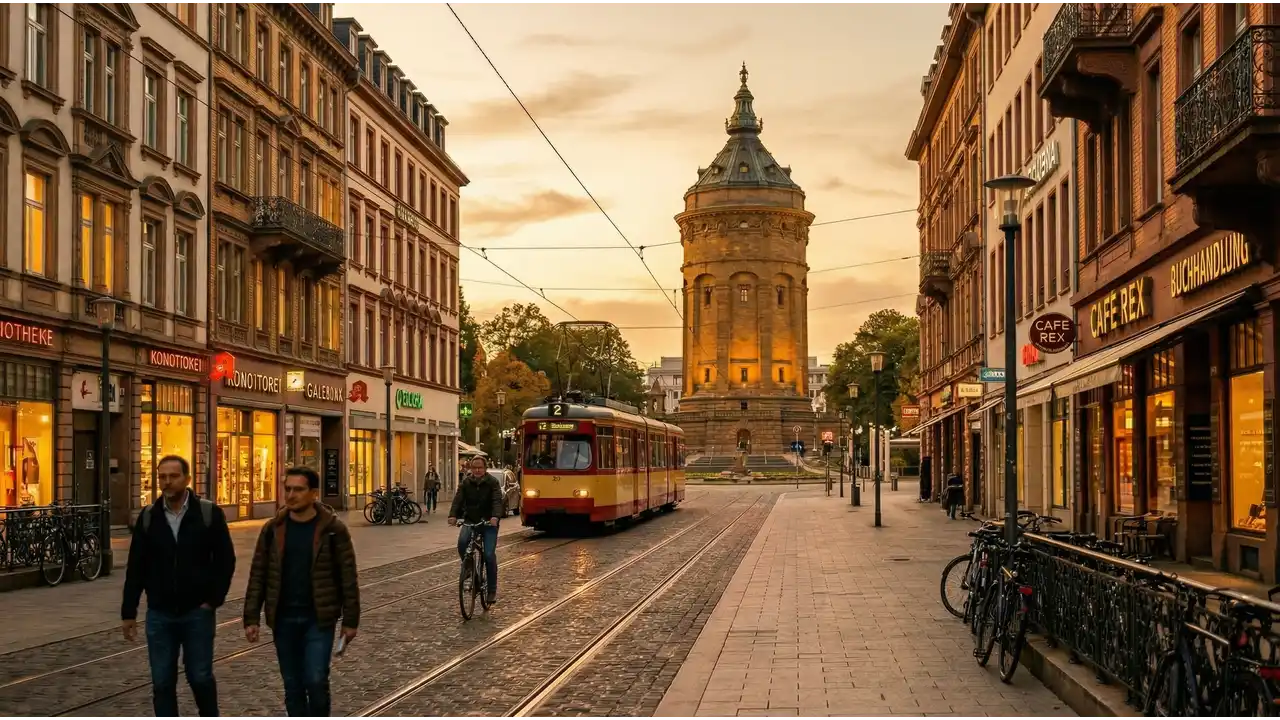
Frankfurt is Germany's financial center, home to the European Central Bank and major banking headquarters. The city sits on the Main River with a mix of modern high-rises and restored half-timbered buildings in the Altstadt. Most residents are German, but significant expat communities exist around banking and tech sectors. Daily life involves reliable public transit (U-Bahn and S-Bahn), German efficiency in services, and a serious approach to work. Summers are warm (70-77 degrees Fahrenheit), winters cold (32-41 degrees). The city feels less touristy than Munich or Berlin, more transactional, with strong international business culture alongside traditional German neighborhoods like Sachsenhausen.
💡 Local Insights
Frankfurt · 2026
Frankfurt's cost of living sits between Berlin (cheaper) and Munich (more expensive). Housing dominates your budget at $1,052/month for moderate living. A one-bedroom apartment in central areas like Sachsenhausen or Bornheim runs $900-1,200; outer neighborhoods like Niederrad or Preungesheim drop to $750-950. Furnished short-term rentals cost 20-30 percent more. Groceries average $395/month for a single person eating at home with mix of German supermarkets (Aldi, Rewe, Edeka) and specialty shops. Eating out is expensive: a basic lunch costs $8-12, dinner $15-25. Public transit costs $110/month (monthly pass). The Main works well for cycling, and many expats bike to work. Expat salary expectations often run 10-15 percent higher than local equivalents, partly reflecting tax brackets and relocation costs. Banking sector salaries skew the perception upward. For budget living, shared apartments and outer neighborhoods shift the equation sharply downward.
Frequently Asked Questions
How much does it cost to live in Frankfurt per month?
A moderate lifestyle in Frankfurt costs $2,275/month. This breaks down to $1,052 for housing (rent for a one-bedroom apartment in central or near-central neighborhoods), $395 for groceries, $110 for public transit, and the remainder for utilities, phone, insurance, dining out, and entertainment. On a budget tier of $1,365/month, you would need to share housing, live in outer neighborhoods, and minimize eating out. A comfortable lifestyle at $3,526/month allows for larger or central housing, dining out regularly, and more discretionary spending.
What is the average rent in Frankfurt?
Average rent is $1,052/month for a one-bedroom apartment in a moderate-cost location. In central neighborhoods like Sachsenhausen, Bornheim, or near the Main, expect $950-1,200 for a one-bedroom unfurnished apartment. Outer neighborhoods like Niederrad, Preungesheim, or Sossenheim rent for $750-950. Two-bedroom apartments run $1,300-1,600 centrally, $1,000-1,350 on the edges. Furnished short-term rentals (common for expats) cost 20-30 percent more. Utilities (heat, water, electricity) add $100-150/month. The rental market is competitive; viewings often happen quickly and landlords ask for references and proof of income.
Is Frankfurt cheap to live in for expats?
Frankfurt is not cheap compared to Berlin or most of Eastern Europe, but moderate compared to Munich, Zurich, or major US cities. For expats on local German salaries, it is manageable. For expats transferred by US or UK employers, Frankfurt feels affordable. Banking and tech roles often come with relocation packages that offset housing costs. The expat community is organized and housing options are plentiful, reducing search friction. Childcare and school fees are reasonable by global standards. However, if you are comparing Frankfurt to Southeast Asia or Latin America, costs will feel high. Budget conscious expats typically share housing or live in neighborhoods like Kalbach or Harheim.
How much does food cost per month in Frankfurt?
Groceries average $395/month for one person eating at home. Aldi and Lidl offer budget options (bread $1, milk $1.20, chicken $6/kg). Rewe and Edeka are pricier but offer more variety. A typical weekly shop for one runs $25-35. Eating out is considerably more expensive: a lunch at a casual restaurant costs $8-12, dinner $15-25. A beer costs $4-6 at bars. Supermarket beer is $0.80-1.50 for 500ml. Frankfurt's food scene includes traditional Apfelwein taverns and international restaurants reflecting the banking crowd. Farmers markets occur weekly in neighborhoods, slightly undercutting supermarket prices. Imported or specialty foods add 30-50 percent to standard grocery costs.
What salary do you need to live comfortably in Frankfurt?
A comfortable lifestyle costs $3,526/month. After German taxes and social contributions (roughly 40 percent for middle-income earners), you need a gross salary of approximately $5,800/month, or $70,000 annually. This supports a one-bedroom apartment in a desirable neighborhood, regular dining out, weekend travel, and savings. A couple can live comfortably on $5,500-6,000 combined gross monthly income, sharing housing and fixed costs. The banking and tech sectors typically pay $50,000-80,000+ gross annually for entry to mid-level roles, which aligns with comfortable living. Local German salaries in public service or small businesses may be lower, requiring the budget tier of $1,365/month instead.
How does the cost of living in Frankfurt compare to other places?
Frankfurt sits in the middle range for major European cities. A moderate lifestyle here costs $2,275 per month, with housing at $1,052 monthly.
Stuttgart, a comparable German city, runs slightly cheaper at $2,175 overall, though its housing costs only marginally less at $1,001. If you're comparing to Southern Europe, Athens comes in noticeably lower at $1,650 for a moderate lifestyle and $697 for housing, reflecting the broader cost gap between Germany and Greece.
The real jump comes if you're considering Dublin, which reaches $3,175 monthly with housing alone at $1,902. That puts the Irish capital roughly 40 percent more expensive than Frankfurt overall.
For a finance hub with strong infrastructure and services, Frankfurt's costs are reasonable relative to peer cities in Western Europe, though expect to pay a premium compared to Mediterranean alternatives.
Yes, but with strict compromises. The budget tier of $1,365/month requires shared housing (cutting rent to $450-550/month per person), cooking almost every meal (staying at $200-220/month for groceries), using public transit exclusively, and minimal discretionary spending. You would live in outer neighborhoods like Harheim, Kalbach, or Preungesheim, a 20-30 minute commute to downtown. A shared two-bedroom apartment costs $900-1,000 total; your share runs $450-550. Dining out happens rarely (once or twice monthly). No car, no expensive hobbies. This budget works for students, early-career workers, or those with substantial savings. Many young professionals do this through shared housing platforms like WG-Gesucht. It is survivable but not comfortable.