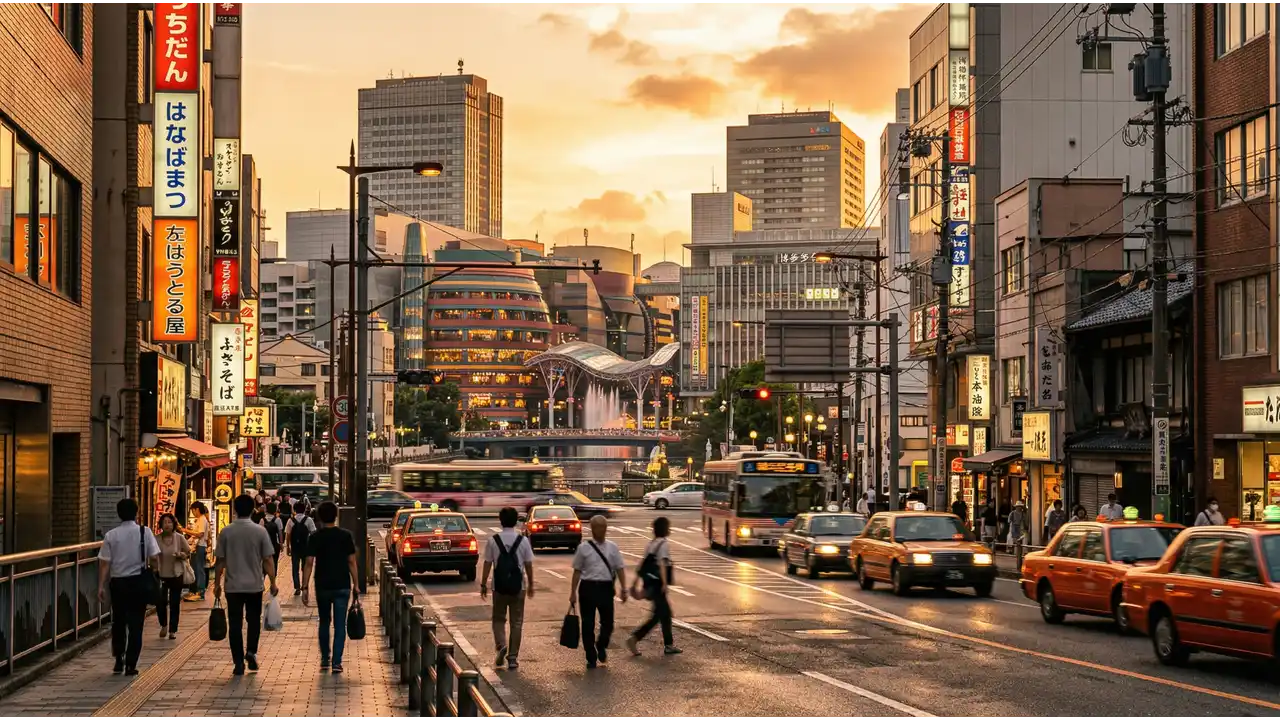
Fukuoka is Japan's sixth-largest city and the economic center of Kyushu. It sits on the northern coast of Kyushu Island and feels less crowded than Tokyo or Osaka while maintaining serious urban infrastructure. The climate is subtropical, with hot, humid summers and mild winters. The population mixes salaried workers, small business owners, students, and a smaller but steady expat community. Daily life centers on efficient train networks, affordable local restaurants, and a strong food culture, especially ramen and yatai (food stalls). The pace is noticeably slower than Tokyo's, and neighborhoods feel accessible. Many expats work in English education, tech, or international logistics.
💡 Local Insights
Fukuoka · 2026
Fukuoka's cost structure sits between Tokyo and smaller Japanese cities. Housing follows the Japan-wide figure of $603/month, which represents a national average. Actual Fukuoka rents vary widely: a modest one-bedroom apartment in suburban areas like Momochi or Hakata runs roughly $400-600/month, while central Tenjin or Daimyo command $600-900/month. Shared housing for expats typically runs $350-550/month. Groceries are genuinely cheap by developed-market standards, at $346/month for an individual. A liter of milk costs around $2, eggs (10) cost $3-4, and rice is under $1/kg. Eating out is the real value: a decent ramen bowl runs $4-6, while convenience store meals cost $3-5. Local transit (bus and train) averages $30-45/month with a regional pass. Expats and locals pay the same prices almost everywhere except for used furniture and international goods. The biggest variable is whether you cook or eat out regularly. A moderate lifestyle at $1,675/month assumes a one-bedroom rental, regular home cooking with occasional restaurant meals, and local transport.
Frequently Asked Questions
How much does it cost to live in Fukuoka per month?
A moderate lifestyle in Fukuoka costs $1,675/month. This breaks down roughly as: housing at $603/month (the Japan-level figure), groceries at $346/month, local transport at $40/month, and the remaining $686/month on utilities, dining out, personal care, and entertainment. A tighter budget of $1,005/month is possible if you share housing, cook almost everything, and minimize entertainment. A comfortable lifestyle runs $2,596/month, allowing for a better neighborhood, regular restaurant meals, and travel within Kyushu.
What is the average rent in Fukuoka?
Fukuoka's housing cost inherits the Japan-wide figure of $603/month rather than a separate local measurement. In practice, what renters encounter varies significantly by neighborhood. Suburban areas (Momochi, Hakataekimae) typically offer a one-bedroom for $400-600/month. Central neighborhoods like Tenjin or Daimyo run $600-900/month for the same space. Expat housing shares range from $350-550/month. Deposits and key money (a non-refundable payment to landlords, standard in Japan) average 1-2 months of rent upfront. Japanese housing is often smaller than Western equivalents, and many apartments lack air conditioning, though most include it. Utilities add $40-70/month.
Is Fukuoka cheap to live in for expats?
Yes, relative to most Western cities and other major Asian hubs. Fukuoka is notably cheaper than Tokyo or Singapore, and comparable to or less expensive than Bangkok or Ho Chi Minh City once you account for housing quality and safety. Groceries and street food are particularly cheap. The trade-off is that wages for English-teaching roles (the most common expat work) are modest, typically $1,500-2,200/month before tax. If you have remote income in a stronger currency, Fukuoka offers strong purchasing power. For sponsored corporate workers, the salary is usually adequate. Retirees on fixed incomes often find Fukuoka works well. The real cost advantage disappears if you maintain Western eating habits or rely on imported goods.
How much does food cost per month in Fukuoka?
Groceries average $346/month for one person eating modestly at home. A carton of eggs costs $3-4, a kilogram of rice under $1, a liter of milk roughly $2, and fresh vegetables are $1-3 per item. Meat and fish are more expensive than rice and vegetables. Eating out is the real value proposition: a bowl of ramen costs $4-6, a tonkatsu set meal $6-9, convenience store onigiri $1-2 each, and a sit-down restaurant dinner for two runs $20-35. Most expats find they spend more on eating out than groceries, both because it's so cheap and because the local food culture encourages it. Supermarkets like Tsuruya offer discounts on bulk items in the evening.
What salary do you need to live comfortably in Fukuoka?
A comfortable lifestyle costs $2,596/month. That means gross income should target $3,200-3,500/month (accounting for Japanese income tax and health insurance, which is mandatory and costs around 8-10% of salary). On a monthly net income of $2,600, you can afford a nicer one or two-bedroom apartment in central Fukuoka ($700-1,000), eat out 3-4 times per week, take occasional trips within Kyushu, and have genuine discretionary spending. English teaching positions typically pay $1,500-2,200/month base, leaving a shortfall unless supplemented by private lessons or tutoring. Corporate expat packages ($3,500-5,000+/month) comfortably exceed comfortable tier.
How does the cost of living in Fukuoka compare to other places?
Fukuoka sits in the middle tier of Asian cities for cost of living. A moderate lifestyle runs $1,675 per month, with housing at $603 per month. Beijing is a direct peer, coming in at $1,575 monthly, though Beijing's housing costs $947 per month, making it notably more expensive to secure a place. If you're coming from Mumbai, Fukuoka will feel pricier overall (Mumbai runs $1,150 monthly with housing at $730), but the difference is manageable rather than dramatic. Doha, by contrast, operates in a different financial bracket entirely at $2,700 monthly. Within Japan itself, Fukuoka is significantly cheaper than Tokyo or Osaka, which makes it an attractive choice for people seeking a major city with lower housing pressure and everyday expenses.
Yes, but only with deliberate choices. The budget tier of $1,005/month requires housing at or under $400/month (shared accommodation or a distant suburb), groceries at $346/month with zero restaurant meals, minimal transport, and almost no entertainment spending. Phone and utilities drop to $30-40/month combined. This works if you're in shared expat housing, cook every meal, use a bicycle for transport, and socialize at low-cost venues. It is possible but tight, leaving no margin for medical expenses, travel, or unexpected costs. Most people living on this budget are students or long-term budget travelers. Japanese unemployment support (if eligible) or part-time teaching can bridge shortfalls. A small raise to $1,200-1,300/month adds meaningful breathing room.