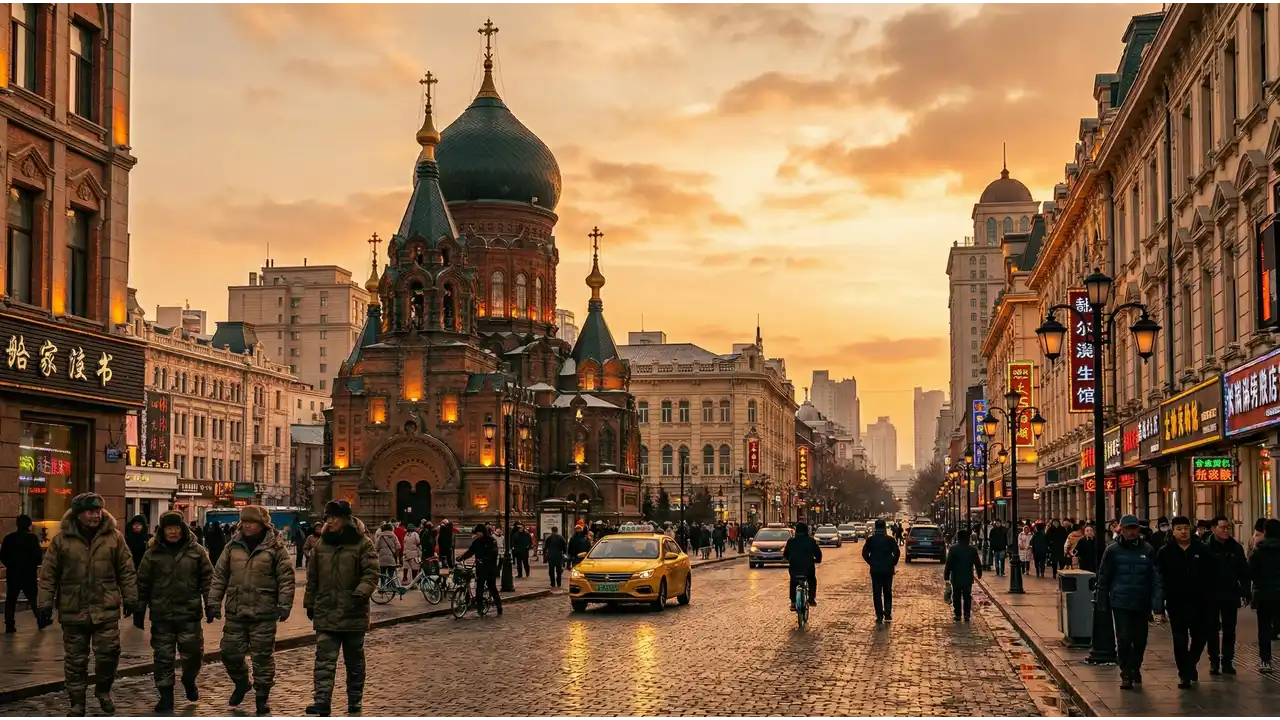
Harbin is a northeastern Chinese city of 5.4 million people, capital of Heilongjiang Province. Winter temperatures drop to minus 20 degrees Fahrenheit, making it one of China's coldest major cities. The cityscape mixes Soviet-era architecture from the early 20th century with modern commercial districts. Daily life centers on the pedestrian Zhongyang Street for shopping, local restaurants serving hand-pulled noodles and dumplings, and extensive bus networks. The Songhua River freezes solid enough for winter tourism. Harbin attracts expats in education, manufacturing, and tech, though the foreign community is smaller than in Beijing or Shanghai. Most neighborhoods are residential, not tourist-focused.
💡 Local Insights
Harbin · 2026
Harbin's cost advantage rests primarily on low grocery and transport expenses. The $195/month grocery figure reflects supermarket prices well below Western cities: local vegetables cost $0.40 to $0.80 per kilogram, eggs around $0.60 per half-dozen. Eating street noodles or in local restaurants costs $2 to $4 per meal. The $371/month housing figure is the national China level that Harbin inherits because no separate Harbin rental measurement exists in the engine. Actual rents vary by neighborhood; expat-friendly areas near universities run higher than residential zones. Bus transport costs roughly $0.30 per trip with monthly passes around $15. Expats face occasional price markups at foreign supermarkets and restaurants, but local Chinese groceries remain cheap. Winter heating costs rise significantly November through March, raising utility bills. Language barriers make long-term negotiation harder than in larger cities.
Frequently Asked Questions
How much does it cost to live in Harbin per month?
A moderate lifestyle in Harbin costs around $975/month. This breaks down to housing at $371/month, groceries at $195/month, with the remainder covering utilities (higher in winter), transport, dining out, and entertainment. The budget tier of $585/month is possible through shared housing, cooking all meals at home, and minimal discretionary spending. The comfortable tier reaches $1,511/month when accounting for better apartments, regular restaurant meals, fitness memberships, and travel within the region.
What is the average rent in Harbin?
The $371/month housing figure in the engine is the China-level standard that Harbin inherits, not a measured rent specific to Harbin itself. Harbin has no separate rental dataset in the cost index. In practice, rents vary significantly by location. Shared apartments in residential neighborhoods cost $200 to $400/month per person. One-bedroom apartments near universities or transit hubs run $300 to $500/month for expats, sometimes higher. Peak heating season adds $20 to $50/month to utility costs. Negotiating in Chinese and renting through local agents rather than expat platforms yields lower rates.
Is Harbin cheap to live in for expats?
Yes, but with caveats. Harbin is significantly cheaper than Singapore, Tokyo, or Hong Kong. Compared to Southeast Asian expat hubs like Bangkok or Hanoi, costs are similar or slightly lower. The real savings come from groceries, transport, and local dining. However, expats typically spend more than Chinese locals on housing and imported goods, narrowing the advantage. Visa complexity and language barriers are real friction points. The climate also drives up winter heating costs. For English teachers and remote workers on modest salaries, Harbin offers reasonable living standards. For expats accustomed to Western conveniences and dining, the discount shrinks.
How much does food cost per month in Harbin?
Groceries average $195/month for a moderate diet buying at local supermarkets and wet markets. A kilogram of rice costs $0.50 to $0.70, eggs $0.60 per half-dozen, chicken $3 to $5 per kilogram, and seasonal vegetables $0.40 to $0.80 per kilogram. Local bakeries sell bread for $0.80 to $1.50 per loaf. Imported Western goods at expat supermarkets cost 50 to 100 percent more. Eating out costs $2 to $4 for street noodles or local restaurants, $8 to $15 at Western cafes. Alcohol from local shops is cheap; beer around $0.50 per can. Monthly spending stretches or contracts sharply depending on how much you eat out versus cook.
What salary do you need to live comfortably in Harbin?
A comfortable lifestyle costs around $1,511/month. This supports a private apartment, regular meals out, utilities including winter heating, gym membership, and modest travel. In annual terms, that is roughly $18,100. Many expat employers in Harbin offer salaries between $1,800 and $3,500/month plus housing, which allows for comfortable living with savings. University English teaching positions often include campus housing and $800 to $1,200/month salary, effectively covering basic costs. Remote workers earning $2,000 to $3,000/month live well. Lower incomes require careful spending: shared housing, cooking most meals, and minimal entertainment.
How does the cost of living in Harbin compare to other places?
Harbin sits in the middle of the budget spectrum for comparable Asian cities. A moderate lifestyle runs $975 per month, with housing at $371 per month, making it noticeably more expensive than Tabriz, where moderate living costs $650 per month. It's slightly pricier than Surabaya at $900 per month, though Harbin's housing is cheaper than Surabaya's at $455 per month. The real price jump comes if you're comparing to Shenzhen, a major coastal economic center where a moderate lifestyle reaches $1,350 per month and housing alone runs $726 per month. For a northeastern Chinese city with genuine winter weather, decent transit infrastructure, and access to Russian goods and culture, Harbin offers reasonable value. You'll find your money stretches further here than in China's tier-one cities, while still paying more than you would in smaller regional hubs.
Yes, but with significant constraints. This budget requires shared housing, no private apartment. Groceries must stay minimal: rice, vegetables, eggs, local noodles. Eating out is rare; coffee shops and restaurants are off-limits. Transport is cheap (bus passes under $15/month). Utilities on shared bills stay low except winter. Entertainment is free or minimal. This budget works for students, recent graduates, or those committed to a very local lifestyle with minimal Western conveniences. It leaves almost no room for travel, medical emergencies, or hobbies. Most working expats find $585/month unsustainable beyond 6 to 12 months.