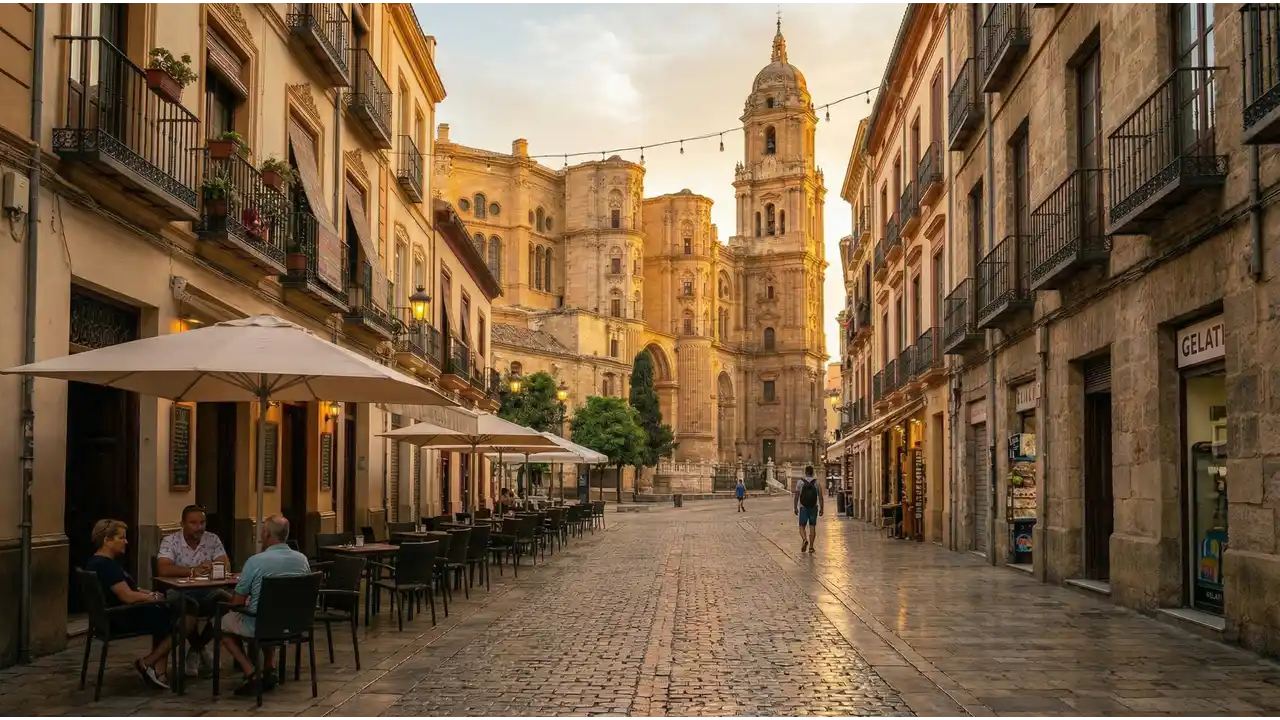
Malaga is a port city on Spain's southern coast, home to about 580,000 people. The old town centers around the cathedral and Alcazaba fortress. Tourism and finance drive the economy. Summers are hot and dry (often 35°C/95°F); winters mild. The city has a mix of Spanish families, long-term expats from Germany and Northern Europe, and seasonal visitors. Daily life revolves around the beach, tapas bars, and a walkable historic center. Public transport is straightforward. English is more common in central areas and among younger residents, but Spanish is necessary for neighborhood life.
💡 Local Insights
Malaga · 2026
Malaga costs less than Madrid or Barcelona, but more than inland Andalusian towns. Housing costs run around $1,030/month, which typically gets a one-bedroom apartment in central areas like the Histórico or Atarazanas, or a two-bedroom further out in neighborhoods like El Palo or Pedregalejo near the beach. Landlords often prefer long-term tenants and may ask for deposits equal to two months' rent. Groceries cost roughly $281/month for one person buying at Carrefour, Dia, or local markets. Produce at neighborhood markets is slightly cheaper than supermarkets. Eating out ranges from $4-6 for menú del día (lunch set menu) to $12-18 for dinner at mid-range restaurants. Public transport (bus and metro) costs $40-50/month for a resident pass. Beach neighborhoods command higher rents; city center is pricier than suburbs. Expats and tourists pay the same as locals once past tourist-trap areas.
Frequently Asked Questions
How much does it cost to live in Malaga per month?
A moderate lifestyle costs around $1,900/month. This includes rent ($1,030/month), groceries ($281/month), utilities ($120-150), transport ($45), dining out ($300-400), and entertainment ($200-300). A budget lifestyle runs $1,140/month, cutting dining out and entertainment. A comfortable lifestyle with more dining, travel, and services costs $2,945/month. Actual spending depends heavily on whether you rent centrally, eat at restaurants frequently, and use paid activities.
What is the average rent in Malaga?
Average rent is roughly $1,030/month for a one-bedroom apartment. Central neighborhoods like the Histórico and Atarazanas run $900-1,200/month. Beach areas (El Palo, Pedregalejo) range $950-1,300/month. Suburbs and outer districts like Churriana or Teatinos run $700-950/month. Two-bedroom apartments average $1,200-1,500/month centrally, $850-1,100/month outside. Short-term rentals (tourist apartments) cost 50-100% more. Landlords typically require two months' deposit and proof of income or employment contract.
Is Malaga cheap to live in for expats?
Malaga is moderately priced for expats. It's cheaper than Paris, London, or Lisbon, but not as affordable as rural Spain or Portugal. The cost advantage comes from lower housing relative to Northern Europe. However, expat clustering in central Malaga has driven up rents in popular areas. Supermarket prices are similar to Northern Europe. Dining out remains affordable ($5-15 for casual meals). Long-term visa requirements and tax residency rules can add compliance costs. For EU retirees on pensions, Malaga is feasible; digital nomads with Western salaries find it quite comfortable.
How much does food cost per month in Malaga?
Groceries run about $281/month for one person. Specific prices: milk $1.20/liter, bread $1/loaf, chicken $8/kg, eggs $2/dozen, olive oil $5-8/liter, vegetables $1-3/kg depending on season. Supermarkets like Carrefour and Dia are cheapest. Local markets (Atarazanas, El Tajo) offer produce 10-20% cheaper but require Spanish or navigation skills. Eating out: menú del día (lunch special) costs $4-7, café con tostadas $3-5, dinner at casual restaurant $12-18. Fish and seafood, a staple, ranges $10-20/kg fresh.
What salary do you need to live comfortably in Malaga?
A comfortable lifestyle requires roughly $2,945/month. This covers rent ($1,030-1,200), groceries ($281), utilities ($150), transport ($50), dining out ($600-700), entertainment and hobbies ($400), and occasional travel ($300). In USD annual terms, that's around $35,000-40,000/year after tax. Non-EU remote workers should account for Spanish tax residency (19-45% depending on income). EU citizens and retirees with pension income have different tax implications. A couple sharing rent can live comfortably on $4,000-4,500/month combined.
How does the cost of living in Malaga compare to other places?
Malaga sits in the middle of southern Europe's cost spectrum. A moderate lifestyle runs $1,900 per month, with housing at $1,030. That makes it roughly on par with Valencia, where a moderate lifestyle costs $2,000 monthly and housing runs $1,133. If you're coming from northern Europe, expect significant savings. Stockholm demands $2,650 for a moderate lifestyle with housing at $1,314, making it substantially pricier than Malaga on both fronts. On the other end, Bucharest offers notably cheaper living at $1,350 monthly for a moderate lifestyle, with housing at $578. Malaga works well as a base for southern Europe, offering reasonable costs without the constraints of truly budget destinations. Your money stretches further here than in major northern capitals.
Yes, but with constraints. A budget lifestyle means renting outside the center ($650-800/month), buying groceries from discount chains and markets ($250-280/month), using public transport ($40/month), cooking most meals ($150-200/month on dining out), and skipping paid entertainment. Utilities and internet add $80-100/month. This leaves almost no buffer for emergencies, medical costs, or travel. It's viable for EU citizens with healthcare access and retirees with pension security. Digital nomads or those requiring travel will find it tight. A solo person can manage; couples need more.