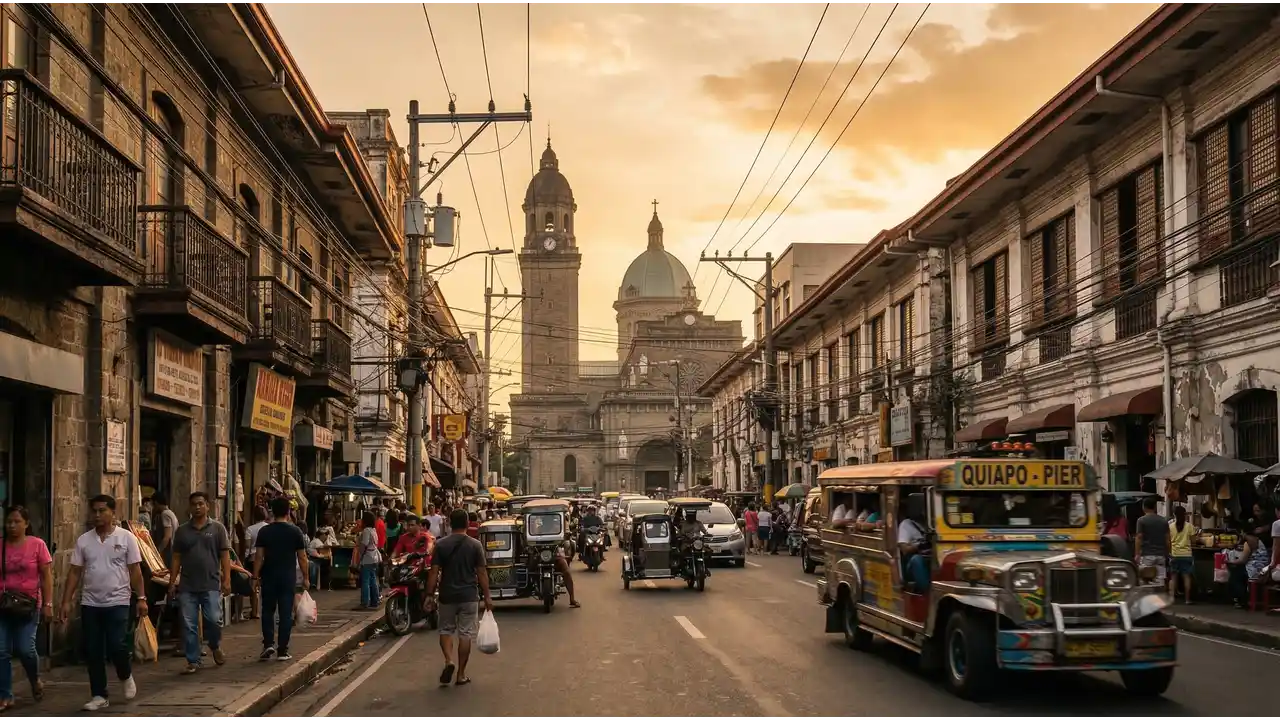
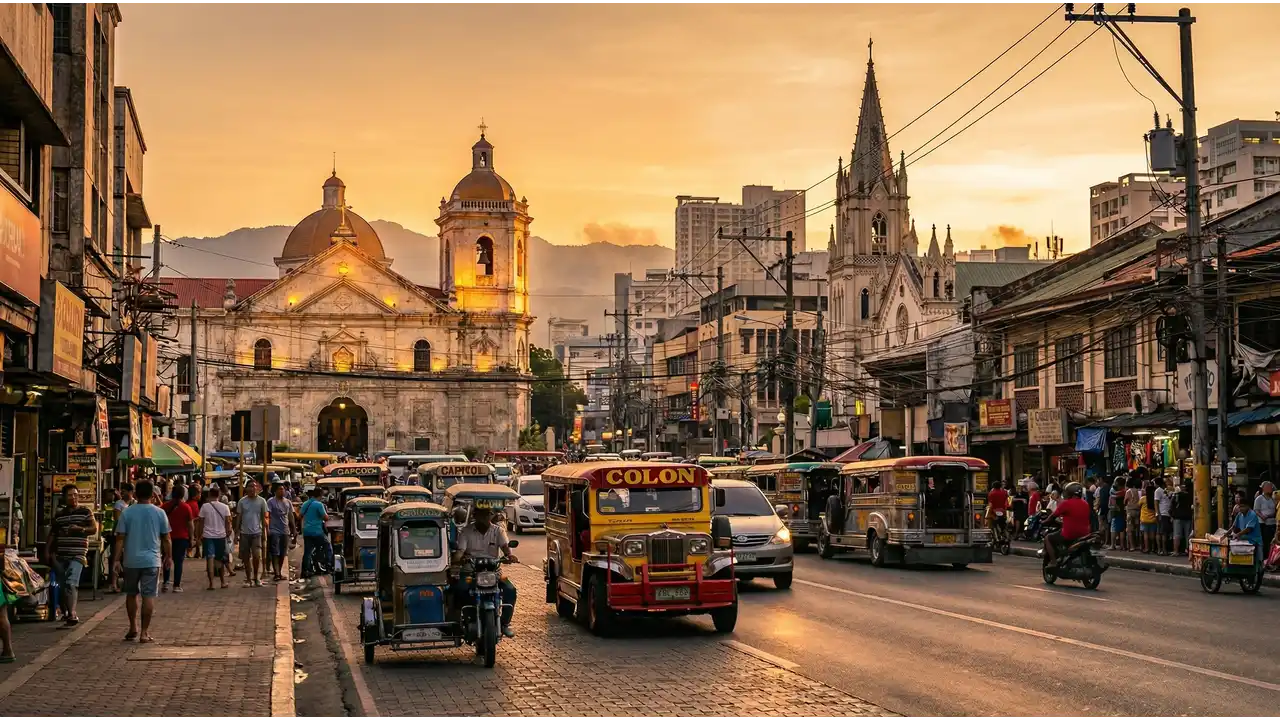
Manila is the capital of the Philippines and home to about 1.8 million people in the city proper, with 14 million across the metro area. The city sits on Manila Bay and experiences a tropical climate with a hot, humid dry season (November to May) and a wet monsoon season (June to October). Daily life revolves around traffic-heavy commutes, dense residential neighborhoods, and a strong food culture centered on family meals and street vendors. Most expats cluster in districts like Makati (the financial center), BGC (Bonifacio Global City, a newer business district), and Quezon City. English is widely spoken. The pace is fast and informal compared to regional neighbors like Singapore.
💡 Local Insights
Manila · 2026
Manila's cost structure is shaped by stark disparities between expat zones and local neighborhoods. Housing averages $660/month and varies dramatically by location. Makati and BGC command $800 to $1,500 for a one-bedroom apartment; outer areas like Quezon City or Marikina run $400 to $600. Groceries cost around $190/month if you shop at local markets and supermarkets like SM or Puregold; imported goods push costs higher. Eating out is cheap (local meals $2 to $4, nicer restaurants $8 to $15 per person), which tempts many expats to reduce cooking. Transport is inexpensive (jeepneys and buses under $0.50 per ride), but traffic adds significant time. Water, electricity, and internet run $40 to $80 combined, depending on usage and location. Local wages are far lower than expat salaries, creating a two-tier pricing system where expats often pay markups on rent and services. Utility costs can spike during the summer cooling season. The budget figure of $1,250/month assumes modest housing, local market food shopping, and public transport use.
Frequently Asked Questions
How much does it cost to live in Manila per month?
A moderate lifestyle in Manila costs around $1,250/month. This breaks down roughly as $660/month for housing (one-bedroom apartment outside the expat core), $190/month for groceries and local market food, $40 to $50/month for utilities and internet, and the remainder for transport, dining out occasionally, and discretionary spending. That figure assumes you shop at local supermarkets, use public transport, and avoid frequent restaurant meals. Costs scale down to $750/month if you cut housing to shared accommodation or outer neighborhoods, eat only local food, and use only buses and jeepneys. The comfortable tier reaches $1,938/month for a better apartment, more frequent dining out, and more flexibility on lifestyle choices.
What is the average rent in Manila?
Average rent is $660/month, but that masks huge variation. In Makati and BGC, one-bedroom apartments rent for $900 to $1,500 per month. Quezon City and Marikina, popular with both expats and locals, range from $500 to $800. Outer neighborhoods like Paranaque or Pasig drop to $400 to $600. Studio units or shared apartments run $300 to $500 in less central areas. Furnished units command a premium. The $660 figure reflects a modest one-bedroom in a middle-ground location with basic amenities. Long-term leases (one year or more) usually negotiate lower rates than short-term rentals. Expats often overpay because landlords assume higher ability to pay; negotiation is standard practice.
Is Manila cheap to live in for expats?
Manila is cheap compared to developed-world cities and other major Asian hubs like Singapore or Hong Kong, but not uniformly. If you live like a local (shared housing, local food, public transport), costs are genuinely low. The danger is lifestyle creep. Expats often gravitate toward Makati or BGC, eat at restaurants catering to Western tastes, use ride-hailing apps, and choose Western groceries, all of which erode the cost advantage quickly. A remote worker on a Western salary finds Manila very affordable; someone on a local Philippine salary would struggle with the same lifestyle. The key is deliberate choices about where to live and what to consume. Budget travelers and remote workers thrive; those seeking creature comforts pay substantially more than the $1,250 moderate figure.
How much does food cost per month in Manila?
Groceries average $190/month if you shop at local markets (Farmer's Market, Divisoria) and Philippine supermarkets (Puregold, S&R, Savemore). Specific prices: rice runs $0.40 to $0.60 per kilogram, eggs $0.80 per dozen, chicken $2 to $3 per kilogram, vegetables $0.30 to $0.80 per piece, canned goods $0.50 to $1.50. Imported groceries at international chains cost double or triple. Eating out locally is cheap: a plate of chicken adobo, rice, and soup costs $1.50 to $3 at street stalls or casual eateries. Casual restaurants charge $5 to $8 per meal; Western-style restaurants in Makati run $12 to $20. Many expats save money by cooking at home and eating local food, though others spend considerably more dining out, which can push food costs to $400 to $500/month.
What salary do you need to live comfortably in Manila?
A comfortable lifestyle runs $1,938/month, which assumes better housing ($900 to $1,200 in a desirable neighborhood), regular dining out at mid-range restaurants, occasional taxis or ride-hailing, and flexibility for entertainment and travel. This translates to a gross annual income of roughly $23,000 to $25,000 USD for a stable expat or remote worker. For couples, combined income of $35,000 to $40,000 provides substantial comfort. Many remote workers earning $2,500 to $3,500/month find Manila very comfortable; those earning $1,500 to $2,000/month can live well but need discipline. Local professionals earning 30,000 to 50,000 pesos monthly (roughly $540 to $900 USD) struggle to achieve the comfortable tier described here. The salary question differs sharply depending on whether you're comparing against local wages or Western income.
How does the cost of living in Manila compare to other places?
Manila at $1,250 per month for a moderate lifestyle sits in the middle tier of major Asian cities. Hanoi is noticeably cheaper at $875 monthly, making it roughly 30% less expensive overall, though housing in Hanoi runs $406 compared to Manila's $660. Almaty functions as a peer city at $1,300 per month with housing costs nearly identical to Manila's at $664. If you're considering Northeast Asia, Fukuoka costs substantially more at $1,675 monthly, with housing surprisingly similar to Manila's despite the higher overall expense. For most expats and remote workers, Manila offers reasonable value for Southeast Asia, though your actual spending depends heavily on neighborhood choice, dining habits, and whether you use local transportation or ride-hailing services regularly.
Yes, but with significant constraints. The budget tier of $750/month means shared housing or a studio in a distant neighborhood ($300 to $400), groceries and very minimal dining out ($200 to $250), utilities ($30 to $40), and transport ($20 to $30). This works if you shop exclusively at local markets, cook most meals, take only buses and jeepneys, avoid tourist zones, and have no car. You'll have little left for entertainment, travel, or emergencies. It's sustainable for digital nomads with minimal overhead or for locals earning that amount in peso income. Expats who try this often find the lifestyle degrading within months: poor neighborhood conditions, isolation, limited healthcare access. The $750 budget is theoretically possible but practically tight for someone accustomed to higher living standards. It's more realistic as a short-term experiment than a long-term expat strategy.