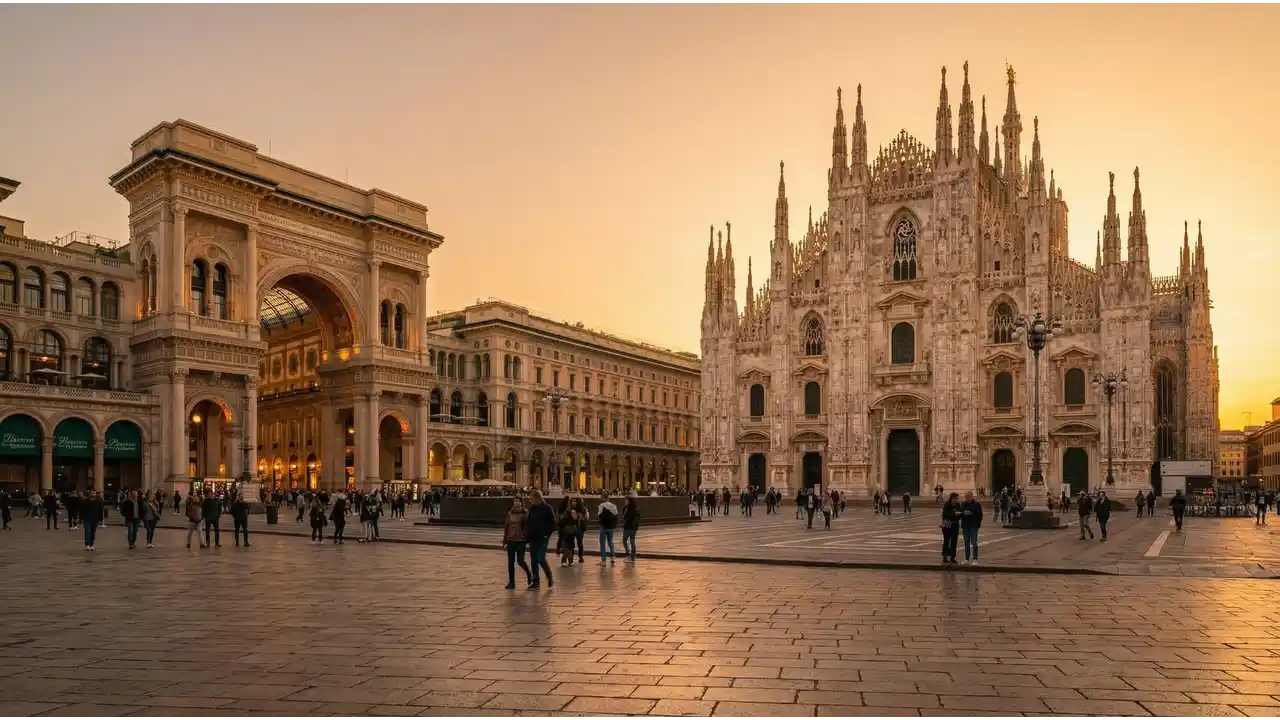
Milan is Italy's economic and fashion capital, a dense northern city of roughly 1.4 million people. The metropolitan area drives manufacturing, finance, and design across Lombardy. Daily life centers on efficient public transit, neighborhood cafes, and office work. Weather is continental: cold and gray winters (near freezing), hot summers. The city draws professionals, students, and families from across Europe and beyond. Streets are orderly and walkable in most districts. Milan lacks the tourist spectacle of Rome or Venice but functions as a working city where cost of living reflects real incomes and competitive rents.
💡 Local Insights
Milan · 2026
Milan costs significantly more than southern Italy but less than London, Zurich, or Paris. Housing dominates the budget at $1,442 per month, concentrated in central and northern districts. A one-bedroom apartment in Navigli or Brera runs $900-$1,100; periphery neighborhoods like Lambrate or Bicocca average $700-$850. Shared housing cuts this in half. Groceries run $406 monthly for one person buying at supermarkets like Carrefour or Esselunga. Eating out (pizza or pasta lunch) costs $7-$12. Public transit (metro, tram, bus) is reliable and inexpensive: an unlimited monthly pass costs around $40. Transport across the region is well-developed. Expats often pay slightly more in central areas or for furnished short-term rentals. Utilities, childcare, and entertainment add $400-$600 monthly depending on lifestyle. Winter heating costs spike. The largest variable is housing location and lease type.
Frequently Asked Questions
How much does it cost to live in Milan per month?
A moderate lifestyle in Milan costs $2,700 per month for one person. Housing runs $1,442 monthly. Groceries average $406. Utilities, transport, dining out, and entertainment fill the remainder. A tight budget (grocery shopping, public transit, no nightlife) can run $1,620 monthly. A comfortable lifestyle with central housing, frequent dining out, and hobbies reaches $4,185 monthly. These figures assume an individual; couples or families may spend more or less depending on shared housing and other economies of scale.
What is the average rent in Milan?
Average rent is $1,442 per month for a one-bedroom apartment. Central neighborhoods like Navigli, Brera, and Duomo command $900-$1,100 for one-bedroom unfurnished flats. South Milan (Porta Romana, Ticinese) ranges $800-$950. Periphery areas like Lambrate, Bicocca, and Rho average $700-$850. Studio apartments run $600-$750 in outer zones, $750-$900 centrally. Furnished short-term rentals cost 20-30 percent more. Shared housing is cheaper, typically $400-$600 per person. Prices have risen steadily with the tech boom and recovery of the job market.
Is Milan cheap to live in for expats?
Milan is moderately priced for a Northern European capital but expensive by Italian standards. Rent consumes a large portion of income compared to cities in Southern Europe, though it undercuts London, Zurich, Amsterdam, or Stockholm. For expats from low-cost countries, Milan is a significant jump. For those from Western Europe or North America, it feels reasonable. Tech workers and corporate employees often receive housing allowances that ease the burden. The labor market is strong enough to support the higher costs, but starting salaries may not stretch far without careful budgeting. English-speaking expat communities cluster in Navigli and Brera, where prices reflect demand.
How much does food cost per month in Milan?
Groceries for one person average $406 monthly when shopping at supermarkets like Carrefour, Esselunga, or Pam. Bread costs $1-$1.50 per loaf. Milk runs $1.20-$1.50 per liter. Pasta and rice are cheap at $0.50-$1.50 per box. Fresh fruit and vegetables cost $2-$4 per kilogram depending on season. Eating out adds significantly: a pizza or pasta lunch at a neighborhood trattoria costs $7-$12. Coffee at a bar runs $1-$2. Markets like Viale Papiniano offer cheaper produce than supermarkets. Organic and specialty shops cost 20-40 percent more.
What salary do you need to live comfortably in Milan?
A comfortable lifestyle requires roughly $4,185 per month or $50,000 annually. This covers $1,442 for housing in a pleasant central or transit-connected neighborhood, $406 for groceries, $200-$300 for utilities and internet, $150 for transport, $400-$600 for dining out and entertainment, and $200-$400 for clothing, personal care, and incidentals. For families, multiply by 1.5 to 1.8 depending on childcare costs and whether children attend private school. Entry-level corporate and tech salaries start around $28,000-$35,000; mid-level roles pay $45,000-$65,000. Freelancers and consultants often earn more but face tax and benefits uncertainty.
How does the cost of living in Milan compare to other places?
Milan sits firmly in the middle tier of European cities. A moderate lifestyle here costs $2,700 per month, with housing at $1,442 per month. Barcelona runs $2,525 monthly overall, making it slightly cheaper than Milan, though Barcelona's housing costs $1,545, which is actually higher. If you're looking for real savings, Leipzig offers substantially lower costs at $1,825 per month, with housing at just $701. On the opposite end, Monte Carlo is significantly pricier at $4,025 monthly, driven largely by housing that reaches $2,323 per month. Milan's positioning reflects its status as a major fashion and finance hub. You'll pay more than in smaller European cities, but substantially less than in ultra-premium destinations. Compared to most Western European capitals, Milan remains reasonable while offering major-city infrastructure and culture.
Yes, but only with significant discipline. The budget tier of $1,620/month requires shared housing (running $400-$600 per person), grocery shopping only at discount supermarkets, zero dining out, and careful use of free transit passes or cycling. You must cut utilities, entertainment, and shopping to near-zero. This works for students, young professionals sharing large flats, or those with external income sources. A single person on $1,620 will feel financially squeezed and likely forgo social activities, travel, and hobbies. It is sustainable short-term but not comfortable long-term. Couples or roommates can achieve modest comfort at this level by sharing housing costs.