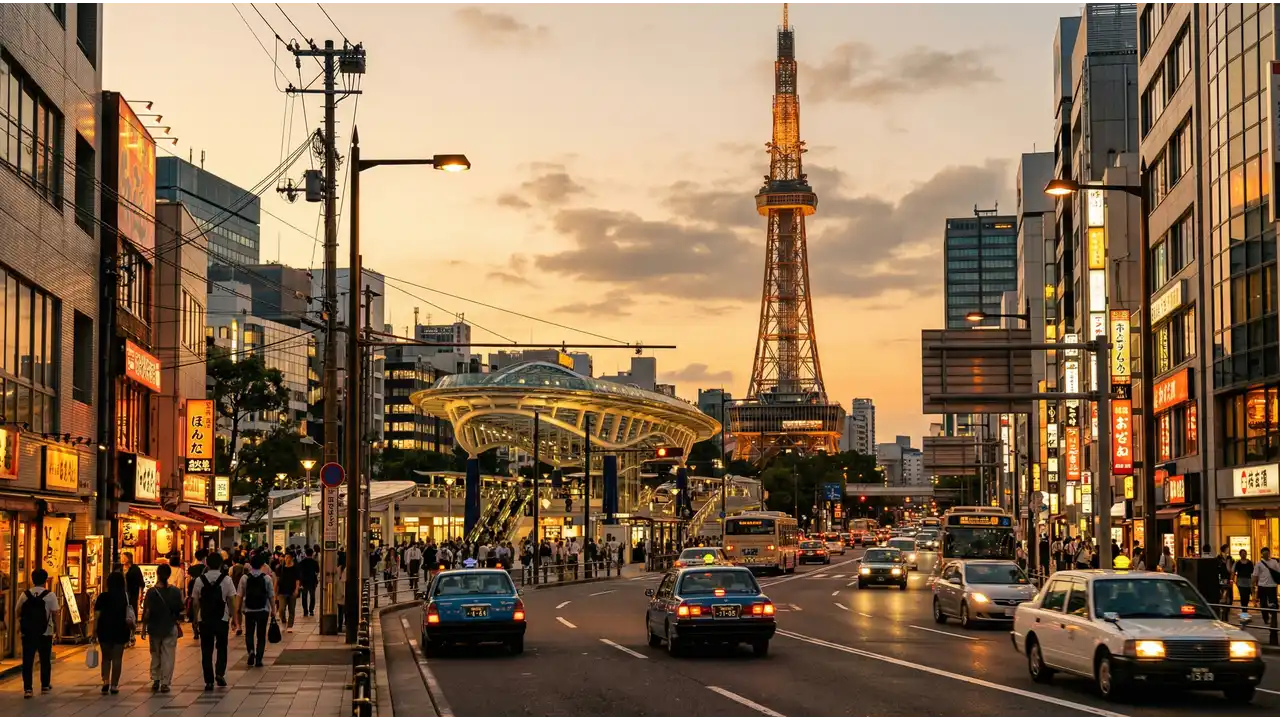
Nagoya is Japan's fifth-largest city and the capital of Aichi Prefecture, located between Tokyo and Osaka on the Pacific coast. It functions as a major manufacturing and automotive hub, with a local population of roughly 2.3 million. The city has a humid subtropical climate with hot, wet summers and mild winters. Daily life centers on efficient train networks, compact neighborhoods, and proximity to both urban amenities and surrounding countryside. The pace is noticeably slower than Tokyo, with less tourist congestion. Expats, Japanese families, and young professionals dominate the residential base. Traffic is manageable, and the city feels organized rather than overwhelming.
💡 Local Insights
Nagoya · 2026
Nagoya's cost structure reflects broader Japan economics rather than regional outliers. Housing costs are moderate by Japanese standards but vary significantly by neighborhood. Central wards like Naka command higher rents, while outer areas like Midori or Chikusa offer better value. The $603/month housing figure represents the Japan-level standard that Nagoya inherits in this measurement. Renters typically encounter one-bedroom apartments in decent neighborhoods ranging from roughly $450 to $750 per month depending on proximity to stations and ward. Food expenses of $346/month are realistic for groceries, with supermarket competition keeping prices stable. Convenience stores charge 20-40 percent premiums over supermarkets. Eating out averages $8-15 for lunch sets, $12-20 for dinner. Train passes cost roughly $40-60 per month for regular commuters. Bicycles are common and cheap second-hand options exist. Expats report stable pricing with no significant markup compared to Japanese residents, though language barriers can lead to slower negotiation on rentals.
Frequently Asked Questions
How much does it cost to live in Nagoya per month?
A moderate lifestyle in Nagoya costs $1,675/month. This breaks down to approximately $603 for housing (the Japan-level figure), $346 for groceries, and the remainder covers transport, utilities, dining out, and other expenses. A budget tier of $1,005/month is possible by sharing housing, cooking all meals, and using free or low-cost activities. A comfortable lifestyle, including better housing and regular dining out, runs $2,596/month. These figures assume stable local prices and typical expat or Japanese resident spending patterns.
What is the average rent in Nagoya?
The $603/month housing figure displayed is Japan's national-level measurement that Nagoya inherits, not a separate Nagoya rental market survey. In practice, renters locally find one-bedroom apartments in central or well-connected neighborhoods ranging from $500 to $800 per month. Outer wards offer units from $400-600. Two-bedroom apartments typically run $700-1,100. These ranges are indicative based on common rental listing patterns. Furnished apartments cost 15-25 percent more. Most leases require a deposit (typically one month's rent) and key money (a non-refundable gift to the landlord, also roughly one month's rent).
Is Nagoya cheap to live in for expats?
Nagoya is moderately priced compared to Tokyo or Osaka, but not dramatically cheaper. Monthly costs of $1,675 for a moderate lifestyle are reasonable by developed country standards. Expats coming from North America or Western Europe will find housing, food, and transport significantly less expensive. However, those from Southeast Asia or less developed regions may find it pricier. Nagoya offers fewer expat-specific services and restaurants than Tokyo, which removes markup costs but can reduce convenience. The main advantage is housing stability and lower pressure on central neighborhood rents. Salary expectations for expats teaching English or in tech range from $1,800-2,800/month, which supports a comfortable life with some savings.
How much does food cost per month in Nagoya?
Groceries average $346/month for one person cooking at home. Supermarkets like Aeon and local chains compete heavily, keeping prices low. Rice costs $0.30-0.50 per kilogram, eggs $0.50-0.70 per unit, and imported items cost 2-3 times more than domestic equivalents. Convenience stores (Seven-Eleven, Family Mart, Lawson) charge premiums of 20-40 percent. Eating out is affordable: lunch sets at restaurants run $8-12, ramen $5-8, and casual dinner $12-20. Izakayas (casual bars with food) offer reasonable value. Alcohol is cheaper than most Western countries. Weekly grocery shopping takes 30-45 minutes with good neighborhood store access.
What salary do you need to live comfortably in Nagoya?
A comfortable lifestyle costs $2,596/month, suggesting a gross monthly salary of roughly $3,200-3,500 (accounting for Japanese income tax of roughly 10-15 percent for middle incomes) or $38,400-42,000 annually. This budget accommodates decent housing, regular dining out, entertainment, and modest travel. Those making $2,000-2,500/month can live comfortably but with reduced discretionary spending. English teaching jobs typically pay $1,800-2,200/month, requiring careful budgeting or supplemental income. Tech and finance roles pay $2,500-4,000/month. Remote work earning in USD or EUR significantly raises purchasing power. Many expats combine primary employment with freelance or part-time teaching to reach the comfortable tier.
How does the cost of living in Nagoya compare to other places?
Nagoya's moderate lifestyle costs $1,675 per month, positioning it squarely in the middle of Asian city costs. Beijing runs $1,575 monthly, making it slightly cheaper overall, though Beijing's housing at $947 per month exceeds Nagoya's $603. Phnom Penh is the most affordable option at $1,150 per month, with housing at $525. If you're comparing upward, Abu Dhabi costs considerably more at $2,675 monthly, driven largely by housing that runs $1,792 per month. For someone relocating from Southeast Asia, Nagoya feels pricier than Cambodia but more reasonable than Gulf cities. Against Chinese peers, you're paying a modest premium mainly outside housing, where Nagoya's utility costs and dining tend to run higher relative to Beijing despite lower rents.
Yes, a budget tier of $1,005/month is possible but requires deliberate choices. Housing must be shared or in outer wards, typically $350-450/month. Groceries stay within $250-300/month by cooking rice, vegetables, and eggs. Transport costs roughly $50/month. This leaves $150-200 for utilities, phone, and minimal entertainment. Eating out nearly disappears; socializing means convenience store meals or free activities. Healthcare costs must be absorbed separately if not covered by employment. Students and those receiving housing subsidies can manage comfortably at this tier. It requires discipline and local knowledge. Most expats find this level unsustainable beyond 3-6 months without cutting social life or personal spending to minimal levels.