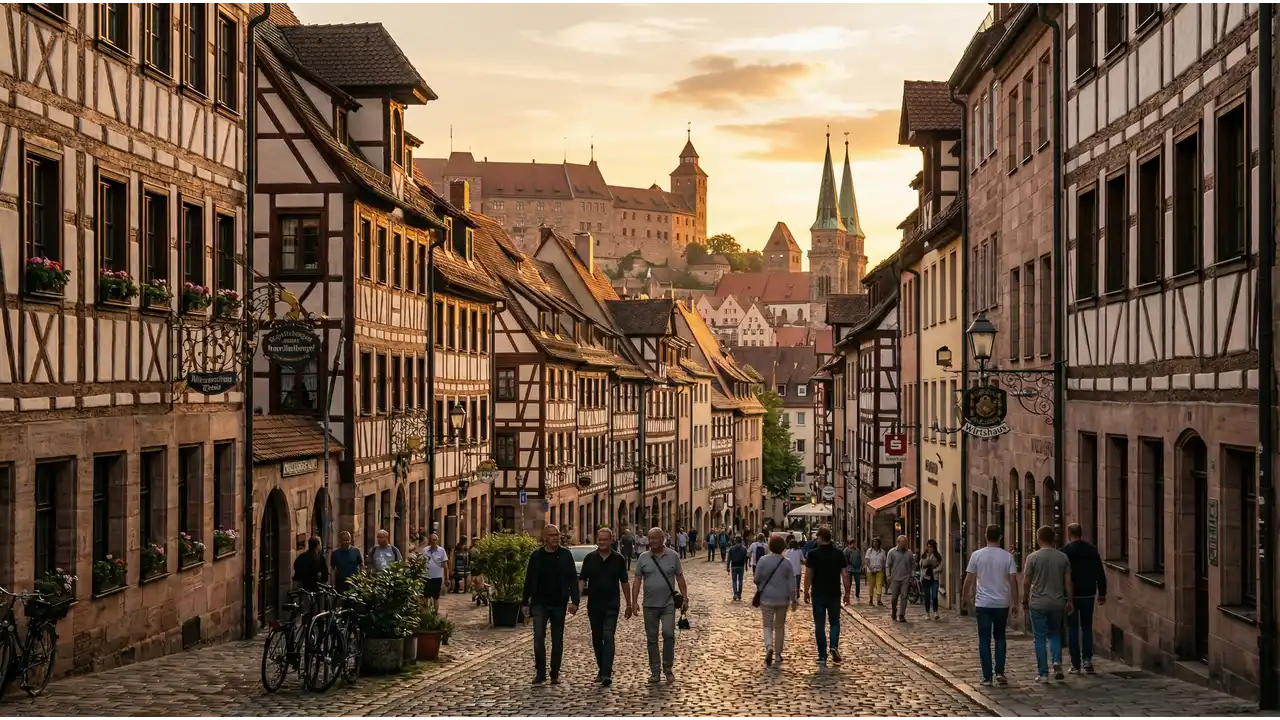
Nuremberg is Bavaria's second-largest city, known for its medieval old town, intact city walls, and role as a major industrial and manufacturing hub. The population is around 520,000. Daily life centers on the Altstadt (old town), where residents navigate narrow streets, markets, and beer halls. Winter temperatures drop to freezing; summers are mild. The city attracts both young professionals working in tech and manufacturing, and long-term expat families. Public transit is efficient and car-dependent suburbs ring the center. The pace is slower than Munich or Berlin but faster than smaller Bavarian towns.
💡 Local Insights
Nuremberg · 2026
Nuremberg costs less than Munich or Stuttgart, making it attractive for budget-conscious expats. Housing runs $801/month on average, with one-bedroom apartments in the Altstadt or Gostenhof ranging from $700 to $950, while outer suburbs like Langwasser or Eibach drop to $600 to $750. Furnished short-term rentals command 20-30% premiums. Groceries average $379/month for a single person buying at chains like Aldi, Lidl, and Rewe. Farmers markets in Hauptmarkt offer seasonal produce at competitive prices. Eating out costs $12 to $18 for a casual lunch, $25 to $40 for dinner. Public transport (U-Bahn, S-Bahn, trams) costs $60/month for a city pass; most residents bike or use cars for suburban commuting. Expats often overpay for rentals through international agencies; using local German platforms (ImmoScout24, WG-Gesucht) cuts costs by 10-15%. Winter heating bills can add $80 to $120/month. Childcare and private schools are cheaper than Munich but utilities are comparable.
Frequently Asked Questions
How much does it cost to live in Nuremberg per month?
A moderate lifestyle in Nuremberg costs $1,975/month. This breaks down to $801 for housing, $379 for groceries, $60 for public transport, $120 for utilities, $250 for dining out, and $365 for other expenses (entertainment, personal care, phone, gym). A budget lifestyle runs $1,185/month (cutting dining out, entertainment, and living in cheaper suburbs). Comfortable living costs $3,061/month, adding larger housing, frequent dining out, and travel.
What is the average rent in Nuremberg?
Average rent is $801/month. One-bedroom apartments in central neighborhoods like Altstadt or Gostenhof run $750 to $950. Two-bedroom apartments in the center range $900 to $1,200. Outer suburbs like Langwasser, Eibach, or St. Johannis offer one-bedrooms for $600 to $750. Furnished short-term rentals are 20-30% higher. Buy-to-rent platforms like ImmoScout24 and WG-Gesucht show actual listings; avoid international agencies which add 15-20% markups. Competition is moderate outside summer.
Is Nuremberg cheap to live in for expats?
Yes, compared to other major German cities. Nuremberg is 15-20% cheaper than Munich and 10% cheaper than Stuttgart or Frankfurt. Housing is the main savings driver. However, expats who don't search actively often pay 20-30% above market through relocation agencies. The city is affordable for single professionals and families earning $45,000 to $60,000 annually, but tech salaries are lower than Berlin or Munich. Expect to spend more time finding housing than in smaller towns; the market moves fast but isn't tight.
How much does food cost per month in Nuremberg?
Groceries average $379/month per person shopping at Aldi, Lidl, or Rewe. Milk costs $0.95/liter, bread $1.50 per loaf, chicken breast $8 per kilogram, apples $2 per kilogram. Farmers markets near Hauptmarkt offer seasonal produce 10-15% cheaper. Eating out: casual lunch (schnitzel, beer) costs $12 to $18; dinner at a mid-range restaurant runs $25 to $40 per person. Beer in beer halls (Kulmbacher Brewery nearby) costs $5 to $7 per half-liter. Expat grocers charge 30-40% premiums. Cooking at home saves significantly versus dining out.
What salary do you need to live comfortably in Nuremberg?
A comfortable lifestyle costs $3,061/month, roughly $37,000 annually before taxes. This supports a one or two-bedroom apartment in a good neighborhood, regular dining out, travel, and entertainment. After German income tax (around 35-40% for that income level), you need gross income of $60,000 to $65,000 annually. Dual-income couples each earning $35,000 to $40,000 gross live comfortably. Tech and manufacturing salaries in Nuremberg typically range $45,000 to $70,000 gross for professionals; expat salaries often lag domestic equivalents by 10-15%.
How does the cost of living in Nuremberg compare to other places?
Nuremberg is cheaper than Munich ($2,400+/month for moderate living) by 15-20%. It's comparable to Cologne ($1,950/month) but more affordable than Frankfurt ($2,200/month). Versus international expat hubs: Prague costs $1,550/month, making Nuremberg 25% pricier but offering higher wages and better infrastructure. Versus Stuttgart ($2,000/month), Nuremberg saves $25 to $50/month on rent and utilities. For North American expats, Nuremberg costs half what Toronto or Vancouver demand. The trade-off: smaller job market and less international scene than Berlin or Munich.
Can you live in Nuremberg on $1,185/month?
Yes, but with clear trade-offs. A budget lifestyle cuts dining out, entertainment, and car use. Rent a one-bedroom in Langwasser, Eibach, or St. Johannis for $600 to $700. Cook all meals, spending $300 to $350/month on groceries. Use public transport ($60/month). Skip car rental, frequent restaurants, and paid entertainment. Expect utilities $100/month, phone $20/month, leaving $25 for incidentals. This works for students, remote workers earning in strong currencies, or those supplementing with partner income. It's tight but not poverty; many locals live this way.