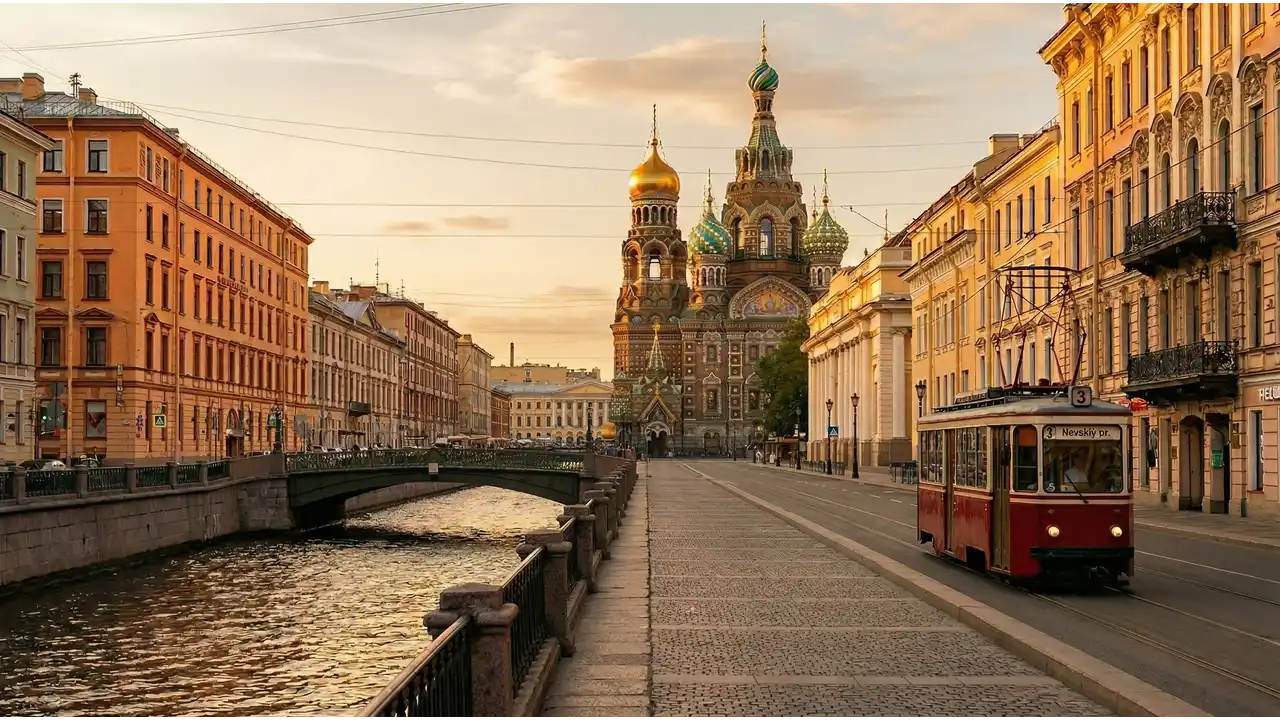
Saint Petersburg is Russia's second-largest city and its cultural capital, built on canals in the Neva River delta. The city has a formal, European feel with grand 18th and 19th-century architecture, museums, and theaters. Winters are long and dark (November through March), with temperatures dropping to around 15°F. Daily life centers on public transit, Soviet-era apartment blocks mixed with historic districts, and a population of roughly 5.4 million. Most residents speak Russian; English proficiency varies outside central areas. The pace is slower than Moscow, with less frenetic business culture and more emphasis on arts and education.
💡 Local Insights
Saint Petersburg · 2026
Saint Petersburg costs less than Moscow or most Western European cities, but prices have shifted significantly in recent years. Housing of around $738 per month typically buys a one-bedroom apartment in outlying neighborhoods (Admiralteysky, Vasileostrovsky) or a shared flat in central districts (Nevsky Prospekt area). Groceries cost roughly $214 per month if you buy locally (markets cheaper than supermarkets) and avoid imported goods. Bread, dairy, and seasonal vegetables are inexpensive; imported products carry hefty markups. Public transport (metro, buses, trams) costs pennies per ride. Expat pricing exists in restaurants and certain service sectors, but supermarket prices are standardized. Political tensions have affected currency stability and availability of some goods. Long-term expats often negotiate housing directly rather than through agencies to avoid premium rates.
Frequently Asked Questions
How much does it cost to live in Saint Petersburg per month?
A moderate lifestyle costs around $1,400 per month. This breaks down to approximately $738 for housing (rent on a one-bedroom apartment), $214 for groceries, $40-60 for public transport, $150-200 for utilities, and $200-300 for dining out and entertainment. The budget tier at $840 per month requires roommates, minimal dining out, and careful grocery shopping. The comfortable tier at $2,170 per month allows for a larger apartment, frequent restaurants, and more discretionary spending.
What is the average rent in Saint Petersburg?
Average rent is roughly $738 per month for a one-bedroom apartment. In outer neighborhoods like Nevsky Prospekt extensions, Vasileostrovsky, and Admiralteysky, expect $600-850 per month. Central locations near the Hermitage or Nevsky Prospekt command $900-1,200. Studio apartments rent for $500-700. Two-bedroom apartments range $1,000-1,400. Furnished apartments cost 20-30 percent more than unfurnished. Direct landlord rentals are often cheaper than agency-listed properties. Lease terms typically require first month, last month, and a deposit upfront.
Is Saint Petersburg cheap to live in for expats?
Yes, but with caveats. Saint Petersburg is cheaper than London, Berlin, or Paris, but more expensive than Sofia or Bucharest. Expats often pay a markup on housing and dining in tourist areas. Your real costs depend on language ability (Russian speakers access lower prices) and willingness to live outside central districts. Visa costs and travel friction add hidden expenses. For Western expats used to US or Northern European prices, the city feels affordable; for those from Southeast Asia or Eastern Europe, it's moderate. Political environment and currency volatility should factor into long-term calculations.
How much does food cost per month in Saint Petersburg?
Groceries average $214 per month. A loaf of bread costs about $0.40, a liter of milk $1.20, eggs (dozen) $1.80, chicken breast $6 per kilogram, and seasonal vegetables $1-3 per kilogram at markets. Supermarkets (Pyaterochka, Magnit) are cheaper than Western chains. Imported goods (US cereals, European cheeses) cost double. Eating out ranges from $3-5 for a basic canteen meal to $15-25 at mid-range restaurants and $40+ at upscale venues. Expat-oriented cafes near tourist sites charge inflated prices.
What salary do you need to live comfortably in Saint Petersburg?
A comfortable lifestyle costs around $2,170 per month, requiring a monthly income of roughly $2,600-2,800 (accounting for taxes and savings). This budget allows a spacious apartment, regular dining out, hobbies, and travel. For dual-income households or remote workers earning in USD or EUR, this threshold is easily met. Local salaries are lower (average professional salaries range $800-1,500 monthly), so most comfortable-tier expats earn from abroad. If relying on local income, budget closer to the moderate tier of $1,400.
How does the cost of living in Saint Petersburg compare to other places?
Saint Petersburg sits comfortably in the middle range for European cities. A moderate lifestyle here costs $1,400 per month, with housing at $738 monthly, making it genuinely affordable compared to Western Europe. Warsaw runs $1,975 total and $1,091 for housing, so expect to pay considerably more if you move west. Catania costs roughly the same overall at $1,450, though housing there is cheaper at $566. If you're coming from Eastern Europe, Minsk is noticeably less expensive at $1,025 with $480 housing. Saint Petersburg offers the stability of European infrastructure and culture without the price tag of major Western cities. Your money stretches further here than in most established capitals, while still giving you access to world-class museums, restaurants, and public transport.
Yes, but with constraints. The budget tier of $840 per month requires a roommate (reducing housing to $350-450), minimal groceries ($150-180), free or cheap transit, and almost no dining out. You'll eat mostly local staples, use public transport, and skip paid entertainment. This works for students, digital nomads with low overhead, or those with housing already secured. The margin for emergencies is thin. Medical costs, visa renewals, and travel home come out of savings. It's sustainable short-term; long-term, most people upgrade to the $1,400 moderate budget for quality of life and financial buffer.