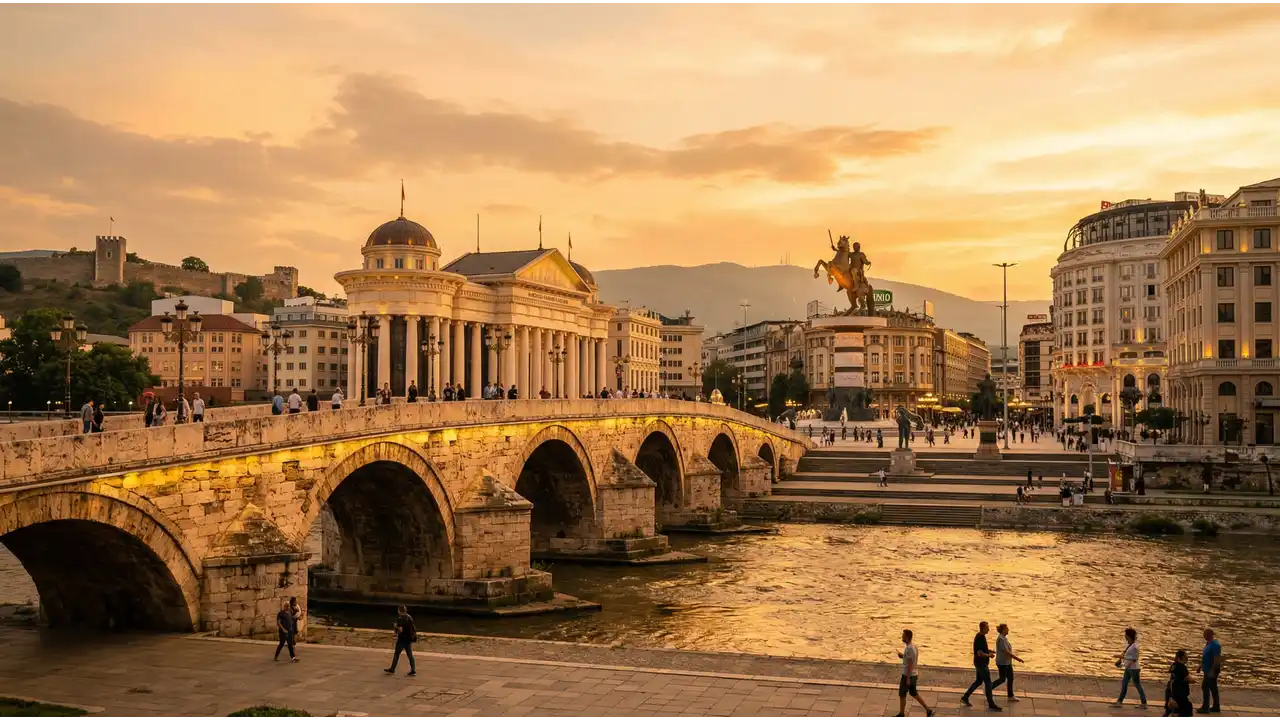
Skopje is North Macedonia's capital and largest city, home to roughly 500,000 people in the metropolitan area. The city sits in a valley surrounded by mountains, with a continental climate that brings cold, snowy winters and warm summers. Daily life centers around the Old Bazaar, Vodno mountain, and the Vardar River. Traffic can be heavy during rush hours. The population is ethnically mixed, with Macedonian, Albanian, Turkish, and Roma communities. Air quality suffers in winter months due to heating and geography. Public transport relies on buses. Most expats cluster in central neighborhoods like Centar and Varos, or newer developments on the city's edges.
💡 Local Insights
Skopje · 2026
Skopje's low cost hinges on cheap housing and food. A one-bedroom apartment in the city center runs $300-$450, while outer neighborhoods drop to $250-$350, keeping the average near $365. Shared flats or studios can dip below $250. Utilities add another $50-$80 monthly. Groceries are genuinely inexpensive: a liter of milk costs under $1, a kilogram of chicken around $4, and a basic meal out runs $3-$6. Buying local at the produce market beats supermarkets. Expats sometimes pay 10-20 percent more for imported goods and Western services. Public bus transport is roughly $30/month with a pass. Taxis are cheap but unmetered, so negotiate or use apps. The biggest cost surprise for expats is healthcare if you need private doctors (public system requires residence permits). Mobile phone plans run $5-$15 monthly. Winter heating costs spike if your apartment has poor insulation.
Frequently Asked Questions
How much does it cost to live in Skopje per month?
A moderate lifestyle costs around $1,000/month. Housing runs $365, groceries around $205, utilities $60, transport $30, and the remainder covers dining out, entertainment, and miscellaneous expenses. A tight budget is possible at $600/month (cutting dining out and entertainment), while a comfortable lifestyle with regular eating out, activities, and travel runs closer to $1,550/month. Exact costs vary by neighborhood, personal habits, and whether you use private services like gyms or expat-focused cafes.
What is the average rent in Skopje?
Average rent is around $365/month. One-bedroom apartments in the city center typically run $300-$450 depending on condition and location. Outer neighborhoods and residential zones offer one-bedroom units for $250-$350. Two-bedroom apartments in the center range from $400-$600. Shared flats or room rentals often drop to $200-$300. Newer developments with amenities cost more. Landlords rarely accept payment in anything but denars (the local currency), though prices in online listings appear in dollars. Check local Facebook groups and websites like Oglasi.mk for current listings. Utilities are separate and add $50-$80.
Is Skopje cheap to live in for expats?
Yes, relative to most of Europe. Rent, groceries, and transport are genuinely affordable. Eating at local restaurants costs $3-$6 per meal. However, expats face a pricing gap: imported goods, Western-standard services, and private healthcare cost significantly more than for locals. International schools run $3,000-$8,000 yearly. If you work remotely on a Western salary, Skopje is very cheap. If you depend on local wages, it's more modest. Air quality in winter is a real issue, not merely a cost factor. Internet is reliable and inexpensive (around $10-$20/month), making remote work feasible.
How much does food cost per month in Skopje?
Groceries average $205/month for a moderate diet. Milk costs under $1 per liter, a kilogram of chicken around $4, eggs roughly $1.50 per dozen, bread $0.50-$0.80 per loaf, and fresh vegetables from the market run $0.50-$2 per kilogram depending on season. Eating out is inexpensive: a burek (filled pastry) costs $0.50-$1, a grilled meat plate with rice $3-$5, and coffee at a cafe $0.80-$1.50. A three-course meal at a mid-range restaurant runs $8-$12. Shopping at the Old Bazaar and local produce markets is cheaper than supermarkets. Imported Western foods cost two to three times more.
What salary do you need to live comfortably in Skopje?
A comfortable lifestyle costs around $1,550/month. This allows for a decent one or two-bedroom apartment, eating out several times weekly, regular entertainment and activities, occasional travel, and some cushion for unexpected expenses or hobbies. At this level, you can afford private gym memberships, occasional shopping, and expat-friendly cafes without watching every denars. For a couple or family, add $400-$600 per additional person for reasonable comfort. Remote workers earning $1,500-$2,000 per month find Skopje quite comfortable. Local salaries are much lower (average around $400-$500), so expats on Western income have substantial purchasing power.
How does the cost of living in Skopje compare to other places?
Skopje sits in the middle-to-lower range for Eastern European capitals. A moderate lifestyle costs $1,000 per month here, with housing at $365 per month. That puts it slightly cheaper than Kazan, where a moderate lifestyle runs $1,100 per month and housing costs $504 per month. Kharkiv is noticeably less expensive, with a moderate lifestyle at $650 per month and housing at $205 per month. If you're comparing upward, Saint Petersburg is significantly dearer at $1,400 per month for a moderate lifestyle, with housing at $738 per month. Within the Balkans and former Soviet space, Skopje offers genuine affordability without the extreme frugality required in cheaper cities. Rent and basic expenses remain low by European standards, making it accessible for remote workers and those on modest incomes.
Yes, but with strict limits. $600/month covers basic housing ($250-$300 in outer neighborhoods), groceries ($150-$180), utilities ($50), transport ($20), and leaves roughly $50-$100 for phone, internet, and minimal other expenses. You'll need to cook nearly all meals, use public transit, skip entertainment and dining out, and avoid healthcare beyond emergencies. Shared housing drops housing costs further. This works if you have minimal expenses and no dependents. It's tight and leaves no buffer for medical costs, travel, or emergencies. Students and budget-conscious travelers manage it, but comfort and flexibility disappear.