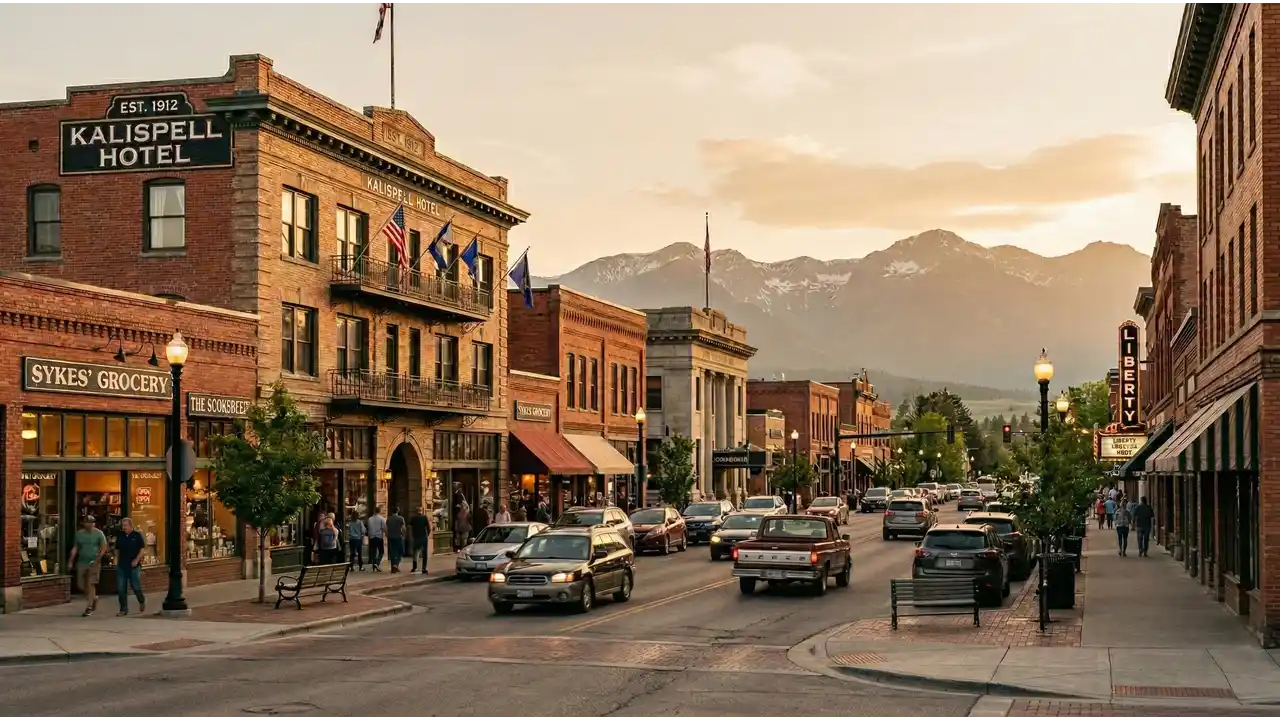
Kalispell is a mountain town in northwest Montana with roughly 25,000 residents, serving as the commercial hub of the Flathead Valley. It sits between Glacier National Park and Flathead Lake, with winters averaging below freezing and significant snowfall. The population is mostly white, working-class, and retirement-age, with growing numbers of remote workers and outdoor enthusiasts. Daily life centers on outdoor recreation, local shops on Main Street, and a slower pace than most US cities. Cost of living is moderate for rural Montana, but housing demand has climbed in recent years.
💡 Local Insights
Kalispell MT · 2026
Kalispell's affordability rests partly on its smaller size and distance from major metros, but proximity to Glacier and the lake has driven up housing costs relative to rural Montana averages. Rent typically runs $1,373/month for a moderate setup. A one-bedroom apartment in the central area runs roughly $900-1,100/month, while a two-bedroom family home or townhouse ranges $1,200-1,600/month. Buying land or a house carries higher prices ($300,000-500,000 for a modest home) due to vacation-home demand. Groceries average $509/month for a household, slightly above US rural averages because supplies come from Missoula or Seattle. Eating out is cheaper than coastal cities but portions and quality vary widely. No public transit exists; a car is essential. Gas, insurance, and maintenance are standard US rates. Local wages lag regional averages, which is why remote work or retirement income is common here. Heating costs spike in winter. Property taxes are moderate by US standards.
Frequently Asked Questions
How much does it cost to live in Kalispell MT per month?
A moderate lifestyle in Kalispell costs $2,950/month. This breaks down roughly as housing at $1,373/month, food (groceries and eating out) at $509/month, transportation at $400-500/month, utilities at $150-200/month, and other expenses like insurance, entertainment, and personal care covering the remainder. A budget lifestyle runs around $1,770/month by cutting housing costs and food. A comfortable tier, including more spacious housing and dining out regularly, reaches $4,573/month.
What is the average rent in Kalispell MT?
Average rent is approximately $1,373/month for a moderate household setup. A one-bedroom apartment in central Kalispell typically rents for $900-1,100/month, while two-bedroom homes or townhouses range $1,200-1,600/month. Prices vary by distance from downtown and proximity to the lake or ski areas. Older apartments on the south side run cheaper, around $850-950/month. Newer or renovated units near downtown command $1,100-1,300/month. Rental inventory is tight during summer and fall tourism season, pushing prices up 10-15 percent. Remote workers and retirees from higher-cost states have increased competition in recent years.
Is Kalispell MT cheap to live in for expats?
Kalispell is moderately priced for expats coming from major US cities or western Europe, but not as cheap as parts of Latin America or Southeast Asia. Housing at $1,373/month is reasonable compared to Denver or Seattle, but utilities and heating costs are higher due to winter climate. Groceries are similar to US average. The real trade-off is limited public transit, so you need a car and gas budget. Expats often find Kalispell affordable for outdoor lifestyle and retirement, but job opportunities are limited unless you work remotely. Language and cultural adjustment are minimal for English speakers. Healthcare exists but specialized services require travel to Missoula.
How much does food cost per month in Kalispell MT?
Groceries average $509/month for a household. A single person buying basics (produce, dairy, meat, bread, pantry staples) spends $120-180/month. A family of four runs $400-550/month with ordinary shopping at local supermarkets (Town & Country, Natural Food Store). Specific prices: ground beef $4-5/lb, chicken $6-8/lb, milk $3.50/gallon, eggs $3-4/dozen, bread $2.50-3.50/loaf. Eating out is cheaper than coastal cities. A burger and fries costs $12-15, dinner entrees at casual restaurants run $15-22. Farmers markets operate seasonally (May-October) with lower prices on local vegetables. Grocery prices are slightly higher than Missoula due to smaller store selection.
What salary do you need to live comfortably in Kalispell MT?
A comfortable lifestyle in Kalispell requires roughly $4,573/month, or about $54,900/year before taxes. This supports a two-bedroom home or apartment, regular eating out, hobbies, and savings. For a single person, $3,500/month ($42,000/year) provides comfort. For a family of four, aim for $5,500-6,500/month ($66,000-78,000/year) to cover housing, food, childcare, and activities without stress. Local wages average $38,000-45,000/year, so most comfortable residents rely on remote work, retirement income, or business ownership. Remote workers from tech hubs find Kalispell affordable. Teachers and healthcare workers earn modestly but struggle with housing costs relative to pay. Cost of living is lower than Denver or Seattle but higher than rural Idaho or eastern Montana.
How does the cost of living in Kalispell MT compare to other places?
Kalispell runs $2,950 per month for a moderate lifestyle, with housing at $1,373 per month. That puts it slightly cheaper than Tampa, which costs $3,100 monthly with housing at $1,492 per month. The difference is modest enough that both cities serve similar budgets.
You'll find Kalispell considerably more affordable than Providence, where a moderate lifestyle costs $3,925 per month and housing alone reaches $2,215 per month. If affordability is your priority, Tulsa undercuts Kalispell substantially at $2,325 per month overall, with housing at just $831 per month, making it a genuine budget alternative.
Kalispell's strength is that it offers mountain-town access and outdoor recreation without the expense of larger Rocky Mountain destinations. Your money goes further here than in many comparable Western cities, particularly on the housing side.
Yes, but with tight constraints. $1,770/month is the budget tier and requires discipline. Rent must stay under $900-1,000/month for a one-bedroom apartment or a shared space. Groceries at $300-350/month means cooking at home, shopping sales, and skipping prepared foods. Utilities are $100-150/month. Transportation (car insurance, gas, maintenance) runs $250-350/month, leaving $70-170 for phone, internet, and personal care. This budget cuts out eating out, hobbies, healthcare copays, and emergency savings. It works for students, remote workers with low expenses, or those with subsidized housing. Most residents on this budget qualify for assistance programs or live with roommates. Winter heating can push costs up, squeezing the budget further.