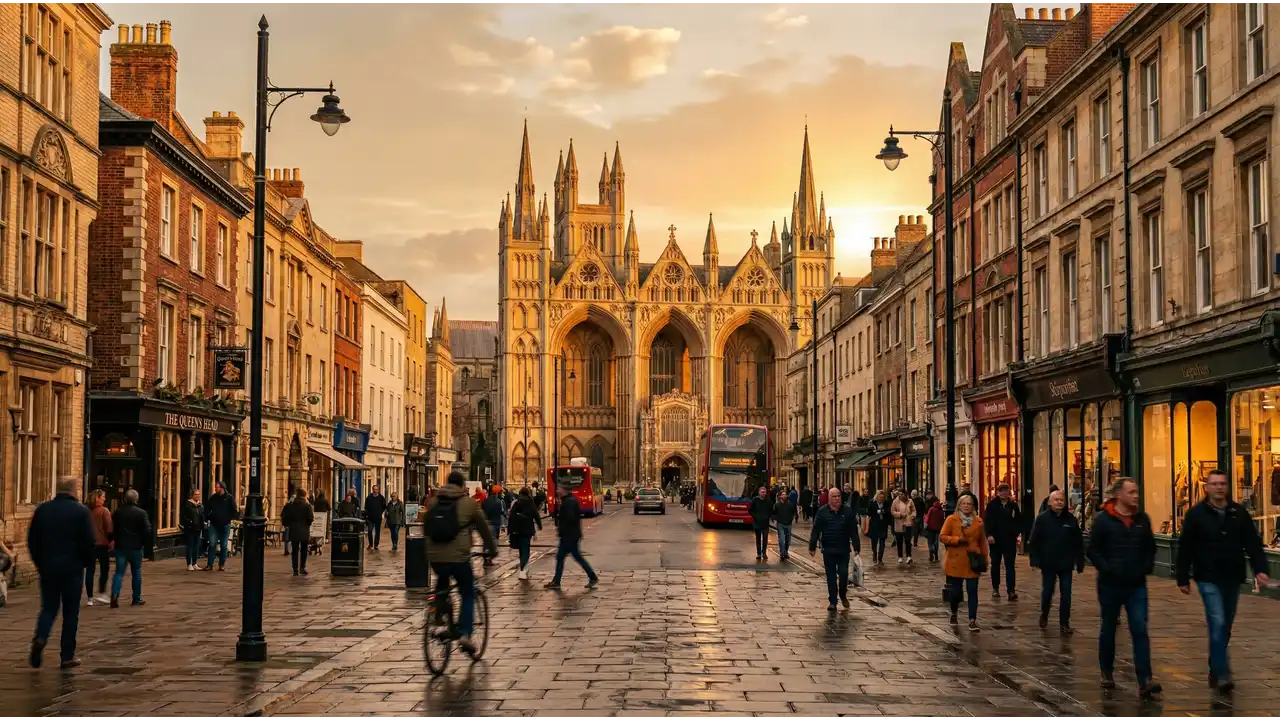
Peterborough is a cathedral city in Cambridgeshire, about 80 miles north of London. The population is around 195,000. Daily life centers on the historic city center, though much of the residential area is postwar suburban development. The climate is cool and damp, typical of the East Midlands. The city has a significant Eastern European population alongside established British residents. Most people commute by car or bus. The River Nene runs through the city. Employment is spread across logistics, manufacturing, healthcare, and public sector work. It is not a tourist destination, which keeps costs lower than market towns further south.
💡 Local Insights
Peterborough · 2026
Peterborough's cost of living reflects its position as a commuter city without London's premium. Housing drives the overall budget at $1,030/month for a moderate lifestyle. A one-bedroom flat in the city center rents for roughly $750 to $950 per month, while outer suburbs offer $600 to $850. New-build rental properties in developments like Hampton are more expensive; older terraced housing in areas like Fletton is cheaper. Buying is more affordable than surrounding areas, which attracts remote workers from London. Groceries run $426/month for a moderate diet. The Tesco, Sainsbury's, and Lidl on the city outskirts set baseline prices. Local markets offer seasonal produce at lower cost. Transport is cheap if you drive (petrol averages $1.40/liter locally). Bus passes cost roughly $60 per month for unlimited city travel. The city has no metro. Council tax varies by band but adds $120 to $180/month. Utilities (gas, electric, water) run $140 to $180/month depending on season and efficiency. Expats find housing negotiable and landlords often pragmatic about non-UK credit histories.
Frequently Asked Questions
How much does it cost to live in Peterborough per month?
A moderate lifestyle in Peterborough costs $2,350/month. Housing is the largest expense at $1,030/month. Food (groceries) averages $426/month. Utilities and council tax add roughly $150 to $200/month combined. Transport, phone, and insurance run $80 to $120/month. Dining out and entertainment vary widely but budget $300 to $400/month for moderate spending. The budget tier lifestyle (minimal discretionary spending) is roughly $1,410/month, while a comfortable lifestyle with regular dining out and travel runs $3,643/month.
What is the average rent in Peterborough?
Rent in Peterborough averages $1,030/month for a moderate one-bedroom flat. City center properties (near the Cathedral or Market Square) rent for $800 to $950/month. Suburban areas like Orton, Longthorpe, and Bretton offer $650 to $800/month for similar space. Newly built rental schemes command higher prices, often $1,000 to $1,200/month for modern two-bedroom apartments. Terraced housing in older neighborhoods like Fletton and Woodston rents for $700 to $900/month. Furnished rentals add 10 to 15 percent to these figures. Landlords typically require references and proof of income; deposit protection is standard under UK law.
Is Peterborough cheap to live in for expats?
Peterborough is genuinely affordable for expats compared to London, Manchester, or Cambridge. Housing is the strongest advantage: $1,030/month gets a livable one-bedroom flat, whereas London averages double that. Transport and utilities are cheaper than university towns. The tradeoff is employment. Peterborough's job market is narrower, so most expats either telecommute, work in logistics or manufacturing, or commute to Cambridge. The Eastern European community (Polish, Lithuanian) is well-established, which eases cultural adjustment but also suggests competing rental demand. Expats without UK credit history may face deposit or guarantor requirements. Overall, if you have income secured elsewhere, Peterborough is a cost-effective base.
How much does food cost per month in Peterborough?
Groceries for one person average $426/month in Peterborough. A weekly shop at Tesco or Sainsbury's for staples (bread, milk, eggs, vegetables, rice, beans) costs roughly $50 to $65. Lidl and Aldi offer 15 to 20 percent savings on similar goods. A loaf of bread is roughly $1.20, a liter of milk $1.10, eggs $2.50 per dozen. Dining out is cheaper than London: a mid-range lunch is $8 to $12, dinner $15 to $25 per person. Takeaway kebab or pizza runs $6 to $9. The Peterborough Market (open Wednesday to Saturday) sells fresh produce at lower cost than supermarkets, especially from April through October.
What salary do you need to live comfortably in Peterborough?
A comfortable lifestyle in Peterborough costs $3,643/month, suggesting a gross annual salary of around $55,000 to $60,000 (after tax, assuming UK employment). This budget includes eating out regularly, modest travel, hobbies, and savings. For a couple, combined gross income of $70,000 to $85,000 provides good security. Remote workers or expats with income from abroad should budget the same monthly amount but face no tax complications if self-employed or pensioned. The local median salary in Peterborough is lower (roughly $35,000 to $40,000 annually), so comfortable living typically requires income from outside the city or above-average local employment.
How does the cost of living in Peterborough compare to other places?
Peterborough sits in the middle of the UK cost-of-living spectrum. A moderate lifestyle here runs $2,350 per month, with housing at $1,030 per month.
That puts it slightly above Leeds, where a moderate lifestyle costs $2,225 monthly and housing runs $1,090. The two cities are close enough that your choice between them will depend more on job market and personal preference than on cost differences.
Move north to Dundee and you'll spend noticeably less. Dundee's moderate lifestyle costs $1,825 per month with housing at $727. Head south to Bristol, though, and costs jump significantly. Bristol runs $2,750 monthly for a moderate lifestyle, with housing alone at $1,574 per month.
For most of England, Peterborough offers reasonable value without the premium you'd pay in major southern cities.
Yes, but with strict discipline. The budget tier is $1,410/month. Housing takes $850 to $950 from that, leaving $460 to $560 for everything else: food, transport, utilities, phone. Groceries must be $300 to $350/month (beans, rice, root vegetables, budget-brand staples from Lidl or Aldi). Utilities run $120 to $140/month. Transport requires either a car (paid for already) with cheap petrol or a bus pass ($60/month). Dining out disappears entirely. No travel, minimal entertainment, no savings. It is feasible if you have secure housing and no dependents, but leaves no buffer for emergencies or unexpected costs. Most people at this budget live with flatmates or in the cheapest suburbs.