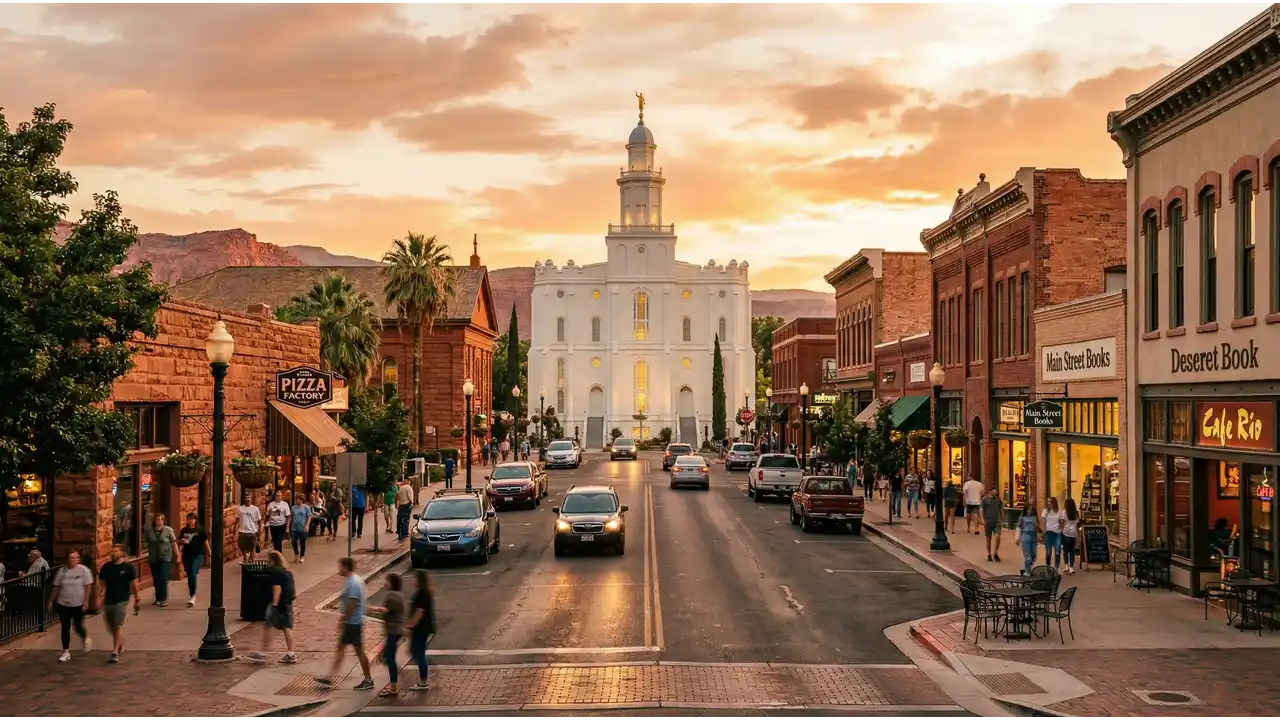
St. George is a city of roughly 80,000 in southwestern Utah, known for proximity to national parks (Zion, Red Rock Canyon, Snow Canyon) and warm, dry climate. The population skews toward retirees, young families, and outdoor enthusiasts. Summers exceed 100 degrees; winters are mild. The city has grown rapidly in the past decade, with new residential development spreading north and east. Daily life centers on car-dependent neighborhoods, local schools, and outdoor recreation. Main street has shops and restaurants; most errands require driving. The area attracts people fleeing colder climates and those seeking affordable housing near red rock scenery.
💡 Local Insights
St. George UT · 2026
St. George remains cheaper than most US metros, but cost growth has outpaced national averages due to rapid in-migration. Housing anchors at $1,423/month and drives the budget. Rental stock is tight; new apartments and townhomes command higher rents than older units. Single-family homes for rent range $1,300 to $1,700/month depending on age and location. Groceries run $493/month for a moderate diet, slightly below national average, with Albertsons and Walmart offering baseline pricing. Eating out is moderate (casual dinner for two around $40 to $50). Utilities are moderate year-round because air conditioning and heating are both needed. Car ownership is essential; public transit is minimal. Gas and vehicle maintenance are at national rates. Healthcare costs are moderate. No state income tax (Utah levies 4.65% to 4.85% on wages), but this is offset by higher property taxes (around 0.6% of assessed value). Property prices have climbed steadily, making purchase difficult on modest incomes.
Frequently Asked Questions
How much does it cost to live in St. George UT per month?
A moderate lifestyle costs $2,950/month. Housing runs $1,423/month, groceries $493/month, with the remainder covering utilities, transport, dining out, and discretionary spending. The budget tier is $1,770/month (cutting back on dining, entertainment, and housing quality), and the comfortable tier is $4,573/month (newer housing, frequent dining out, travel). Your actual cost depends heavily on housing choice and whether you own a car outright or finance one.
What is the average rent in St. George UT?
Average rent is $1,423/month across the city. A one-bedroom apartment in central St. George runs $1,100 to $1,300/month; a two-bedroom townhome ranges $1,350 to $1,600/month. Newer units north of the downtown strip (Bloomington Hills, The Ledges neighborhoods) command premiums at the higher end. Older, established neighborhoods like Diagonal Street have more modest rents near $1,200 to $1,350/month. Single-family home rentals typically run $1,400 to $1,700/month. Vacancy is tight; landlords have minimal pressure to negotiate.
Is St. George UT cheap to live in for expats?
St. George is affordable compared to coastal US cities and many expat hubs abroad, but it is not a bargain destination. Rent of $1,423/month is reasonable for a US small city, but significantly higher than Mexico City, Bangkok, or Lisbon. If you are accustomed to major metro pricing (San Francisco, New York, London), St. George feels cheap. If you have lived in lower-cost countries or smaller towns, it may feel expensive. The real draw is outdoor recreation access, mild winters, and reliable US infrastructure, not rock-bottom pricing.
How much does food cost per month in St. George UT?
Groceries average $493/month for a moderate diet. A gallon of milk runs $3.50 to $4; a pound of ground beef $4.50 to $5.50; eggs $3 to $4 per dozen. Walmart and Albertsons are the main grocery anchors. Whole Foods does not exist locally; organic produce costs more at regional chains. Eating out ranges $12 to $16 for a casual lunch, $25 to $35 for a dinner entree at a sit-down restaurant. The city has limited fine dining; most restaurants are casual chains or local pizza and Mexican options. A week's groceries for one person typically runs $110 to $130.
What salary do you need to live comfortably in St. George UT?
A comfortable lifestyle costs $4,573/month, or roughly $55,000/year gross income (accounting for taxes and benefits). This tier allows newer housing ($1,700 to $2,000/month), regular dining out, entertainment, travel, and modest savings. A household of two should aim for combined income around $90,000 to $100,000 before taxes. The moderate tier ($2,950/month, or $36,000/year) is feasible for individuals without dependents, though it requires discipline on discretionary spending. Utah's lack of state income tax on pensions helps retirees but does not offset higher housing growth.
How does the cost of living in St. George UT compare to other places?
St. George sits comfortably in the middle tier of US cost of living. A moderate lifestyle runs $2,950 per month, with housing at $1,423 per month.
To put that in perspective, New Orleans costs about the same at $2,775 monthly, though its housing runs slightly cheaper at $1,254. Memphis is genuinely affordable by comparison, with a moderate budget of $2,500 and housing at $1,022. If you're coming from a major metro area, Miami will feel like sticker shock at $3,925 monthly and $2,311 for housing.
St. George's real advantage is housing affordability relative to other growing western cities. You're paying less than Miami while getting access to outdoor recreation and a younger demographic than many peer markets. Cost of living here has risen noticeably in recent years, but it remains below national averages.
Yes, but with real constraints. The budget tier of $1,770/month requires shared housing (studio or one-bedroom), grocery discipline, minimal dining out, and used car ownership. A single person might rent a basic one-bedroom for $1,100 to $1,200/month, leaving $570 to $670 for food, utilities, transport, and insurance. Groceries must stay near $400/month; no streaming services, entertainment, or savings buffer. This works short-term but leaves little margin for emergencies or unexpected costs. Couples sharing rent can stretch further. Most people living on this budget are students, early-career workers, or retirees with paid-off housing.