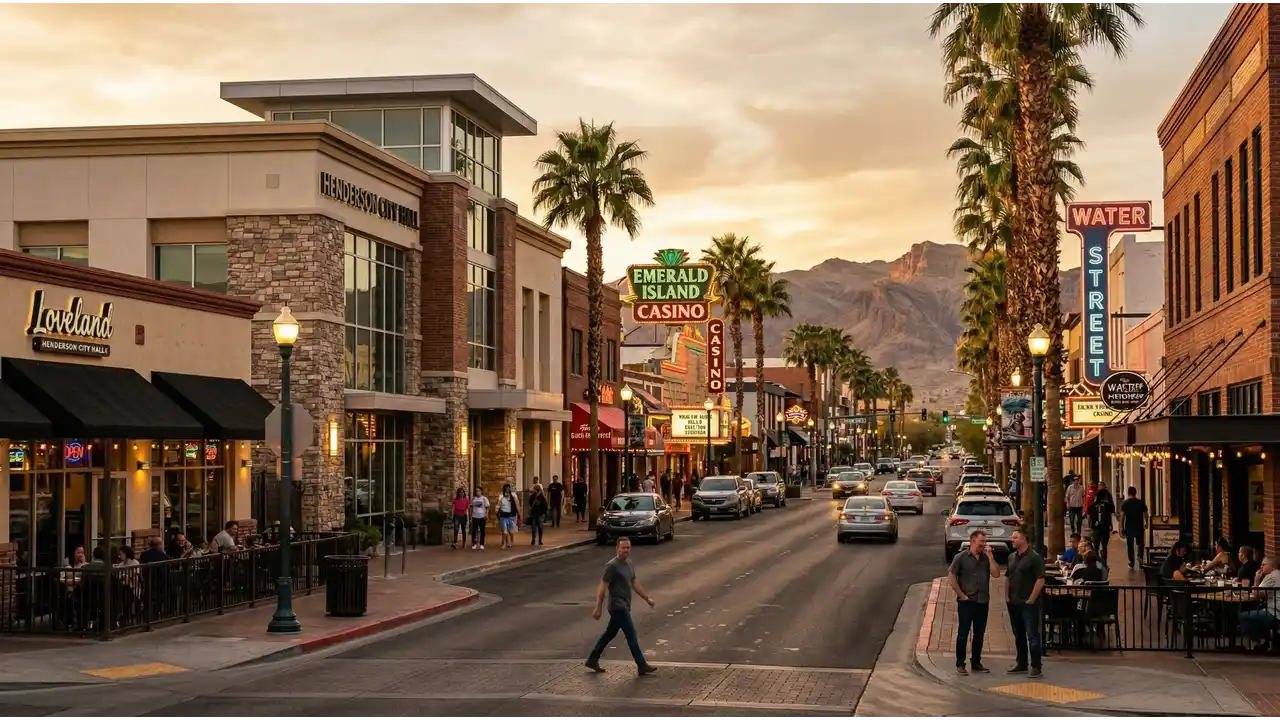
Henderson is a planned suburban city in southern Nevada, about 20 miles southeast of Las Vegas. It's the state's second-largest city, built around master-planned residential communities with grid-like streets and low density. Most residents work in Las Vegas or remote jobs. The climate is desert: extremely hot summers (110+ degrees), mild winters, and very little rain. Daily life centers on cars, shopping centers, and family-oriented amenities. You'll find a mix of young families, retirees, and service workers. The city has parks and recreation facilities but limited public transit. It's quieter and more residential than Las Vegas proper.
💡 Local Insights
Henderson NV · 2026
Henderson costs less than Las Vegas and significantly less than coastal US metros, but it's not a bargain basement city. Housing runs around $1,412/month for moderate living, which typically means a two-bedroom apartment in established neighborhoods like Green Valley or Lake Las Vegas, or a small house further out. New construction and resort-adjacent properties cost more; older complexes south of Lake Mead Boulevard cost less. Groceries average $512/month for two people eating mostly at home. Walmart and Albertsons are the anchors; prices are competitive with national averages. Eating out is cheap by US standards (casual chains $12-18 per meal). Transportation is car-dependent with no meaningful public transit. Gas and maintenance are standard US costs. Utilities spike in summer (air conditioning), typically $150-250/month. Property taxes on homes are low (around 0.6% of assessed value). Expats find Henderson easier to navigate than Vegas proper but should budget for a car and prepare for extreme heat. Salaries run lower than major metros, which partially offsets the cost-of-living advantage.
Frequently Asked Questions
How much does it cost to live in Henderson NV per month?
A moderate lifestyle in Henderson costs around $3,000/month. Housing is $1,412/month. Groceries run $512/month for two people. Utilities add $150-250 in summer, $80-120 in winter. Transportation (car ownership, gas, insurance) typically runs $600-800/month. Dining out, entertainment, and personal care make up the remainder. A budget lifestyle is possible at $1,800/month if you share housing and cook most meals. A comfortable lifestyle with more flexibility costs closer to $4,650/month.
What is the average rent in Henderson NV?
Average rent is approximately $1,412/month. A one-bedroom apartment in central neighborhoods like Green Valley runs $1,200-1,500/month. Two-bedroom units average $1,400-1,700/month. Older complexes south of Lake Mead Boulevard are cheaper, around $1,100-1,300/month. Newer properties or those near the Lake Las Vegas resort area cost $1,600-2,000/month. Houses for rent start around $1,600-1,800/month and go up from there. Prices have been relatively stable. Most leases require first month, last month, and a security deposit.
Is Henderson NV cheap to live in for expats?
Henderson is moderately priced for expats relocating within the US. It's cheaper than major metros (San Francisco, New York, Los Angeles) but not a bargain compared to secondary cities. The real cost advantage is housing, which at $1,412/month is 30-40% less than coastal equivalents. However, expats should factor in the car dependency (higher transport costs) and extreme summer heat (high utilities). English is widely spoken, and the population is diverse. Banking and opening a lease are straightforward. If you're comparing to international expat hubs like Mexico City or Southeast Asia, Henderson is significantly more expensive overall.
How much does food cost per month in Henderson NV?
Groceries for a moderate diet average $512/month per person. Staples: milk $3.50/gallon, eggs $2.50/dozen, chicken breast $7/pound, rice $1.50/pound, bread $2-3/loaf, fresh produce varies seasonally. Chain groceries (Walmart, Albertsons, Sprouts) are competitive with national averages. Eating out is affordable: casual chains $12-18/meal, fast food $8-12. Mid-range restaurants run $15-30 per person. Grocery shopping is best done at Walmart Supercenter or Albertsons for lower prices. Restaurant culture in Henderson skews casual and affordable compared to Las Vegas tourism pricing.
What salary do you need to live comfortably in Henderson NV?
A comfortable lifestyle costs around $4,650/month. For a single person, that's roughly $56,000/year gross (accounting for taxes). For a household of two, $70,000-80,000/year combined income provides comfort without tight budgeting. This tier allows for a nicer rental ($1,600-1,800/month), eating out regularly, car ownership, utilities, and discretionary spending. Many Henderson households earn $60,000-90,000 annually. If you're freelance or remote, remember Nevada has no state income tax, which is a real advantage. Lower salaries are possible but require careful budgeting and sharing housing.
How does the cost of living in Henderson NV compare to other places?
Henderson runs $3,000 per month for a moderate lifestyle, placing it squarely in the middle of the Southwest cost range. You'll spend $1,412 monthly on housing there.
The closest peer is Austin, which costs $2,875 per month overall with housing at $1,347. That's a practical tie, though Austin's housing is slightly cheaper. Tucson is genuinely affordable by comparison at $2,550 monthly, with notably lower housing costs of $930. If you're coming from a major metro, Chicago runs $3,550 per month, so Henderson will feel considerably lighter on your wallet. The housing difference is especially sharp: Chicago housing runs $1,955 against Henderson's $1,412.
Henderson offers reasonable affordability for a developed US city without requiring you to compromise on urban services or amenities. It's the practical choice if you want Southwest living costs without dropping to smaller-market pricing.
Yes, but with constraints. A budget lifestyle requires roommates or shared housing to keep rent to $700-900/month per person, leaving $900-1,100 for food, transport, utilities, and everything else. Groceries need discipline: $200-250/month per person on basic items. No car ownership is unrealistic given no public transit, but a used car ($3,000-5,000 paid cash) with minimal insurance and maintenance is necessary. Utilities run $100-150 even in efficiency mode. Eating out is minimal. This budget works for students, remote workers living frugally, or those in the early phase of relocation. It's tight but livable if you prioritize housing efficiency.