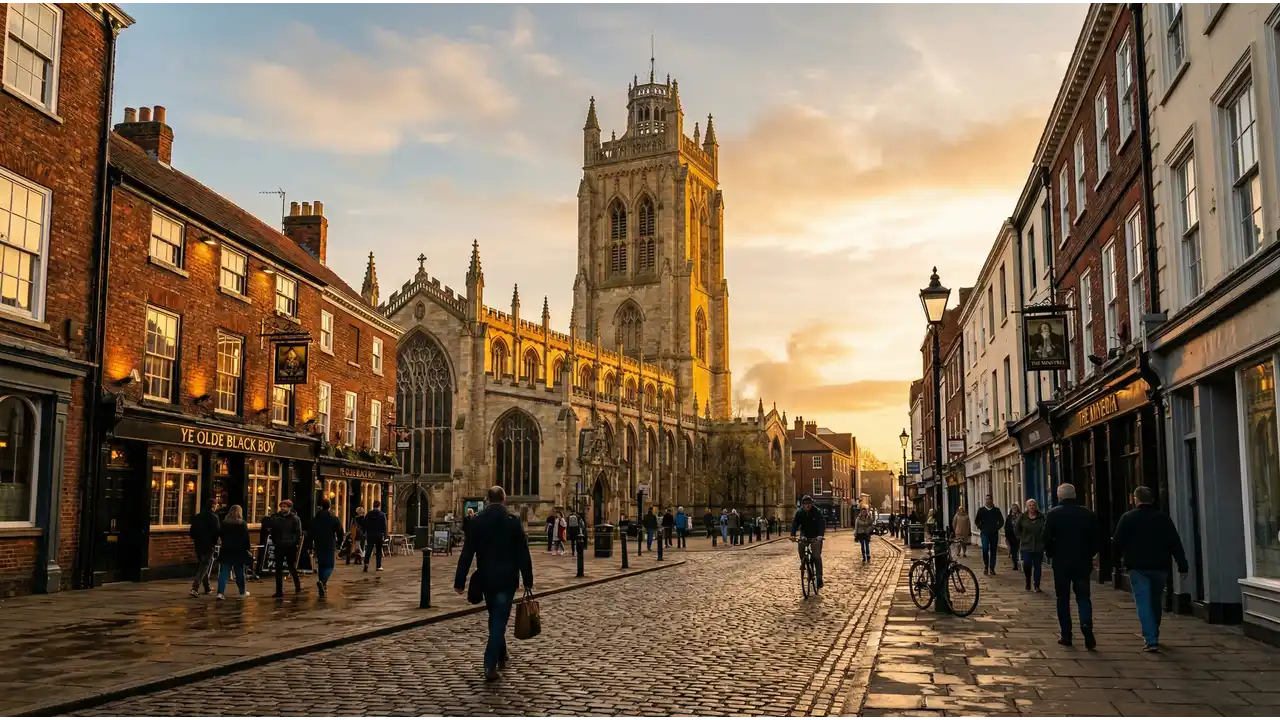
York is a cathedral city in North Yorkshire with a population around 210,000. Medieval walls encircle the historic center, where the Minster dominates the skyline. The city draws students, retirees, and professionals. Climate is cool and damp (around 50°F average). Daily life centers on the compact old town for shopping and dining, with residential areas spreading outward. Tourism drives parts of the economy. It feels slower than London but more cosmopolitan than surrounding market towns. Winters are wet rather than snowy. Most residents walk or cycle locally; regional rail connections exist but are slower than major cities.
💡 Local Insights
York · 2026
York's costs reflect its status as a mid-size cathedral city with heritage appeal and university presence. Housing dominates expenses at $1,090/month for moderate standards. City-center rentals for a one-bedroom flat run $650-$850, while two-bedroom properties are $850-$1,150. Neighborhoods like Bishopthorpe and Acomb offer lower rents around $700-$900 for comparable space. Groceries (supermarket staples) cost around $374/month for one person eating at home. A pint of milk is $0.70, a loaf of bread $1.20, chicken breasts $8/kg. Eating out is moderate by UK standards: casual lunch around $9-$12, dinner in a mid-range restaurant $16-$22. Bus travel within York costs $1.70 per journey or $50/month for unlimited local passes. Train travel to Leeds or Manchester runs $8-$15 per trip. Council tax (local property tax) adds $120-$180/month depending on property band. Expats should budget separately for visa-related costs and international transfers, which add 2-4% to overall expenses. Utility costs vary seasonally but average $140-$180/month (heating peaks in winter).
Frequently Asked Questions
How much does it cost to live in York per month?
A moderate lifestyle in York costs $2,250/month. This breaks down as housing at $1,090/month, groceries at $374/month, transport around $70/month (bus passes and occasional journeys), utilities $150/month, and discretionary spending (dining, entertainment, personal care) at roughly $475/month. A tight budget is $1,350/month if you share housing or live outside the center, while a comfortable lifestyle allowing regular dining out and travel runs $3,488/month. These figures assume single occupancy; couples can achieve economies of scale, particularly in housing.
What is the average rent in York?
Rent in York averages $1,090/month for moderate standards, based on CostLiving Engine data. One-bedroom flats in the city center rent for $650-$850/month. Two-bedroom properties run $850-$1,150/month. Outside the medieval city center, neighborhoods like Bishopthorpe, Acomb, and Rawcliffe offer lower rents in the $700-$950/month range for comparable space. Shared housing (two or three occupants) can drop individual rent to $450-$650/month. Council tax (property tax) adds $120-$180/month on top of rent. Long-term tenancy is standard; deposits are typically five weeks' rent and regulated by government scheme.
Is York cheap to live in for expats?
York is moderately priced for expats compared to London (roughly 30-40% cheaper in most categories) but costs more than northern industrial cities like Manchester or Sheffield. At $2,250/month moderate costs, it's affordable for mid-career professionals and remote workers but tighter for students or single incomes. Expat communities are modest compared to major cities, so specialized services (international groceries, visa services) may be less convenient or costlier. Strengths include lower housing pressure than London, good rail access to other regions, and a walkable center. Main drawback: limited job market outside education, heritage tourism, and retail means many expats work remotely or relocate for employment.
How much does food cost per month in York?
Groceries for one person cost around $374/month at UK supermarkets (Tesco, Sainsbury's, Asda, Lidl). Typical prices: whole milk $0.70/liter, bread $1.20/loaf, eggs $2.50/dozen, chicken $8/kg, pasta $0.60/box, apples $1.50/kg. Eating out is moderate: casual lunch (sandwich, coffee) $9-$12, pub meal $14-$18, mid-range dinner $16-$22 per person. Indian or Chinese takeaway runs $8-$12 per meal. The city center has pricier tourist-focused restaurants; residential areas offer better value. Farmer's market on Thursdays near Parliament Street offers seasonal produce at competitive prices. Budget-conscious shoppers can eat for less using discount chains like Lidl or Aldi.
What salary do you need to live comfortably in York?
A comfortable lifestyle costs $3,488/month, suggesting a gross annual salary of around $50,000-$55,000 (accounting for UK tax and National Insurance). This allows regular dining out, travel within the UK or Europe a few times yearly, hobbies, and modest savings. For a household with two earners, combined income of $75,000-$85,000 supports a two-bedroom home, family activities, and financial breathing room. The moderate budget of $2,250/month requires roughly $32,000-$35,000 gross annually. Entry-level salaries in hospitality and retail are $22,000-$28,000, requiring careful budgeting or shared housing. York's job market outside education and heritage tourism is limited, so many comfortable residents work remotely.
How does the cost of living in York compare to other places?
York sits in the middle ground for UK city costs. A moderate lifestyle runs $2,250 per month, with housing at $1,090 monthly. This puts it slightly ahead of Sheffield, where moderate living costs $2,175 with housing also at $1,090, so you're paying a modest premium for what York offers.
Move north to Dundee and costs drop noticeably. Dundee's moderate lifestyle runs $1,825, with housing at $727, making it genuinely cheaper for both categories. Edinburgh, by contrast, is considerably pricier. A moderate lifestyle there costs $2,775 and housing runs $1,574, so you'd pay roughly 23 percent more overall than York.
Compared to larger English cities like London, York remains affordable. Compared to smaller market towns, it's more expensive but still reasonable for a place with York's cultural amenities and job market.
Yes, but with constraints. This budget requires shared housing (reducing individual rent to $450-$600/month) or a room in a house. Studio flats at the upper end of budget exist but offer little financial cushion. You'll cook almost entirely at home; eating out is rare (a few budget meals monthly). Transport relies on bus passes ($50/month). No car ownership. Utilities, council tax, phone, and internet still apply. Savings are minimal. This works for students (university housing helps), people with reduced bills (living with family), or those supplementing with side income. Unexpected costs (medical, travel home) become serious problems. It's feasible but leaves no margin for error and requires discipline.