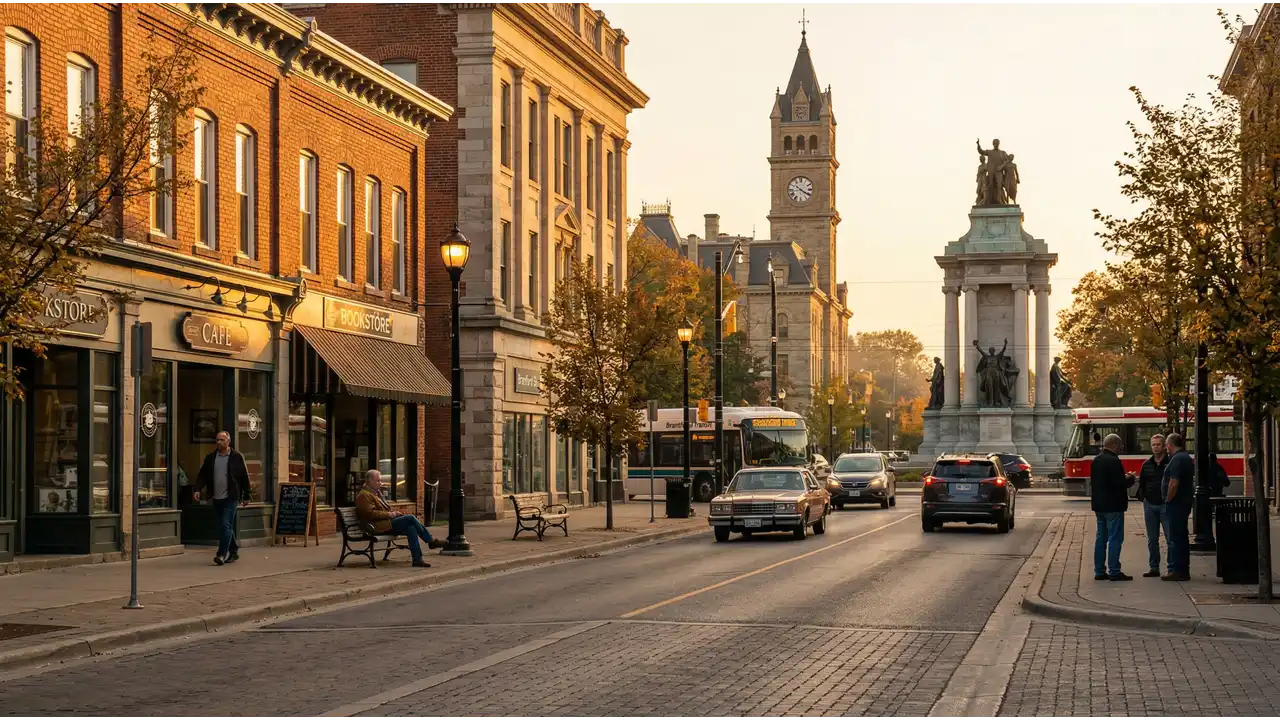
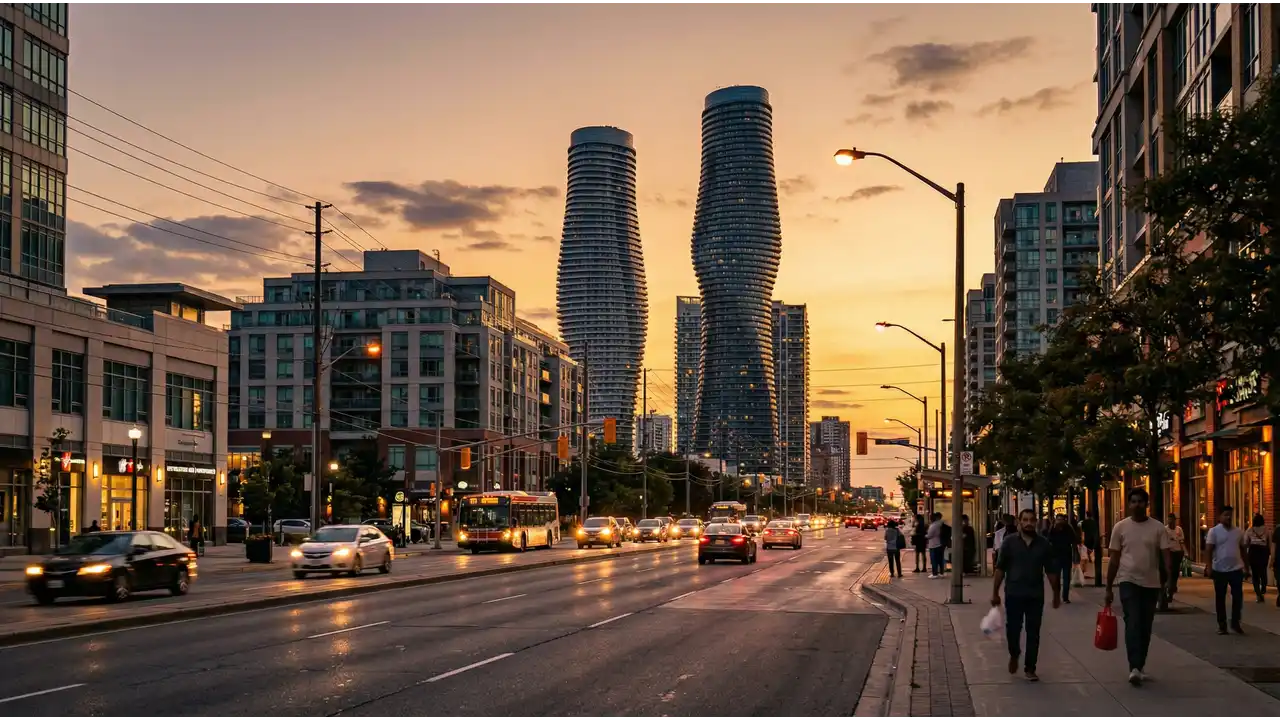
Brantford is a mid-sized city of around 150,000 people in southwestern Ontario, about 30 kilometers west of Hamilton. It sits along the Grand River and has a mixed industrial and residential character. The economy has shifted away from manufacturing toward small business, healthcare, and education (Laurier University is based here). Winters are cold and snowy, summers moderate. Daily life revolves around car commuting, local shopping on Colborne Street, and accessing services in nearby larger cities. Most residents are Canadian, with growing immigrant communities from South Asia and Eastern Europe. It feels like a practical, working-class city without pretense, not a destination draw but a functional place to live affordably.
💡 Local Insights
Brantford ON · 2026
Brantford's cost of living sits well below Ontario's average, driven primarily by a soft housing market and steady supply of older rental stock. Housing runs around $1,044 per month and reflects a mix of aging rental apartments and single-family homes in working-class neighborhoods. Demand is lower than in Toronto or Hamilton, which keeps pressure off prices. Groceries average $437 monthly for a moderate diet, consistent with broader Ontario prices for items like milk, bread, and produce at Food Basics or No Frills. Transit is minimal (local bus service only), making a car necessary for most residents, which adds transport costs outside the core budget figure. Expats will find Brantford cheaper than Toronto by 35-40% on rent, but should not expect urban amenities. Downtown renewal efforts have stabilized some blocks, but many neighborhoods remain economically challenged. No significant expat premium exists here, unlike larger centers.
Frequently Asked Questions
How much does it cost to live in Brantford ON per month?
A moderate lifestyle in Brantford costs about $2,400 per month. Housing accounts for $1,044 monthly, groceries around $437, utilities approximately $180-200, transport (car-dependent) roughly $300-400, and discretionary spending another $400-500. A budget lifestyle drops to $1,440 monthly by cutting housing to shared accommodations, minimizing dining out, and using public transit where available. A comfortable lifestyle reaches $3,720 by allowing larger housing, regular dining out, and more discretionary activities. These figures cover a single person; families and couples typically benefit from economies of scale on rent and utilities.
What is the average rent in Brantford ON?
Average rent in Brantford hovers around $1,044 per month for a moderate rental. A one-bedroom apartment in the city center or stable neighborhoods like east Brantford rents for $950-1,100, while a two-bedroom runs $1,100-1,300. Shared accommodations or rooms in house-shares drop to $600-750. Older walk-up apartments on Colborne or in residential blocks are the norm. Housing supply is stable, so vacancy rates remain healthier than Ontario's major centers, preventing sharp rent spikes. Properties outside downtown, in areas like St. George or south Brantford, may be slightly cheaper. Landlords tend to be small independent owners rather than large corporate firms.
Is Brantford ON cheap to live in for expats?
Yes, Brantford is genuinely affordable for expats, especially those relocating from Toronto, Vancouver, or major US cities. Rent is 35-40% lower than Toronto and utilities are comparable to broader Ontario. Groceries follow standard Canadian supermarket pricing with no expat surcharges. However, the tradeoff is limited expat community infrastructure, fewer international restaurants, and a car-dependent lifestyle. Job market for skilled expats exists mainly in healthcare and education; tech jobs favor larger centers. Brantford suits remote workers and retirees more than those seeking cultural amenities or nightlife. Indian and South Asian communities have established presences, making those expat groups relatively comfortable. European expats should expect a quieter, more car-centric adjustment.
How much does food cost per month in Brantford ON?
Groceries for one person average $437 monthly for a moderate diet. A loaf of bread runs $2-3, milk (2 liters) $4-5, chicken breasts $8-10 per pound, eggs (dozen) $3-4, and bananas $0.60-0.80 per pound. Budget grocers like Food Basics and No Frills dominate; Walmart and Costco offer savings for bulk buyers. Dining out is cheaper than Toronto; a casual lunch is $12-15, dinner entrees $15-20. Eating out regularly bumps the monthly food budget to $600-700. Ethnic markets (South Asian, Eastern European) in east Brantford offer good produce and specialty items at lower prices than mainstream chains.
What salary do you need to live comfortably in Brantford ON?
A comfortable lifestyle in Brantford costs $3,720 per month, suggesting a gross household income around $70,000-80,000 annually (accounting for taxes and irregular expenses). For couples, $55,000-60,000 combined can work. A single person earning $50,000-55,000 gross has breathing room after taxes. Remote workers earning USD salaries have significant advantage; earning $50,000 USD annually puts you well above the comfortable tier. Teachers, nurses, and skilled trades earn within this range locally. Homebuyers should aim for down payment savings; mortgage rates and property values have shifted, but $300,000-400,000 is realistic for detached homes in stable neighborhoods.
How does the cost of living in Brantford ON compare to other places?
Brantford is genuinely affordable for Ontario. A moderate lifestyle here costs $2,400 per month, with housing running $1,044 monthly. That puts you well below Vancouver, where the same moderate lifestyle costs $2,875 with housing at $1,740. You're also cheaper than Calgary, which sits at $2,175 overall and $1,114 for housing. Edmonton edges out Brantford on price, running $1,900 monthly with housing at $835, but Brantford's gap is narrow enough that local factors like job availability and community fit matter more than the modest difference. If you're coming from Toronto or a major US city, Brantford's costs will feel noticeably lower. The trade-off is smaller job market and fewer services, but for people who can work remotely or have flexibility on employment, the savings are real.
Yes, but with discipline. A budget lifestyle of $1,440 requires shared housing at $600-700, groceries kept to $350-400 monthly, minimal transport costs, and no dining out. This works for students, remote workers with low expenses, or early-career individuals willing to sacrifice space and comfort. You'll need to share a house or take a small bachelor apartment, cook all meals, use transit or bike when possible, and avoid social spending. Unexpected costs (car repair, medical, phone replacement) strain this budget fast. It is achievable in Brantford more easily than Toronto or Hamilton, but leaves little margin for error. Better for short-term stays or life transitions than permanent settlement for most people.