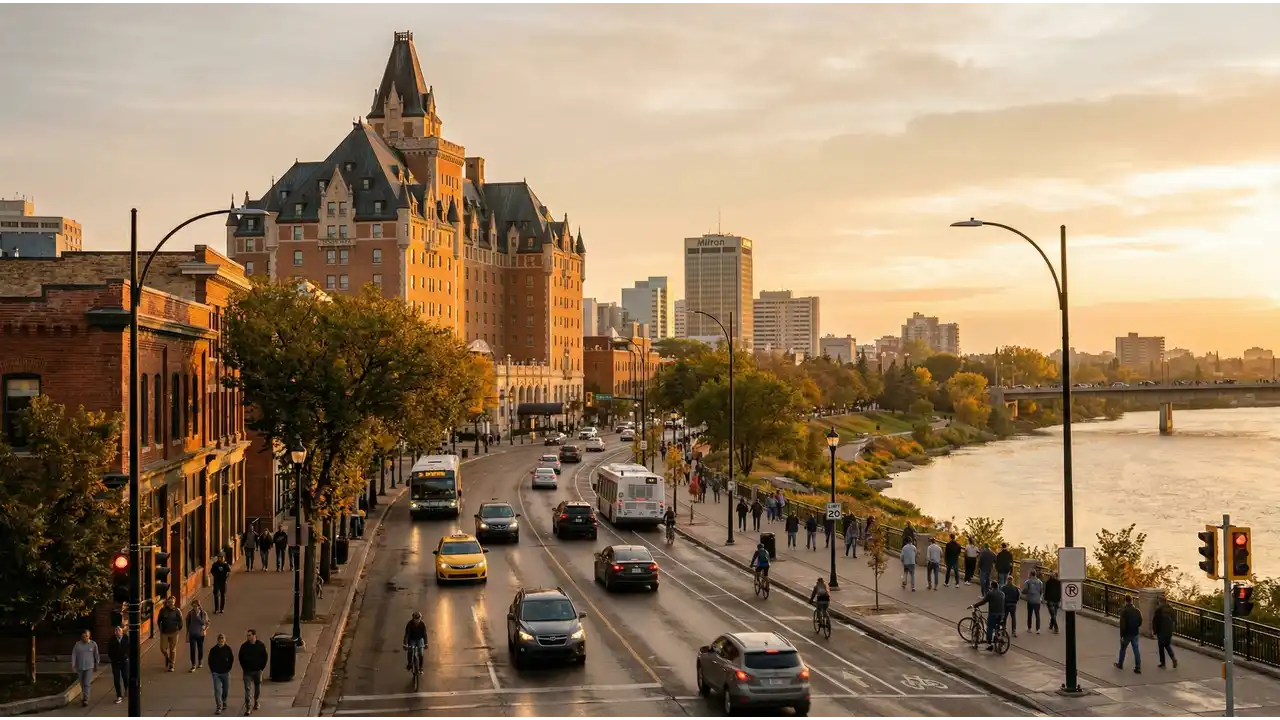
Canada spans six time zones across 3.8 million square miles, from Atlantic provinces to Pacific coast and Arctic territories. Winter is severe in most regions, with temperatures dropping to -20°F or lower. Summers are mild to warm. Major cities (Toronto, Vancouver, Montreal, Calgary) draw most expats and immigrants. Daily life centers on car ownership outside city cores, strong public services, and significant distances between amenities. Healthcare is public but prescription drugs and dental are private expenses. Population is roughly 40 million, increasingly diverse in urban centers. Work culture tends toward formality and punctuality.
💡 Local Insights
Canada · 2026
Canada's cost of living breaks along geographic lines. Major cities (Vancouver, Toronto, Montreal) drive the highest costs, while prairie and Atlantic cities run 20-30 percent lower. Housing accounts for $1,292/month in a moderate budget and is the primary cost driver, especially in Greater Toronto Area and Metro Vancouver where rents for a one-bedroom apartment run $1,400-$1,800/month, while smaller cities see $900-$1,200/month. Groceries total $438/month for one person; price inflation hit Canada harder than peers after 2021, and competition remains limited in rural areas. Transportation costs depend heavily on car ownership (gas, insurance, payments) versus transit use in urban areas. Expats often underestimate telecom costs (cell phone plans run $60-$100/month) and property taxes where applicable. Exchange rates matter for USD earners. Salaries tend to be 10-15 percent lower than comparable US positions, partially offset by public healthcare coverage.
Frequently Asked Questions
How much does it cost to live in Canada per month?
A moderate lifestyle in Canada costs $2,650/month for one person. This breaks down to housing at $1,292/month, groceries at $438/month, utilities around $150-$200, transportation $200-$300, and discretionary spending on dining, entertainment, and personal care. A tight budget runs $1,590/month (housing, food, basics only). A comfortable lifestyle with dining out, travel, and hobbies costs $4,108/month. Costs vary substantially by city; Vancouver and Toronto run 30-40 percent higher than Calgary or Halifax.
What is the average rent in Canada?
Average rent across Canada is approximately $1,292/month. In major cities, one-bedroom apartments rent for $1,400-$1,800/month in Vancouver and Toronto, $1,100-$1,400/month in Montreal, and $900-$1,200/month in Calgary or Ottawa. Outside metropolitan areas, rent drops to $700-$1,000/month. Room rentals in shared houses run $600-$900/month in cities. Landlord-tenant laws vary by province. Most leases require first month's rent and a security deposit upfront. Competition for rental housing is fierce in Vancouver and Toronto, with applications often decided within hours.
Is Canada cheap to live in for expats?
Canada is moderately expensive for expats, similar to the UK or Australia but more costly than Mexico or Southeast Asia. At $2,650/month, it ranks below the US (especially coasts) but above most non-English-speaking countries. For US-based expats earning in USD, the favorable exchange rate (currently around 1.4 CAD per USD) adds purchasing power. However, housing is the sticking point; Vancouver and Toronto rival San Francisco and London in rental costs. Expats on fixed salaries often find the cost of living higher than expected. Tax rates are competitive, and healthcare is free, which offsets other expenses for employed residents.
How much does food cost per month in Canada?
Groceries average $438/month for one person. Staples like milk ($0.65-$0.85/liter), bread ($2.50-$3.50/loaf), chicken ($8-$12/kg), and eggs ($3.00-$4.00/dozen) are typical. Grocery chains (Loblaws, Sobeys, Metro, Costco) dominate urban areas; smaller towns have fewer options and higher prices. Eating out costs $12-$18 for casual meals, $25-$50 for mid-range restaurants. Coffee runs $2.50-$4.00. Food price inflation has moderated but remains above historical averages. Asian and Indian groceries are cheaper in diverse neighborhoods (Toronto, Vancouver, Montreal).
What salary do you need to live comfortably in Canada?
A comfortable lifestyle costs $4,108/month, or roughly $49,000/year gross income in most provinces after tax. This covers housing ($1,292/month), groceries, utilities, transport, dining out occasionally, hobbies, and travel. In high-cost cities like Vancouver or Toronto, comfortable living typically requires $55,000-$65,000/year to maintain that standard. Dual-income households earning $60,000-$80,000 combined find comfortable living achievable in mid-tier cities. Lower-income thresholds apply in Atlantic Canada and prairie provinces. Household size, debt, and lifestyle preferences shift this significantly.
How does the cost of living in Canada compare to other places?
Canada's moderate lifestyle costs $2,650 per month, with housing running $1,292 monthly. This puts Canada in the middle tier globally.
For direct comparison, Tennessee runs $2,750 monthly on a moderate budget, making it a near peer despite slightly higher overall costs. Mexico is substantially cheaper at $1,600 for a moderate lifestyle, with housing at $730 monthly. If you're looking at premium destinations, Barbados costs $3,725 monthly, with housing at $1,955.
Canada's housing expense of $1,292 sits near Tennessee at $1,281, suggesting similar real estate pressure in both places. Your actual cost depends heavily on which Canadian city you choose. Vancouver and Toronto run considerably higher than the national average, while smaller provinces like Saskatchewan and Manitoba offer lower expenses. Mexico appeals to budget-conscious expats, while Barbados attracts those seeking Caribbean living regardless of price.
Yes, but only under tight constraints. At $1,590/month (the budget tier), you cover rent ($900-$1,100/month in smaller cities), groceries ($350-$400/month), utilities ($100-$120), and transit ($40-$60/month). This leaves almost nothing for clothing, health, entertainment, or emergencies. Budget living requires a roommate or very cheap rental market outside major cities, careful grocery shopping, and no dining out. It's workable for students or short stays but difficult for sustained independent living. Medical or car emergencies quickly break the budget. Housing affordability improves dramatically outside Vancouver, Toronto, and Montreal.