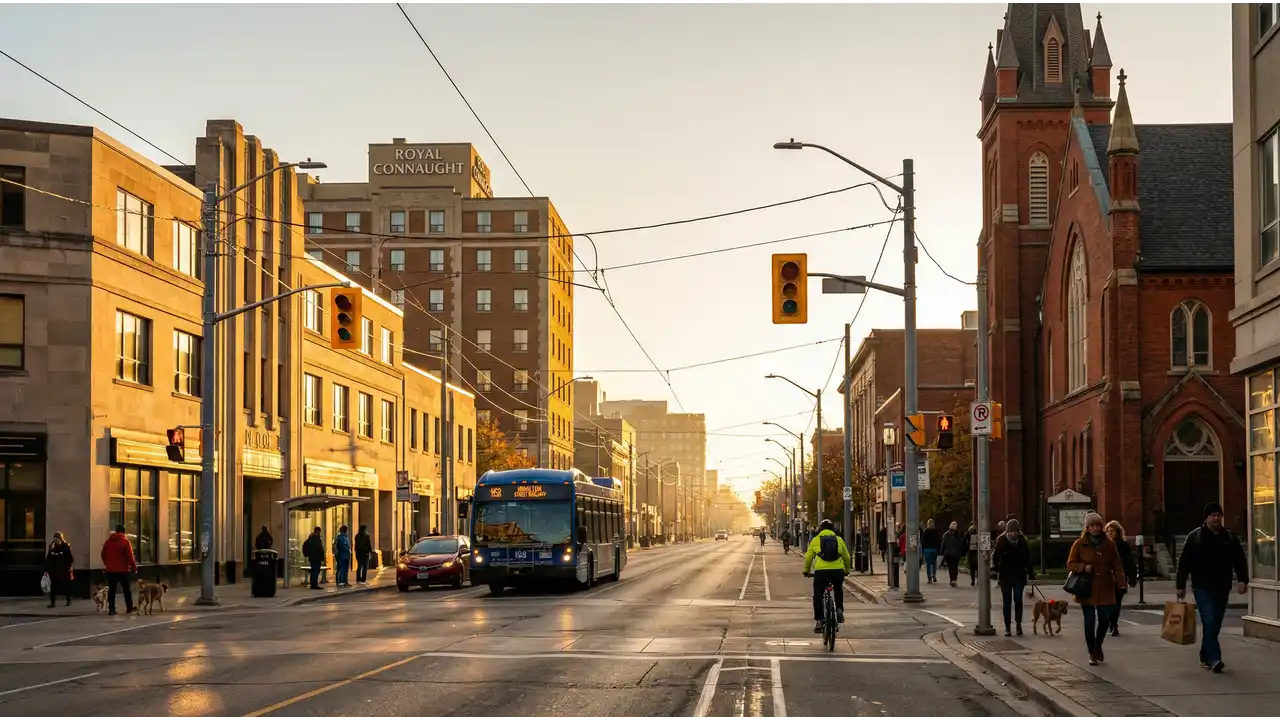
Hamilton sits at the western end of Lake Ontario, 40 kilometers southwest of Toronto. It's a former steel town that has shifted toward healthcare, education, and tech employment. The city has a working-class character with neighborhoods ranging from established residential areas to waterfront redevelopment zones. Winters are cold and snowy; summers moderate. The population is around 570,000. Daily life involves either car commuting or transit on HST buses. The downtown core has undergone selective revitalization, though many neighborhoods remain economical and functional rather than trendy.
💡 Local Insights
Hamilton ON · 2026
Hamilton's cost advantage comes from being outside Toronto's orbit while maintaining reasonable job access and transit links. Housing averages $1,219/month, driven by lower prices in established neighborhoods like Dundas, Ancaster, and parts of central Hamilton, though waterfront areas command premiums. Groceries run around $437/month for moderate eating habits at chains like Metro, Sobeys, and Walmart. Transportation is a major variable: car ownership is typical (fuel, insurance, maintenance run $400-600/month), but HST transit passes cost around $110/month. Food costs remain steady whether you're local or expat. What varies is housing search; expats sometimes overpay by targeting only new condos or central neighborhoods. Real savings appear when you rent in less gentrified zones like Glanbrook or east Hamilton and leverage the Go Transit connection to Toronto employment. Utilities typically add $150-200/month for a one-bedroom apartment.
Frequently Asked Questions
How much does it cost to live in Hamilton ON per month?
A moderate lifestyle in Hamilton costs around $2,575/month. This breaks down roughly as: housing $1,219, groceries $437, utilities $150-200, transport $150-300 (depending on car ownership vs transit), and remaining discretionary spending. The budget tier (around $1,545/month) cuts heavily into housing and transport by choosing roommates or relying entirely on transit. A comfortable lifestyle runs $3,991/month and assumes more dining out, newer housing, and car ownership. Actual costs vary by neighborhood and personal choices around transportation.
What is the average rent in Hamilton ON?
Average rent aligns with $1,219/month across Hamilton's neighborhoods. A one-bedroom apartment in central areas like downtown or near Hess Street runs $1,100-1,300/month. Two-bedrooms are typically $1,300-1,600/month. Peripheral neighborhoods like Dundas, Stoney Creek, or Ancaster offer one-bedrooms from $950-1,150/month. Waterfront locations and newer condos near the harbor push toward $1,400-1,700/month. Shared housing or basement apartments drop below $900/month but come with fewer amenities. Rental inventory is steady but competitive during summer. Most leases require first and last month's rent upfront plus a damage deposit.
Is Hamilton ON cheap to live in for expats?
Hamilton is genuinely affordable compared to Toronto, Vancouver, or major U.S. cities, but not a bargain destination. Rent at $1,219/month average is reasonable for Ontario but doesn't match Prairie or Atlantic Canada cities. Expats accustomed to U.S. Northeast or California find real cost relief here. Those from Europe (London, Berlin) may find housing comparable but transportation cheaper because transit is less developed and car-dependent. The advantage is stability: prices hold steady year to year, not subject to the speculation affecting Toronto. The trade-off is that Hamilton is a smaller labor market; most expat employment connects back to Toronto offices or remote work.
How much does food cost per month in Hamilton ON?
Groceries for one person average $437/month on a moderate budget. Staples: milk $3-4/liter, whole chicken $8-12, eggs $3-4/dozen, bread $2.50-3.50, fresh vegetables $1-3/lb depending on season. Budget-conscious shoppers using No Frills or Walmart Supercentre drop to $350-400/month. Eating out is moderate: casual lunch $12-16, coffee $3-5, dinner at a casual restaurant $18-28/person. Ethnic groceries (South Asian, Caribbean) are cheap and widely available on King Street West. No significant expat price premium on groceries compared to locals; markets are competitive.
What salary do you need to live comfortably in Hamilton ON?
A comfortable lifestyle runs $3,991/month, suggesting a gross income target of around $60,000-65,000/year to maintain after-tax expenses. This assumes housing of $1,200-1,500/month, regular dining out 2-3 times weekly, car ownership with insurance and fuel, and discretionary spending on entertainment and travel. A single earner at $55,000/year gross (roughly $42,000 net annually) lands in the moderate budget range. Dual-income households can live quite well here on combined $90,000+/year. Self-employed or contract workers should budget conservatively and account for quarterly tax payments.
How does the cost of living in Hamilton ON compare to other places?
Hamilton sits in the middle of Ontario's cost spectrum. A moderate lifestyle here runs $2,575 per month, with housing at $1,219 per month.
The nearby city of Mississauga is slightly cheaper overall at $2,425 per month, though its housing costs $1,371 per month, making it pricier for rent or mortgages despite lower general expenses. If you're comparing to other Canadian cities, Hamilton's costs are substantially lower than Toronto, where housing alone far exceeds the provincial average.
Internationally, Hamilton is more expensive than Mexico City, where a moderate lifestyle costs $1,925 per month. It's significantly cheaper than Hong Kong at $3,450 per month. For North American standards, Hamilton offers genuine affordability without sacrificing urban amenities like healthcare, transit, and employment options.
Yes, but with real constraints. This budget tier assumes housing around $800-950/month (roommates, basement apartment, or suburban rental), groceries at $350-380/month (discount stores, minimal eating out), and minimal transport costs (transit only, no car). Entertainment, travel, and dining out essentially disappear. This works for students, early-career workers, or those with an existing support network. It requires discipline and local knowledge to find affordable housing outside the prime rental market. Many who attempt this budget underestimate utilities and transportation once winter hits. It's viable but leaves no margin for emergency medical costs or job transitions.