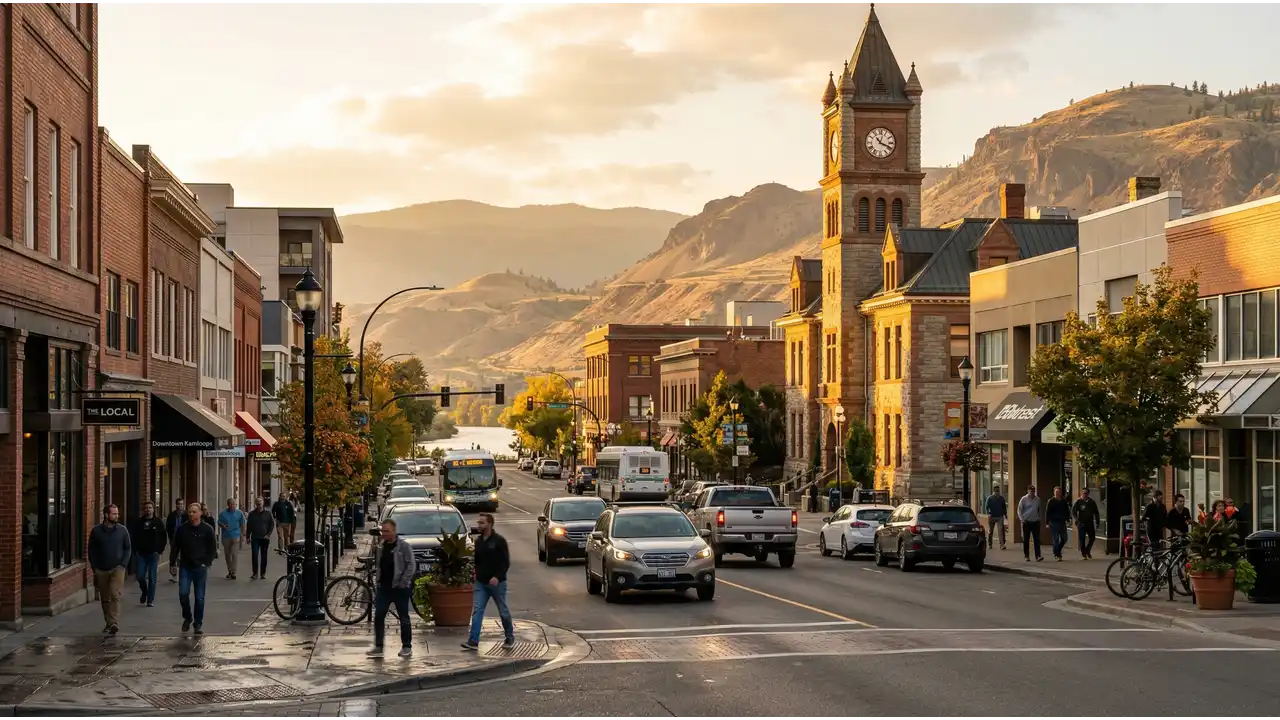
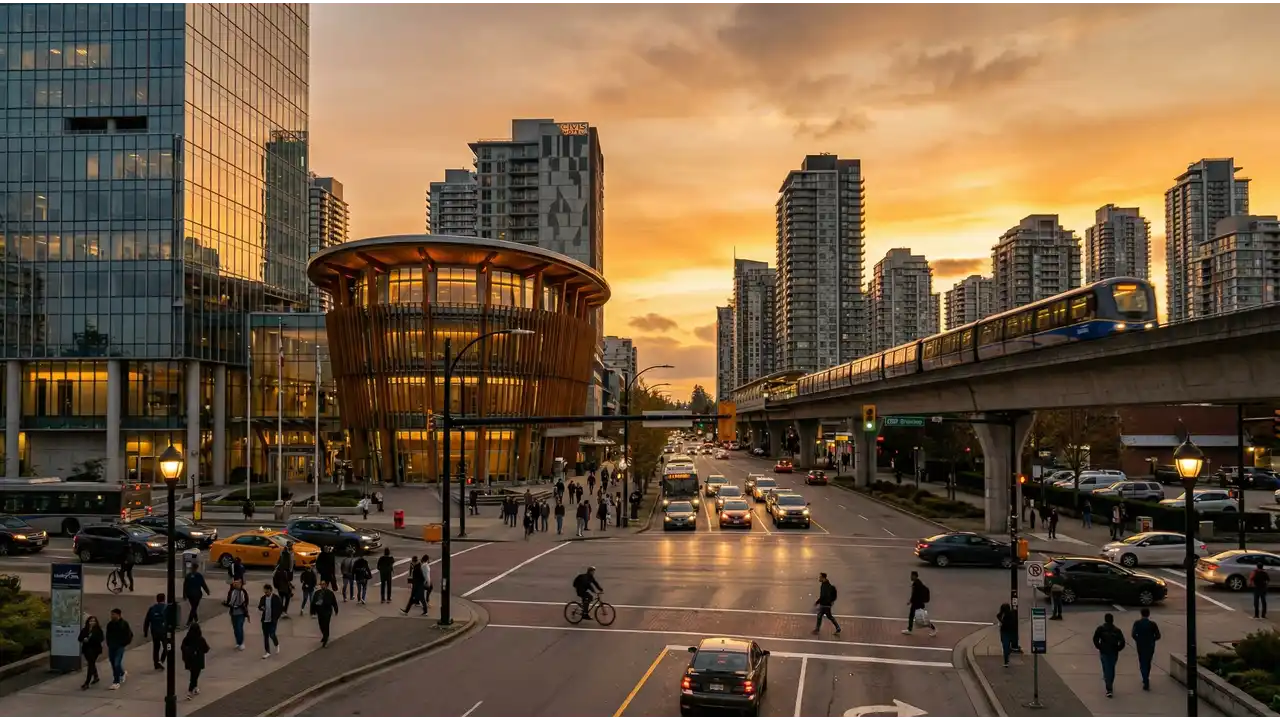
Kamloops is a mid-sized city of about 90,000 people in British Columbia's interior plateau, roughly halfway between Vancouver and the Alberta border. It sits at the confluence of two rivers in a semi-arid landscape with warm, dry summers and cold winters. The population is mixed: retirees drawn by the climate, families working in healthcare and education, outdoor enthusiasts, and a small but steady stream of expats. Daily life centers on the downtown core, shopping districts along Trans-Canada Highway, and easy access to hiking, skiing, and lakes. It's smaller and quieter than Vancouver or Calgary, with noticeably less rain and more sunshine than the coast.
💡 Local Insights
Kamloops BC · 2026
Kamloops is genuinely affordable for Western Canada. Housing averages $1,114/month, making it cheaper than Vancouver, Calgary, or Toronto. A one-bedroom apartment downtown runs $900-$1,100, while a two-bedroom in the same area sits around $1,200-$1,350. Shared housing or suburbs push prices lower. Groceries at $439/month are reasonable; expect to pay $2-$3 per liter of milk, $4-$5 for a pound of ground beef, and $1.50-$2 for a dozen eggs. Eating out costs less than major cities but more than rural areas. Transit is minimal; most residents drive. A used car from a private seller or lot will cost $8,000-$15,000. Gas runs roughly national average. Healthcare is free for residents. The biggest cost driver is heating during winter; budget $100-$150/month for natural gas in January and February. Expats report costs are predictable and lower than anticipated compared to Toronto or Vancouver.
Frequently Asked Questions
How much does it cost to live in Kamloops BC per month?
A moderate lifestyle in Kamloops costs $2,475/month. This breaks down to $1,114 for housing (rent or mortgage), $439 for groceries, and the remainder for utilities, transport, entertainment, and personal care. A tighter budget runs $1,485/month if you share housing, cook most meals, and minimize driving. A comfortable lifestyle with dining out and more discretionary spending reaches $3,836/month. Most residents fall in the moderate range; the actual cost depends heavily on whether you drive and eat out frequently.
What is the average rent in Kamloops BC?
Monthly housing costs average $1,114, which typically covers rent for a one-bedroom apartment downtown or a two-bedroom in outer neighborhoods. A one-bedroom downtown runs $900-$1,100/month; a two-bedroom $1,200-$1,350/month. Shared housing or basement suites drop to $700-$900/month. House rentals start around $1,400-$1,600/month. Buying is more affordable than renting; a modest home in outer Kamloops runs $350,000-$450,000, with mortgages often lower than equivalent rent after down payment. Landlords rarely require deposits larger than one month's rent. Competition is lighter than in major BC cities, giving renters more negotiating room.
Is Kamloops BC cheap to live in for expats?
Kamloops is moderately priced for expats coming from major North American cities. It is cheaper than Vancouver, Toronto, or Calgary but not as inexpensive as smaller Prairie cities. Housing at $1,114/month is the main advantage. Utilities, food, and transport align with or slightly undercut national Canadian averages. Expats accustomed to US costs will find Kamloops comparable to mid-sized American cities like Missoula or Bozeman. The trade-off is a smaller social scene and fewer job opportunities in specialized fields. Healthcare is free for permanent residents. The climate is drier and sunnier than coastal BC but colder in winter. Expats typically settle within 3-6 months; the cost shock is mild if you're used to major metros.
How much does food cost per month in Kamloops BC?
Groceries average $439/month for one person on a moderate diet. A liter of milk costs $2-$2.50, a dozen eggs $1.50-$2, ground beef $4-$5 per pound, and chicken breast $3.50-$4.50 per pound. Vegetables and fruit are cheaper in summer when local farms supply farmers' markets. Eating out is moderate: a casual lunch runs $12-$16, dinner at a mid-range restaurant $18-$28 per person. Coffee is $2-$3, a beer at a bar $5-$7. Supermarkets like Save-on-Foods and Walmart dominate; independent grocers are fewer. Families or meal planners can reduce grocery costs to $350-$400/month by buying bulk and seasonal produce.
What salary do you need to live comfortably in Kamloops BC?
A comfortable lifestyle costs $3,836/month, requiring a gross income of roughly $55,000-$60,000 annually (depending on taxes and deductions). This supports regular dining out, a reliable car, entertainment, and modest travel. Couples can comfortably live on $65,000-$75,000 combined gross income. Homeowners with a mortgage instead of rent may need more, though lower housing costs offset this. Most full-time jobs in Kamloops pay $35,000-$55,000 annually; healthcare, education, and trades often offer higher wages. Part-time or gig work is common but typically pays $16-$20/hour. The comfortable tier assumes you own or share a vehicle; transit-only living would lower the threshold to $3,200-$3,400/month.
How does the cost of living in Kamloops BC compare to other places?
Kamloops sits in the middle of British Columbia's cost spectrum. A moderate lifestyle runs $2,475 a month, with housing at $1,114. That makes it noticeably cheaper than Vancouver, where the same lifestyle costs $2,875 monthly and housing alone runs $1,740. Compared to Toronto, Kamloops is roughly equivalent, with Toronto at $2,600 for a moderate budget and $1,462 for housing. If you're moving from Edmonton, expect to pay more. Edmonton's moderate lifestyle costs $1,900 monthly with housing at $835, so Kamloops will feel like a step up in price. The main difference comes down to housing. Kamloops is more affordable than coastal BC but less of a bargain than Alberta's capital. Your money stretches further here than in either Vancouver or Toronto.
Yes, but with careful choices. The budget tier of $1,485/month assumes shared housing (around $600-$700/month), groceries at $400/month, minimal transport costs, and no eating out. A room in a shared house is easier to find than a solo apartment at this price. You'd need to cook most meals, use transit or bike, and skip regular entertainment spending. Student or part-time worker housing is often below $700/month. This budget works if you receive student loans, have a partner with income, or access subsidized housing. Working full-time on minimum wage (currently $15.65/hour in BC) yields roughly $2,000-$2,100/month gross, making $1,485 tight but possible with roommates and discipline. Healthcare is free, reducing emergency costs.