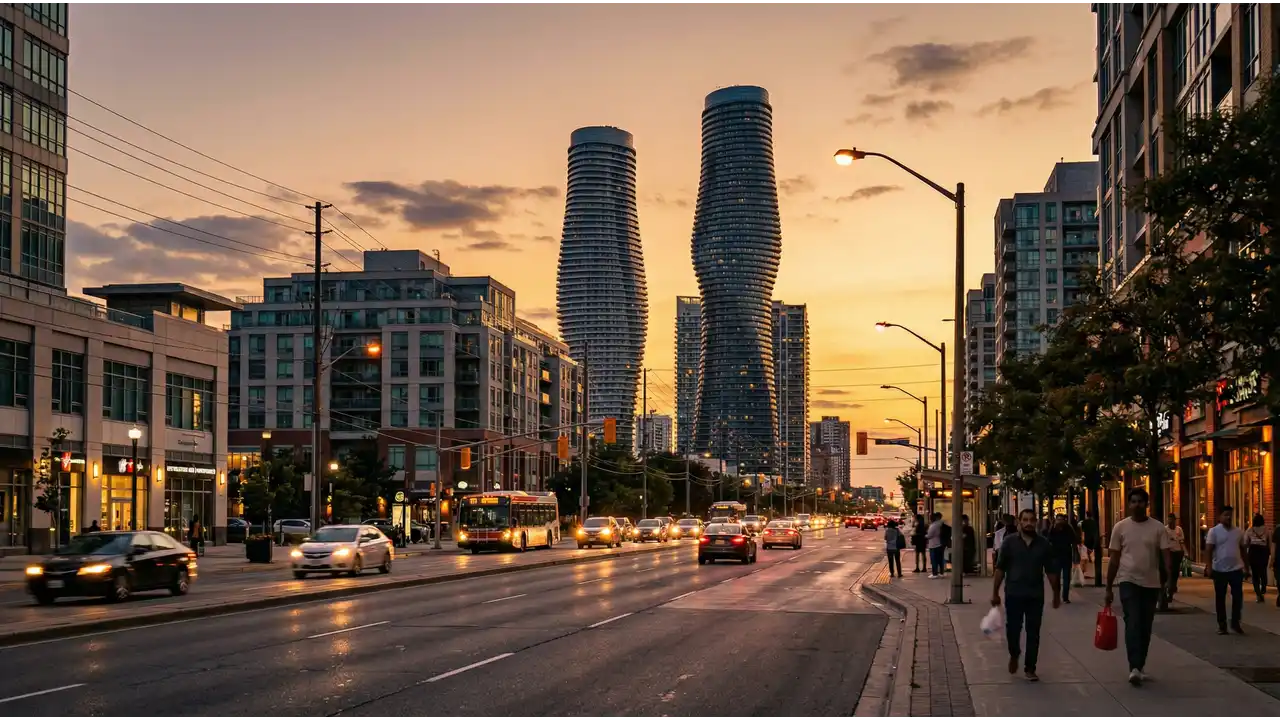
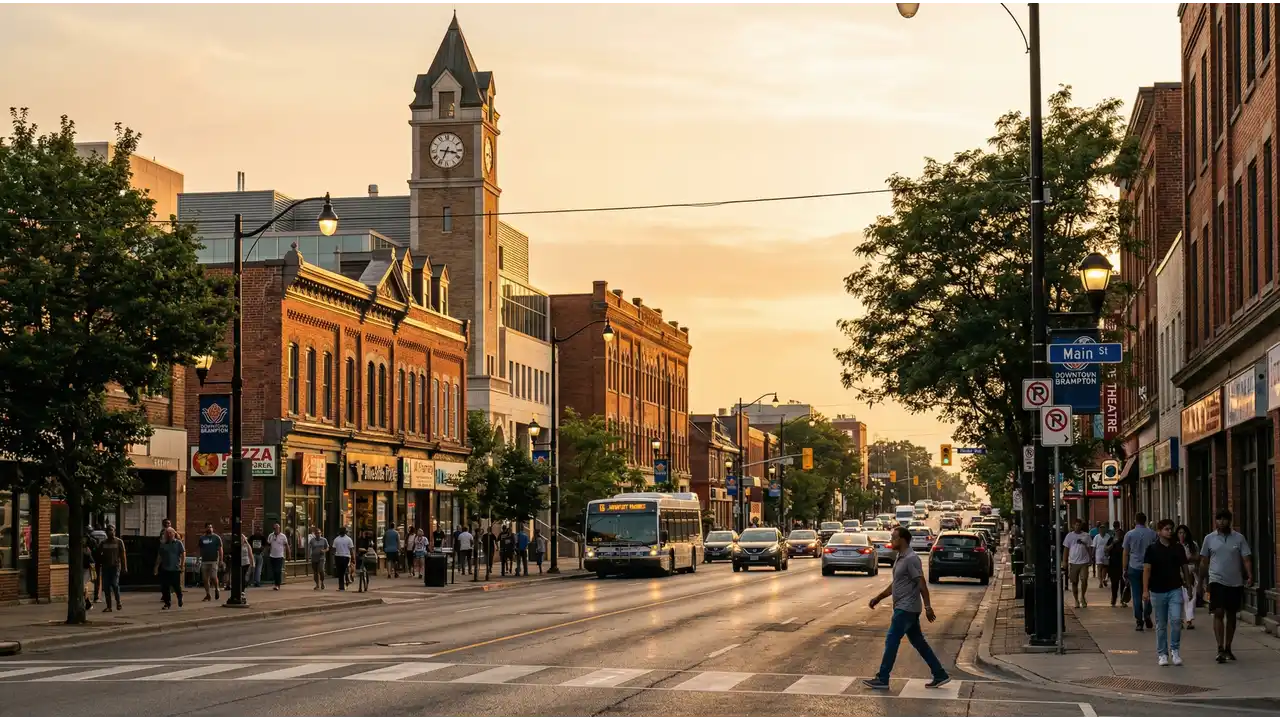
Mississauga is Canada's sixth-largest city, located in Ontario west of Toronto along Lake Ontario. It's primarily a residential and commuter community with a growing downtown core and suburban neighborhoods. The population is diverse, with significant South Asian, Chinese, and European communities. Daily life centers on car commuting, though transit has expanded. The climate is humid continental: warm summers (75-80°F), cold winters (25-35°F) with heavy snow. Most residents work in Toronto or locally in tech, finance, and healthcare. The waterfront offers parks and trails. Shopping, dining, and entertainment concentrate in downtown Mississauga, Square One mall, and scattered plazas throughout neighborhoods.
💡 Local Insights
Mississauga · 2026
Housing dominates Mississauga's cost structure at $1,371/month, reflecting Ontario's tight rental market. One-bedroom apartments in the downtown core or near transit run $1,300-$1,500, while older suburban units go lower. Buying is steeper: detached homes average $700,000+. Groceries at $340/month are reasonable for Canada, slightly below Toronto. No-name brands at Loblaws, Metro, or discount chains like Food Basics cut costs. Transit is available via MiWay local buses and GO Transit regional rail to Toronto (around $150-$200/month for passes). Expats should budget extra for car ownership if not downtown: insurance, gas, and parking add $400-$600 monthly. Utilities run $150-$200 in moderate weather. Property taxes are notably high on owned homes (around 0.6-0.7% of property value annually). Mississauga is neither cheap nor expensive by Canadian standards, sitting between affordable prairie cities and Toronto's premium.
Frequently Asked Questions
How much does it cost to live in Mississauga per month?
A moderate lifestyle in Mississauga costs around $2,425/month. Housing is the largest expense at $1,371/month. Groceries run about $340/month for a single adult buying staples. Transportation, utilities, and dining out add another $400-$500. This covers a one-bedroom apartment, regular transit or modest car costs, eating at casual restaurants once or twice weekly, and basic entertainment. The budget tier ($1,455/month) means cutting out restaurants and keeping utilities minimal. The comfortable tier ($3,759/month) allows for larger housing, frequent dining, and discretionary spending.
What is the average rent in Mississauga?
Average rent sits around $1,371/month based on current market data. One-bedroom apartments in downtown Mississauga or near Square One typically rent for $1,300-$1,500. Older, suburban one-bedrooms can run $1,100-$1,300, particularly in neighborhoods further from the core. Two-bedroom units average $1,600-$1,850. Waterfront or newly built units push $1,600+. Landlords often require first and last month's rent upfront plus a damage deposit. The market is competitive; places near GO Transit stations rent faster and command premiums. Utility costs (hydro, water, heat) add $120-$180/month depending on the unit and season.
Is Mississauga cheap to live in for expats?
Mississauga is moderately priced for a Canadian city but not cheap globally. Rent at $1,371/month is lower than downtown Toronto but higher than many U.S. cities outside major metros. Expats accustomed to South Asian or European costs will find it expensive; those from San Francisco, London, or Singapore will find it reasonable. The major cost shock is usually car ownership: insurance, gas, and parking can run $500-$600/month if you don't live downtown. Healthcare is free, reducing that burden. Groceries are pricier than the U.S. South or Southeast Asia. Expats should factor in provincial income tax (5.05% on first $51,000 roughly) and property taxes if buying. Employer sponsorship often includes housing allowances that offset rent.
How much does food cost per month in Mississauga?
Groceries for one person average $340/month, or roughly $80/week. A dozen eggs costs $3-$4, a liter of milk $2.50-$3, a loaf of bread $2-$3, chicken breast $10-$12/pound. Loblaws, Metro, and Food Basics are common chains; Costco and Walmart offer bulk and discount options. Eating out is pricier: casual dining (burger, fries, drink) runs $12-$16; mid-range restaurants $15-$25 per entree. A monthly food budget of $400-$450 comfortably covers groceries plus occasional takeout. Mississauga's ethnic markets (South Asian shops, Chinese groceries along Kennedy Road) often undercut supermarket prices on produce and specialty items. Alcohol is government-regulated and expensive ($15-$25/bottle for wine, $40+ for spirits).
What salary do you need to live comfortably in Mississauga?
A comfortable lifestyle costs around $3,759/month, suggesting a gross annual salary of roughly $60,000-$65,000 after taxes (or about $50,000 net annually). This assumes single occupancy. Couples can often reduce per-person costs by sharing housing. A $60,000 gross salary typically nets $3,600-$3,800 monthly after federal and Ontario provincial tax. This covers a one-bedroom apartment or modest two-bedroom, regular dining out, car ownership with insurance, and modest entertainment. For renters without dependents, $55,000-$60,000 is workable; for homeowners or families, budget $75,000+. Self-employed or contract workers should add 15-20% to account for benefits and tax variability.
How does the cost of living in Mississauga compare to other places?
Mississauga's moderate lifestyle runs $2,425 per month, with housing at $1,371 per month. This puts it slightly above Ottawa, where a moderate lifestyle costs $2,350 per month and housing runs $1,288 per month. You'll find Mississauga considerably more affordable than Vancouver, where a moderate lifestyle reaches $2,875 per month and housing climbs to $1,740 per month. If you're comparing to international options, Mexico City is noticeably cheaper, with a moderate lifestyle at $1,925 per month and housing at $1,140 per month. Mississauga sits in Canada's middle range for major cities. Your expenses will depend heavily on your neighborhood choice and whether you rent or own, but the baseline moderate budget accounts for a stable middle-class lifestyle including transportation and dining out occasionally.
Yes, but with significant constraints. The budget tier of $1,455/month is tight. Allocate $1,100-$1,250 for a shared one-bedroom or bachelor apartment in a suburban neighborhood away from transit. This leaves $200-$350 for groceries, transportation, utilities, and phone. You'll need to shop sales at discount grocers (Food Basics, No Frills), cook at home almost entirely, and avoid eating out. Car ownership is not feasible; you must use MiWay transit or live walkable to work. Utilities must be minimized (bundle internet/phone). This budget works for students, recent arrivals, or those with employer housing subsidies. Any unexpected cost (medical, car repair, moving) breaks it. It's survivable but leaves no margin; most people need $1,800+ to avoid financial stress.