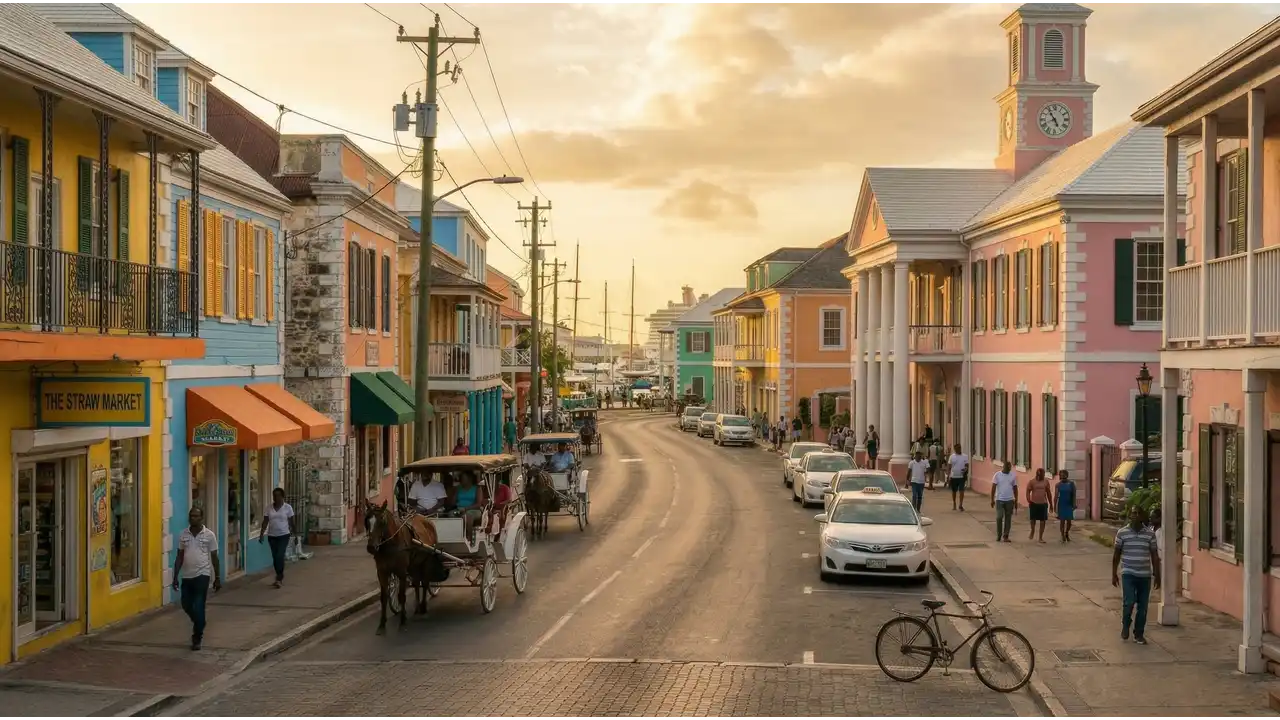
Nassau is the capital and economic center of the Bahamas, sitting on New Providence Island. It functions as a financial hub and cruise tourism gateway, which shapes both its economy and daily life. The city has a year-round tropical climate with hurricane season June through November. Residents include Bahamian nationals, Caribbean expatriates, and international workers drawn by financial services and tourism sectors. Daily life centers on downtown commerce, beachfront areas, and suburban residential zones. Infrastructure relies heavily on cars, though jitneys (shared minibuses) serve fixed routes. The pace is slower than North American cities but faster than smaller Caribbean islands. Cost pressures come from tourism economy markup and import-dependent supply chains.
💡 Local Insights
Nassau · 2026
Nassau's cost structure reflects its role as a tourism and financial services hub. Housing costs are significant. The $2,058/month figure represents the Bahamas national housing average that Nassau inherits, as no separate Nassau rent measurement exists. In practice, renters encounter considerable variation. A one-bedroom apartment in central Nassau or nearby residential areas typically runs $1,200 to $1,800/month for modest furnished units; beachfront or premium downtown spaces exceed $2,500/month. Buying or renting from international landlords often carries higher markups than local transactions. Groceries reflect import-heavy supply chains. The $505/month baseline assumes modest local shopping; a single chicken breast costs $4 to $6, a liter of local milk runs $3 to $4. Eating out is expensive compared to food shopping. One meal at a mid-range restaurant costs $15 to $25. Transport by private vehicle requires fuel ($4 to $5 per gallon) and car maintenance; jitneys cost $1.50 per ride but run limited routes. International schools and private healthcare add major costs not captured in the moderate budget. Expats often pay 20-40 percent more than locals for equivalent services due to currency assumptions and targeted pricing.
Frequently Asked Questions
How much does it cost to live in Nassau per month?
A moderate lifestyle in Nassau costs $3,625/month. This breaks down roughly as housing $2,058/month (the Bahamas national figure), groceries $505/month, with remaining costs split across utilities, transportation, dining out, and miscellaneous expenses. The budget tier runs $2,175/month for those minimizing costs; the comfortable tier reaches $5,619/month for those including more frequent dining, entertainment, and services. These figures assume a single adult or couple; family costs scale with school fees and larger housing needs.
What is the average rent in Nassau?
The $2,058/month housing figure shown is the Bahamas national average that Nassau inherits, not a separate local rent measurement. Nassau has no independently measured rent baseline. In practice, renters find one-bedroom apartments in residential neighborhoods or central areas ranging $1,200 to $1,800/month for furnished units. Beachfront, premium downtown, or recently renovated properties run $2,000 to $3,500/month or higher. Furnished short-term rentals cost more than unfurnished long-term leases. Security deposits, typically one month's rent, are standard. Prices vary significantly by neighborhood and landlord nationality, with expatriate-owned properties generally commanding higher rates than locally-owned units.
Is Nassau cheap to live in for expats?
No. Nassau ranks as expensive for the Caribbean and significantly exceeds most North American mid-sized cities. For expats accustomed to US costs, housing and dining represent the sharpest shocks. Food import markups of 30-50 percent above US supermarket prices are common. Utilities, international schools, and healthcare all carry premium pricing targeting tourism and financial sectors. Expats moving from London, Toronto, or Singapore find Nassau moderately priced. Those relocating from smaller Caribbean islands or Central America discover substantial cost increases. Salary expectations for expats typically start $60,000 to $80,000 annually, though positions exist across income levels. Long-term expats often find niches (real estate, tourism management, professional services) where compensation reflects local costs.
How much does food cost per month in Nassau?
Groceries average $505/month for modest shopping. A typical weekly trip to a supermarket costs $30 to $45. Specific item costs: eggs run $5 to $7/dozen, chicken breast $4 to $6/pound, ground beef $6 to $8/pound, rice $1.50 to $2/pound, fresh vegetables $2 to $4 per item depending on season and import source. Local fresh produce is cheaper when available but highly seasonal. Imported foods carry 40-60 percent markups versus US prices. Eating out runs $15 to $25 per meal at casual restaurants; higher-end dining reaches $40 to $60/person. Local fast food (conch salad, fried grouper) is cheaper than franchised chains. Shopping at discount stores or purchasing directly from local fishermen can reduce costs somewhat.
What salary do you need to live comfortably in Nassau?
A comfortable lifestyle costs $5,619/month, suggesting annual gross income around $75,000 to $90,000 for stable expenses. This tier includes regular dining out, entertainment, vehicle ownership, and discretionary spending. Factor in taxes (Bahamas has no income tax but levies VAT at 12 percent on most purchases). Housing alone at the comfortable level might reach $2,500 to $3,500/month in better neighborhoods or larger units. Healthcare, international school fees for children, and travel can push comfortable budgets higher. Expats in professional roles (finance, tourism management, consulting) typically earn $70,000 to $150,000+, which aligns with comfortable living. Those on $40,000 to $60,000 annual salary find Nassau tight and often share housing or accept trade-offs in neighborhood quality.
How does the cost of living in Nassau compare to other places?
Nassau runs $3,625 a month for a moderate lifestyle, with housing consuming $2,058 of that. This puts it squarely in the middle-to-upper range globally. Tel Aviv, a peer city, costs $3,400 monthly, making it slightly cheaper overall, though housing there runs $1,812 versus Nassau's $2,058. If you're coming from Santo Domingo, expect to spend roughly triple: Santo Domingo runs $1,325 monthly with housing at $623. On the other end, Zurich is noticeably pricier at $4,625 monthly, with housing alone hitting $2,563. Nassau's cost is driven heavily by imported goods, tourism-driven prices, and limited local production. Whether it feels expensive depends on your origin. For North American and European visitors, it's reasonable. For Caribbean relocators from cheaper islands or mainland Latin America, it represents a significant jump.
Yes, but with significant constraints. The $2,175/month budget tier requires disciplined spending. Housing must stay under $1,200/month (a small one-bedroom in an outlying neighborhood or shared housing). Groceries demand $400 to $450/month of careful shopping at discount stores and local markets. Transportation relies on jitneys and walking; car ownership is impractical. Dining out shrinks to occasional local spots, not restaurants. Utilities, phone, and internet compress to $80 to $100/month. Entertainment and entertainment spending disappear. Medical emergencies become urgent problems without private insurance. This budget works for single individuals accustomed to frugal living, local workers with family support systems, or those combining it with secondary income. Expats on this level report loneliness and social isolation; local networks provide crucial informal support. Students and young professionals occasionally manage it; families cannot.