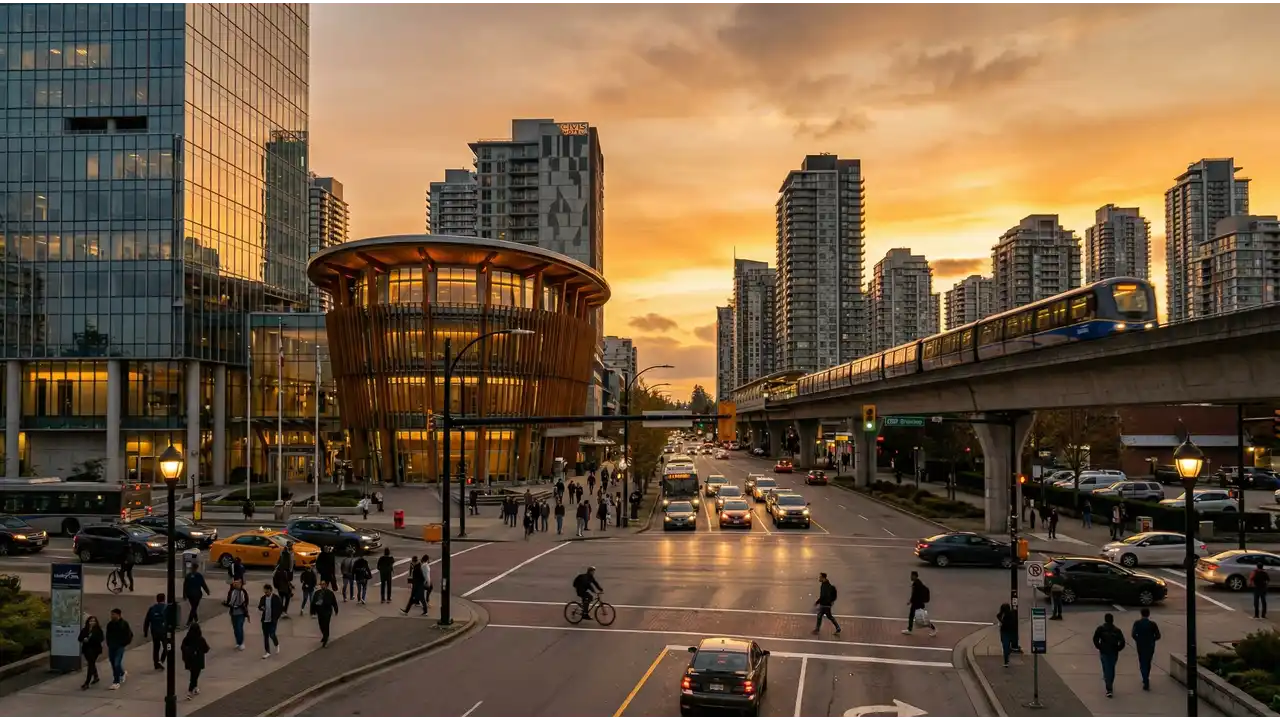
Surrey is British Columbia's second-largest city, located about 30 kilometers southeast of Vancouver. It's a sprawling, car-dependent community with significant South Asian, Chinese, and Punjabi populations, reflecting waves of immigration over the past 30 years. Daily life revolves around driving between shopping centers, residential subdivisions, and industrial parks. The city has no light rail, though bus transit exists. Winters are mild and wet; summers warm and dry. Housing stock is mostly single-family homes and low-rise apartments built from the 1970s onward. The city appeals to families seeking affordable space near Vancouver without downtown density.
💡 Local Insights
Surrey BC · 2026
Surrey's affordability relative to Vancouver proper comes from distance and car dependency. A moderate lifestyle costs $2,575/month. Housing at $1,219/month reflects the market for modest two-bedroom rentals in older complexes or shared homes in neighborhoods like Whalley or Guildford. New construction commands higher rents but remains cheaper than Vancouver proper. Groceries run $437/month for a single person buying at chains like Costco, Save-on-Foods, or ethnic markets offering competitive produce and staples. Transit is limited, so most residents budget for a car, adding $400-600/month in payments, insurance, and fuel. Expats often find Surrey cheaper than Australian cities (Sydney, Melbourne) but more expensive than Southeast Asia or Eastern Europe. New arrivals should expect to spend significantly on transportation and underestimate distances; the city sprawls across 317 square kilometers.
Frequently Asked Questions
How much does it cost to live in Surrey BC per month?
A moderate lifestyle costs $2,575/month. This covers rent ($1,219/month), groceries ($437/month), utilities, transportation, dining out occasionally, and modest entertainment. A tighter budget runs $1,545/month, cutting back on dining and entertainment. A comfortable lifestyle sits at $3,991/month, allowing for dining out regularly, car payments, and discretionary spending. These figures apply to a single adult; families with children face higher costs, particularly housing and childcare.
What is the average rent in Surrey BC?
Average rent is $1,219/month, reflecting typical two-bedroom apartment rentals. A one-bedroom in older complexes runs $950-1,100/month; two-bedrooms in similar buildings, $1,100-1,350/month. New purpose-built rentals are scarce and cost $1,400-1,700/month for two bedrooms. Single-family home rentals range $1,300-1,700/month. Whalley and Guildford are most affordable; South Surrey near the US border is pricier. Most rentals require first and last month's deposit plus references, and vacancy rates are low.
Is Surrey BC cheap to live in for expats?
Surrey is affordable compared to Vancouver, Toronto, or Australian cities, but not cheap by global standards. Expats from Southeast Asia or South Asia often find housing and food expensive. Those from Western Europe or Australia may see cost savings. A key drawback is transportation; car ownership adds $400-600/month, negating some housing savings versus denser cities. Expat communities are established (Indian, Chinese, Filipino, Filipino), so networks exist. However, limited walkability and transit make car dependency less optional than in other North American cities.
How much does food cost per month in Surrey BC?
Groceries average $437/month for one person buying staples at major chains. A dozen eggs costs $3-4; a liter of milk, $2.50-3.50; chicken breast, $8-11 per pound. Ethnic markets (South Asian, Chinese, Filipino) offer competitive produce and staples 10-20 percent cheaper than mainstream supermarkets. Eating out is moderate: a casual lunch is $12-16; dinner at a mid-range restaurant, $18-30. Coffee at a cafe is $3-4.50. Grocery inflation has cooled but remains above historical averages.
What salary do you need to live comfortably in Surrey BC?
A comfortable lifestyle costs $3,991/month, suggesting an annual gross income of around $60,000-65,000 (accounting for taxes). This covers rent, food, utilities, car ownership, regular dining out, and modest savings. Couples can combine incomes; many households run two jobs. A single-income household at $50,000 annually is tight; $60,000+ is more realistic for comfortable living. Renters need to show income at 3-3.5 times monthly rent to qualify for leases, typically $3,600-4,200 annually.
How does the cost of living in Surrey BC compare to other places?
Surrey, British Columbia sits in the moderate range for Canadian cities. A moderate lifestyle costs $2,575 per month here, with housing running $1,219 monthly. That places it slightly higher than Ottawa, where the same lifestyle costs $2,350 per month, though Ottawa's housing is marginally pricier at $1,288. Quebec City is notably cheaper at $1,975 overall, driven by housing at just $974. If you're coming from the Caribbean, expect significant sticker shock: Nassau runs $3,625 monthly with housing at $2,058. Surrey's cost sits between the affordable Quebec option and the pricier Nassau market, making it a reasonable choice for those relocating within Western Canada while remaining more expensive than most Eastern Canadian alternatives.
Yes, but carefully. This budget tier requires a one-bedroom apartment around $900-1,050/month, leaving $595 for food ($437/month), utilities ($80-100/month), phone ($50-60/month), and transit ($85/month or a car's fuel). No buffer for car payments, insurance, or dining out. This works best without a vehicle, relying on SkyTrain access (limited) or bus transit. Families cannot live on this budget. Renters are vulnerable to rent increases; any spike forces difficult choices. This tier suits single adults sharing housing or without vehicle needs, but most residents find it restrictive.