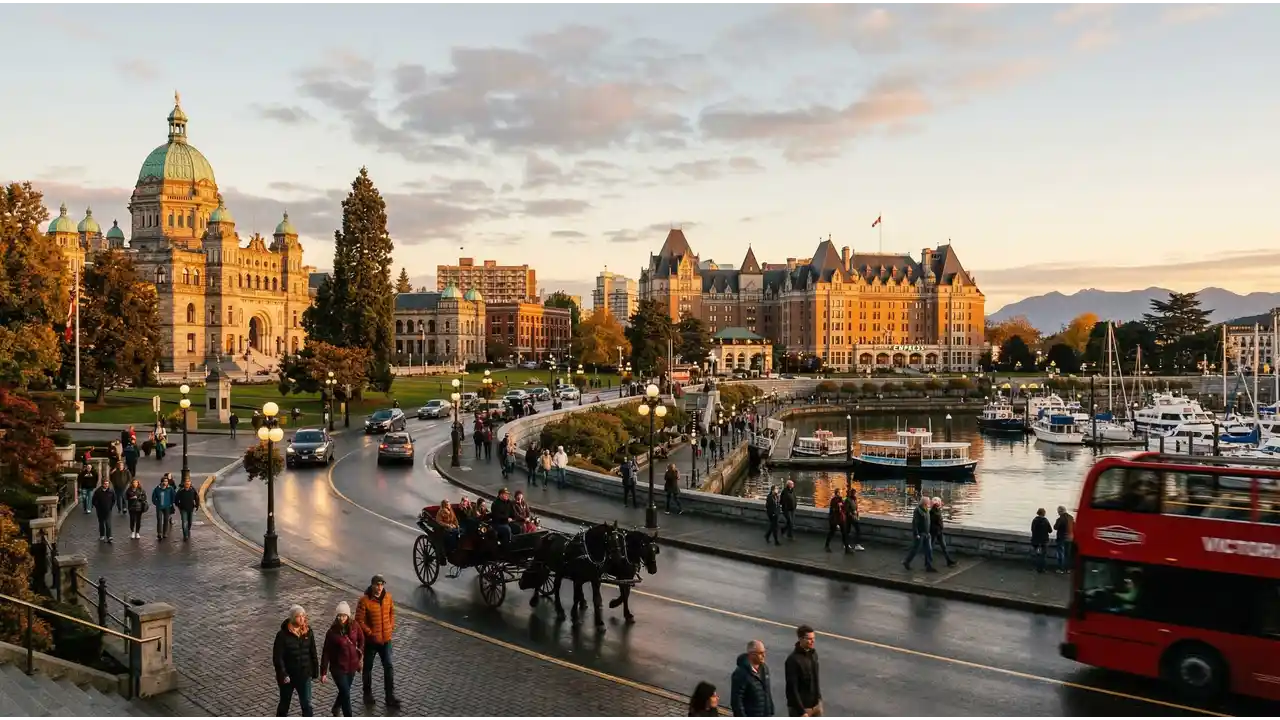
Victoria is British Columbia's capital, a city of roughly 85,000 on Vancouver Island's southern tip. The waterfront defines daily life here, with the Inner Harbour at the center of downtown. The climate is mild by Canadian standards (rarely below freezing, occasional rain), which brings retirees and remote workers from colder regions. Most residents are Canadian, with a visible expat population from Australia, UK, and Europe. Daily rhythms revolve around local coffee culture, walkable neighborhoods, and proximity to beaches and hiking trails within 30 minutes. The city has a slower pace than Vancouver, with fewer high-rise developments and more heritage character in older neighborhoods like James Bay and Fernwood.
💡 Local Insights
Victoria · 2026
Victoria's cost of living at $2,125 per month for a moderate lifestyle sits well above smaller Canadian prairie cities but below Vancouver or Toronto. Housing is the largest driver of total costs, with waterfront premiums and limited supply pushing rents higher than inland alternatives. Neighborhoods closer to the harbor (James Bay, Downtown) command 15-25% premiums over outer areas like Fernwood or Langford (a suburb 20 minutes east). Renters find fewer vacancies in summer, and landlord-tenant regulations favor tenants, which can slow turnover. Groceries track slightly above the Canadian average due to island transport costs and limited competition, though weekly specials at Save-On-Foods and Costco keep basics manageable. Transit (BC Transit) costs $95 monthly for unlimited bus access, but many residents walk or cycle year-round. Expats often underestimate heating and property insurance costs in winter. Local wages tend to trail Vancouver by 8-12%, a real consideration for salaried workers.
Frequently Asked Questions
How much does it cost to live in Victoria per month?
A moderate lifestyle costs around $2,125 per month. Rent typically runs $1,100-$1,400 for a one-bedroom apartment downtown or near the harbor; $900-$1,100 in outer neighborhoods. Groceries for one person average $280-$320 monthly. Utilities (electricity, heat, water, internet) range from $150-$220 in winter months, lower in summer. Transit or gas for a car adds $95-$200 monthly. Dining out, entertainment, and personal care account for the remainder. This figure assumes no car ownership in the budget tier; car costs would add $400-$600 monthly for insurance, fuel, and maintenance.
What is the average rent in Victoria?
One-bedroom apartments in central neighborhoods (Downtown, James Bay, Cook Street Village) rent for $1,200-$1,450 monthly. Two-bedroom units in the same areas run $1,500-$1,900. Outer neighborhoods like Fernwood, Oaklands, or Saanich offer one-bedrooms at $950-$1,150 and two-bedrooms at $1,250-$1,500. Langford and other suburbs 15-25 minutes away drop to $900-$1,200 for one-bedrooms. Furnished short-term rentals cost 30-50% more. Vacancy rates are typically tight (2-3%), especially May through August. Landlords often require first and last month's deposit plus a reference check.
Is Victoria cheap to live in for expats?
Victoria is moderately priced compared to global expat hubs, but not cheap compared to most of Canada. For Australians or UK expats accustomed to Sydney or London rental levels, it feels affordable. For Americans from major metros, it's slightly cheaper than Seattle or Portland. However, compared to Southeast Asia or Mexico, costs are significantly higher. The real advantage for expats is the stable legal environment, Canadian services, and English-speaking population. Most expats find their budget stretches further if they avoid waterfront neighborhoods and embrace transit or cycling. Visa requirements matter: working remotely requires either permanent residency or a valid work permit; tourists cannot legally work.
How much does food cost per month in Victoria?
Groceries for one person average $280-$320 monthly at mainstream supermarkets (Save-On-Foods, Thrifty Foods, Costco). Specific costs: chicken breast around $8-$10/pound, ground beef $5-$7/pound, milk $4-$5/liter, bread $2.50-$3.50/loaf, eggs $3-$4/dozen. Restaurant meals run $16-$28 for casual dining, $40-$70 for mid-range. Coffee culture is strong; a latte costs $5-$6. The Farmers Market (May-October, Saturdays at Market Square) offers seasonal produce at competitive prices. Eating out regularly pushes food costs to $600-$800 monthly. Island transport adds roughly 10% to grocery prices versus mainland Canada.
What salary do you need to live comfortably in Victoria?
A comfortable lifestyle costs around $3,294 per month, suggesting a gross monthly income of $4,400-$4,900 (to account for taxes and benefits). That translates to roughly $53,000-$59,000 annually before tax. This tier includes a one-bedroom in a desirable neighborhood, regular dining out (4-6 times weekly), entertainment and travel, a reliable vehicle or premium transit use, and modest savings. Those earning $60,000-$75,000 gross annually can live comfortably with breathing room for emergencies and savings. Keep in mind that BC provincial and federal income taxes reduce take-home pay by 20-30% depending on income level. Self-employed individuals or freelancers should budget conservatively.
How does the cost of living in Victoria compare to other places?
Victoria sits between Vancouver ($2,400-$2,600 moderate tier) and smaller BC cities like Kelowna ($1,800-$1,950). Compared to US West Coast equivalents, it's cheaper than Seattle ($2,450) or Portland ($2,300), comparable to mid-sized cities like Boise. For Canadians moving from the prairies (Calgary, Winnipeg at $1,650-$1,750), Victoria feels noticeably pricier. Internationally, it's significantly more expensive than Mexico City ($1,400) or Lisbon ($1,550), but cheaper than London ($3,100) or Sydney ($2,900). The value proposition for expats depends heavily on visa status, employment prospects, and preference for four-season weather and English-speaking services.
Can you live in Victoria on $1,275/month?
Yes, but with strict trade-offs. Budget living requires a roommate situation (shared one-bedroom or two-bedroom split), keeping rent to $600-$700. Groceries drop to $200-$240 monthly via bulk buying and cooking at home. Transit costs $95. That leaves roughly $180-$280 for utilities, phone, and personal care. This budget cuts out dining out, entertainment, travel, and car ownership. It works best for students, house-sitters, or those with free accommodation options. Most people sustain it for 3-6 months before social and lifestyle costs push the monthly spend up. Those with dependents or health needs will find $1,275 insufficient.
💰 What's Your Budget?
Enter your monthly budget and see what lifestyle you can afford in Victoria.