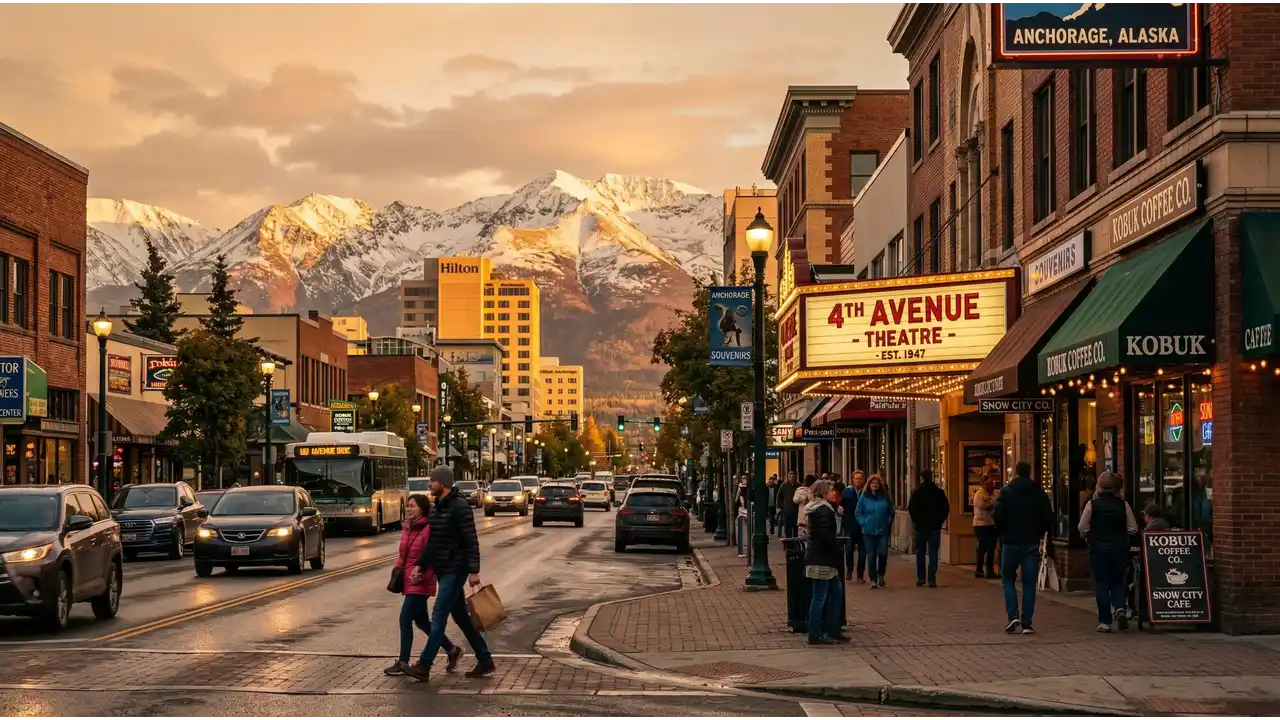
Anchorage is Alaska's largest city, home to about 290,000 people on a peninsula surrounded by the Chugach Mountains and Cook Inlet. The climate is subarctic: winters are long and dark (about 5 hours of daylight in December), summers brief and mild with nearly 24-hour daylight in June. Daily life revolves around outdoor recreation, fishing, and hiking. The population is diverse, with significant military presence from nearby Fort Richardson and Elmendorf Air Force Base. Most residents drive; public transit is minimal. Winters require genuine preparation: heating costs spike, vehicle maintenance becomes critical, and many people use snow tires. Summer attracts tourists and temporary workers. The city feels sprawling and car-dependent, with distinct neighborhoods spreading across the valley.
💡 Local Insights
Anchorage AK · 2026
Anchorage's cost structure is driven by remoteness and climate. Everything ships in, raising prices on groceries and goods. Housing averages $1,282 per month, reflecting a mix of rentals and ownership; neighborhoods like Midtown and Downtown command higher rates, while South Anchorage and Eagle River offer more moderate options. Groceries run $675 monthly for a moderate diet, roughly 20 percent higher than the continental US average according to BLS data, because nearly all food is imported. Heating costs are substantial in winter, often $150 to $250 monthly depending on efficiency and fuel type. Public transit consists of a limited bus system (Municipality of Anchorage People Mover); most residents own vehicles, factoring in gas, maintenance, and winter tires. Expats often find costs higher than expected, though less extreme than Juneau or Fairbanks. Locals and newcomers pay the same prices. Budget for seasonal variation: summer and winter have markedly different expenses.
Frequently Asked Questions
How much does it cost to live in Anchorage AK per month?
A moderate lifestyle costs $3,375 per month. This breaks down to roughly $1,282 for housing (rent or mortgage), $675 for groceries, plus utilities, transportation, dining out, and entertainment. A budget lifestyle runs $2,025 monthly if you minimize discretionary spending and find cheaper housing or roommates. A comfortable lifestyle with more flexibility costs around $5,231 monthly. These figures assume you're living as a resident, not a tourist. Costs vary significantly by neighborhood and personal choices around heating, vehicle ownership, and food preferences.
What is the average rent in Anchorage AK?
Average rent is $1,282 per month. One-bedroom apartments in central areas like Midtown or Downtown typically rent for $1,300 to $1,500. South Anchorage and Eagle River offer cheaper options around $1,100 to $1,200 for similar units. Two-bedroom rentals run $1,600 to $2,000 depending on location and condition. Housing costs have risen steadily; supply is tight and turnover is relatively low. Most leases require first month, last month, and security deposit upfront. Roommate situations can drop your share to $600 to $900. The rental market favors longer-term leases over short-term stays.
Is Anchorage AK cheap to live in for expats?
No. Anchorage is expensive by US standards and especially pricey for expats expecting Third World pricing. It costs more than Denver, Portland, or Seattle on groceries and utilities, and rivals those cities on rent. The remoteness tax is real: imported goods, food, and even local services cost significantly more. Expats from lower-cost countries often find it shocking. That said, salaries in Anchorage are often higher than comparable positions in the lower 48 states, particularly in oil and gas, healthcare, and federal sectors. If you're relocating for work, verify your compensation covers $3,375 monthly plus seasonal heating costs. It's not a budget destination.
How much does food cost per month in Anchorage AK?
Groceries average $675 monthly for one person on a moderate diet. A gallon of milk runs $4 to $5, eggs $4 to $6 per dozen, ground beef $7 to $9 per pound. Fresh produce is cheaper in summer (local farmers markets), expensive in winter. Frozen and imported vegetables cost more year-round. Eating out is expensive: a basic meal at a casual restaurant costs $15 to $20, fine dining $50 to $80 per person. Coffee shops charge $4 to $6 per drink. Buying imported or specialty items (European cheeses, Asian ingredients) adds 30 to 50 percent over continental US prices. Shopping at Costco or Fred Meyer helps reduce costs if you plan ahead.
What salary do you need to live comfortably in Anchorage AK?
A comfortable lifestyle requires about $5,231 per month, which translates to roughly $62,700 annually before taxes. This allows for a decent rental, regular dining out, entertainment, travel, and seasonal flexibility. In practice, Anchorage jobs offering relocation often pay $60,000 to $80,000 or higher, particularly in healthcare, federal work, and energy sectors. If you're earning the state median household income (approximately $85,000 combined), you can live comfortably. Single earners at $50,000 annually will find it tight; budget-conscious living is necessary. Consider that winters see higher utility bills, and any major expense (car repair, medical) impacts your cash flow more severely than in cheaper cities.
How does the cost of living in Anchorage AK compare to other places?
Anchorage sits in the middle range for US cities. A moderate lifestyle runs $3,375 per month here, which is noticeably higher than Norfolk at $2,650 but lower than Honolulu, Hawaii at $4,475. Nashville, another peer city, comes in at $3,075 monthly, making Anchorage slightly more expensive for overall living costs.
Housing is where Anchorage's position becomes clearer. At $1,282 per month for moderate-tier housing, Anchorage is cheaper than Nashville at $1,589 and significantly cheaper than Honolulu, Hawaii at $2,214. Norfolk offers the lowest housing costs at $1,051. The gap between Anchorage and Honolulu reflects Alaska's geographic isolation, though Anchorage remains substantially more affordable than Hawaii's capital. If you're coming from the continental US, expect modest price increases across most categories, with housing being the main exception compared to some peer cities.
Yes, but it requires discipline. The budget tier of $2,025 monthly means finding housing at the lower end ($900 to $1,100, often through roommates or outlying areas), cooking nearly all meals ($400 to $450 monthly), and minimal discretionary spending. You'll skip restaurants, entertainment, travel, and car ownership becomes difficult without subsidized parking or transit passes. Winter heating becomes a real constraint: many budget-dwellers struggle with utility spikes unless they live in efficient housing or accept cold temperatures. This budget works if you're young, single, flexible on location, and willing to sacrifice comfort. It's tighter than it appears because unexpected costs (medical, car maintenance) have no cushion. Most people living at this level are doing so temporarily or supplementing with other income.