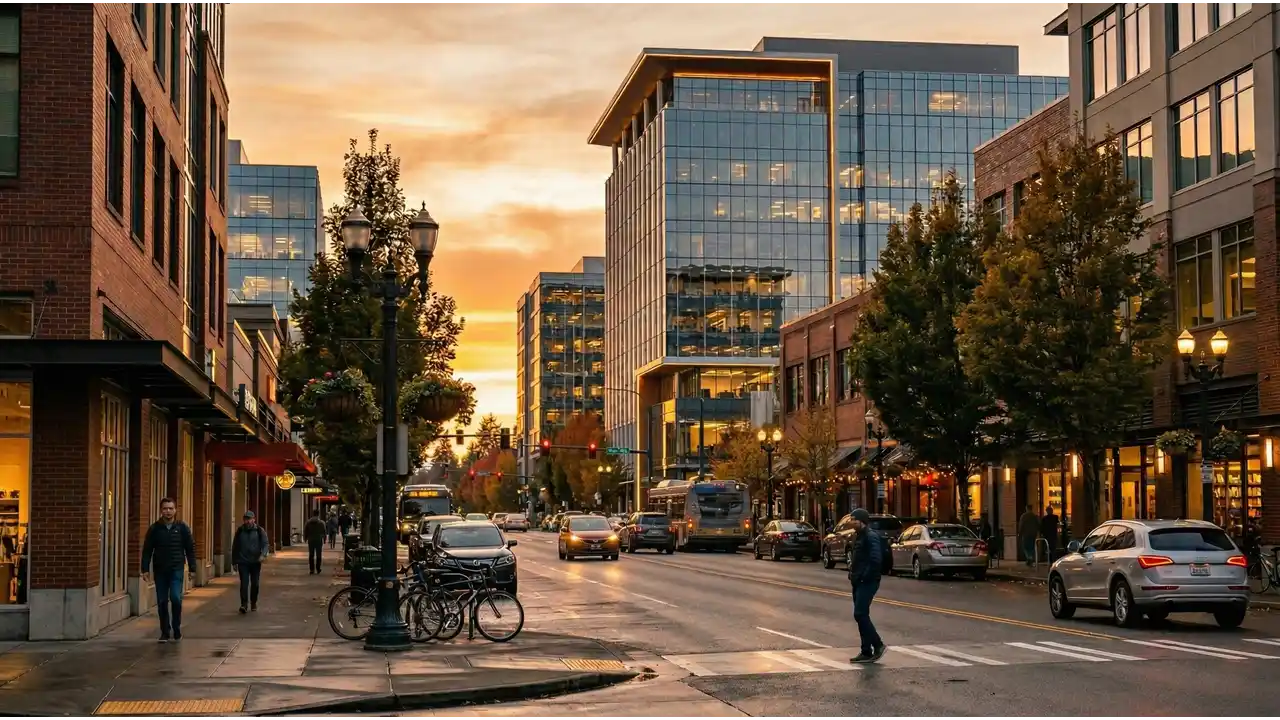
Bellingham is a college town of about 90,000 people on Puget Sound, between Seattle and Vancouver BC. Western Washington University dominates the culture and economy. The climate is mild and wet, with gray winters and dry summers. Most residents are professionals, students, outdoor enthusiasts, and people who chose smallness over Seattle's scale. Daily life centers on walkable downtown, the waterfront, and easy access to hiking and mountains. Cost of living sits between rural Washington and Seattle proper, reflecting local wages (education, healthcare, tech) and strong demand from people seeking proximity to nature without megacity prices.
💡 Local Insights
Bellingham WA · 2026
Bellingham's costs track between budget and comfortable, depending on housing choices. The $1,505/month housing figure reflects a mix: shared housing or smaller rentals in South Bellingham run $1,100-$1,300, while waterfront or newer rentals near downtown reach $1,700-$2,000. Groceries at $571/month are reasonable for the region, slightly lower than Seattle. Local wages in education and healthcare support the moderate tier. Transit is limited to Whatcom Transportation Authority buses, so most people drive or bike, which adds transport costs. Expats find Bellingham cheaper than Seattle or Vancouver BC but more expensive than most US interior towns. The town's size means fewer luxury services, which helps contain costs. Winter heating and car dependency are the main budget surprises. Seasonal workers and students push rents up in fall and down in summer.
Frequently Asked Questions
How much does it cost to live in Bellingham WA per month?
A moderate lifestyle costs $3,275/month. This breaks down as: housing $1,505, groceries $571, utilities $150-$200, transport $250-$350 (car-dependent), dining and entertainment $400-$500, and miscellaneous expenses $500-$700. Budget tier costs $1,965/month if you live frugally in shared housing and minimize discretionary spending. Comfortable living runs $5,076/month with larger housing, frequent dining out, and more leisure activities. Most single professionals land in the moderate range.
What is the average rent in Bellingham WA?
Housing costs average $1,505/month for a moderate lifestyle. A one-bedroom apartment in South Bellingham or near WWU runs $1,100-$1,300. Downtown and waterfront rentals range $1,600-$2,000. Shared housing (room rental) is $800-$1,100. Single-family homes rent for $1,800-$2,500 depending on condition and location. Prices have risen steadily since 2018 due to tech remote work and migration from Seattle. Landlords typically require first month, last month, and deposit upfront. Lease terms are usually 12 months.
Is Bellingham WA cheap to live in for expats?
Bellingham is moderately priced for expats, cheaper than Seattle, Vancouver BC, or Portland, but more expensive than rural interior US towns. If you're coming from Europe or major Asian cities, costs feel reasonable. If you're from a low-cost country, budget carefully. The main surprise is car dependency, which adds transport costs not always obvious upfront. Utilities and heating are modest. Healthcare through a US employer plan is affordable; without it, expect $200-$400/month for individual coverage. Internet and phone are standard US prices. Salaries for professional expats (tech, education, healthcare) are lower than Seattle but sufficient for moderate comfort.
How much does food cost per month in Bellingham WA?
Groceries for one person run $571/month ($19/day), assuming cooking at home. A bag of groceries at Safeway or Town & Country is 15-20% cheaper than downtown Seattle. Specific prices: chicken breast $7-$9/lb, ground beef $6-$8/lb, apples $2.50-$3/lb, milk $4-$5/gallon, eggs $4-$5/dozen. Eating out costs $15-$22 for casual lunch, $25-$40 for dinner at a mid-range restaurant. Coffee is $5-$6. The Bellingham Farmers Market (summer weekends) offers seasonal produce at fair prices. Budget grocers like Fred Meyer and Walmart offer lower prices than specialty shops.
What salary do you need to live comfortably in Bellingham WA?
For comfortable living, aim for $5,076/month after tax, roughly $65,000-$70,000 annual gross income for a single person. This allows for $1,800-$2,000 rent, dining out 2-3 times per week, regular entertainment, and modest travel savings. Couples can stretch that further with shared housing. Entry-level jobs in education, healthcare, and retail pay $18-$22/hour, supporting the budget tier. Professional roles (software engineer, healthcare manager, university staff) pay $60,000-$90,000+. Two incomes at moderate salaries ($35,000-$45,000 each) support comfortable living for a household.
How does the cost of living in Bellingham WA compare to other places?
Bellingham sits in the moderate range for US cost of living. A moderate lifestyle here costs $3,275 per month, with housing at $1,505 per month. This puts it slightly more expensive than Kansas City, where the same lifestyle runs $2,600 monthly and housing costs $1,097. Bellingham is actually cheaper than Santa Fe, New Mexico, which costs $3,175 for a moderate lifestyle despite having higher housing expenses at $1,631 per month. If you're considering a major move, Honolulu, Hawaii is considerably pricier at $4,475 monthly with housing at $2,214. Bellingham's cost reflects its position as a growing college town with a strong job market in the Pacific Northwest, balancing affordability better than other West Coast alternatives while remaining accessible compared to smaller mountain communities.
Yes, but with constraints. The budget tier allows rent of $1,100-$1,200 (shared housing or small studio), groceries $400-$450 (careful shopping, minimal eating out), utilities $100-$120, and transport $200-$250 (bus or shared car costs). This cuts entertainment, travel, and discretionary spending almost entirely. You have no buffer for car repairs, medical bills, or emergencies. It works best for students, couples sharing expenses, or people receiving housing support. Most working adults in Bellingham spend closer to $2,500-$3,500 for sustainable, stress-free living. The $1,965 budget requires deliberate frugality.