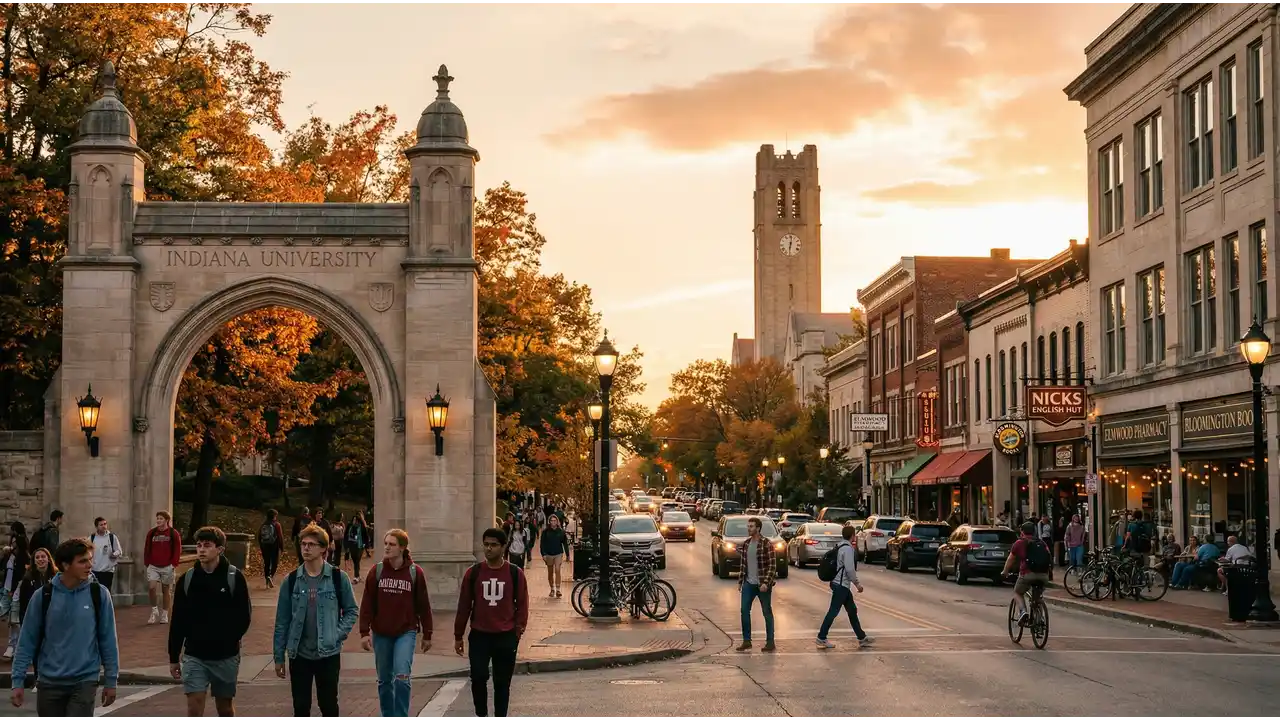
Bloomington is a college town of roughly 85,000 people anchored by Indiana University's Bloomington campus. The city has a young demographic (median age around 25) and a transient student population that turns over each year. Daily life centers on campus, local restaurants, and the downtown square. Winters are cold and gray, with average lows around 25°F from December through February. Spring and fall are mild. The city is car-dependent outside downtown, though many students and young professionals bike or use university transit. Job markets outside university employment and some tech startups are limited, which affects wage levels and why rents stay moderate.
💡 Local Insights
Bloomington IN · 2026
Bloomington's cost of living tracks lower than comparable US college towns, largely because Indiana University employment sets wage floors that don't support premium rents. Housing averages $1,133/month, which buys a one-bedroom apartment near downtown or campus, or a two-bedroom further out. Student housing competition keeps rents from spiking; landlords expect regular turnover. Groceries run $505/month and align with national averages, with standard supermarkets (Kroger, Walmart) offering competitive prices. Eating out is cheaper than urban centers, with local diners and ethnic restaurants offering meals for $10-14. Public transport is minimal; most residents drive or bike. Utilities typically add $120-150/month. The university dominates the local economy, so employment prospects outside academia, healthcare, or service industries are narrow. Expats and remote workers find Bloomington affordable but may struggle with limited international services. Salaries for non-academic jobs run 10-15% below national averages, offsetting the low cost of living.
Frequently Asked Questions
How much does it cost to live in Bloomington IN per month?
A moderate lifestyle in Bloomington costs around $2,700/month. This covers housing at $1,133/month, groceries at $505/month, utilities around $140/month, and transport roughly $250/month, plus discretionary spending on dining, entertainment, and personal care. A budget tier (minimal spending, shared housing, no car) runs about $1,620/month. A comfortable tier with nicer housing and regular dining out runs closer to $4,185/month. These figures assume you are not a student with university meal plans or subsidized housing.
What is the average rent in Bloomington IN?
Average rent is around $1,133/month. One-bedroom apartments near downtown or the university typically rent for $900-1,150/month. Two-bedroom units run $1,100-1,400/month, depending on location and condition. Older student-housing buildings are cheaper, around $800-950/month for a bedroom in a shared house. Newer complexes or properties in desirable neighborhoods command $1,200-1,350/month. Rent fluctuates with the academic calendar; prices may drop slightly in summer when students leave. The wide student population keeps landlords from raising rents aggressively. Utilities (electric, gas, water) typically add $120-150/month on top of rent.
Is Bloomington IN cheap to live in for expats?
Bloomington is genuinely affordable compared to most US college towns and major cities. Rent, groceries, and services cost less than Boston, Chicago, or Washington DC. However, expats often find the cost advantage overstated because salaries outside the university are low, and the job market is narrow. Visa and work-permit requirements tie many expats to the university or limited employers. International groceries and services are limited; expect to travel or order online for specialty items, which raises costs. If you have remote income or university employment, Bloomington is cheap. If you depend on local job wages, the low cost of living barely offsets the low salaries.
How much does food cost per month in Bloomington IN?
Groceries average $505/month for a single adult eating home-cooked meals. Staples like chicken ($2.50-3.50/lb), ground beef ($3.50-4.50/lb), eggs ($2-3/dozen), milk ($3.50/gallon), and bread ($2.50-3.50/loaf) track national averages. Local Kroger and Walmart stores offer competitive pricing. Eating out is affordable: a diner meal runs $8-12, casual pizza or ethnic food $10-15, and nicer restaurants $18-25 per entree. Many students rely on cheap takeout from downtown shops, which keeps restaurant prices modest. Grocery costs stay moderate because the city lacks the density and demand pressures of larger urban areas.
What salary do you need to live comfortably in Bloomington IN?
A comfortable lifestyle requires about $4,185/month gross income, or roughly $50,000 annually. This budget allows for a one-bedroom apartment in a desirable neighborhood ($1,200-1,350/month), regular dining out, a car with insurance and gas, and discretionary spending on hobbies and travel. If you earn $50,000-55,000/year after taxes, you can live comfortably without roommates or financial stress. The budget tier threshold is around $19,500/year, but that requires significant compromises: shared housing, no car, minimal dining out, and strict grocery budgeting. University employees and white-collar professionals typically earn $40,000-60,000/year; service and retail jobs pay $22,000-30,000/year.
How does the cost of living in Bloomington IN compare to other places?
Bloomington is genuinely affordable for a college town. A moderate lifestyle runs $2,700 per month, with housing at $1,133 per month. This puts it slightly cheaper than Knoxville, Tennessee, where a moderate lifestyle costs $2,800 and housing runs $1,313 per month. Both are solid options if you want Midwestern or Upper South living without major expenses. Compared to larger metros, the difference is stark. Miami costs $3,925 monthly for a moderate lifestyle, with housing alone at $2,311 per month. If you're looking internationally, Bremen is considerably cheaper at $1,850 per month overall, though that reflects a different cost structure entirely. For the US context, Bloomington offers the kind of affordability that makes sense for students, early-career workers, and anyone stretching a budget without sacrificing access to decent amenities and cultural offerings.
Yes, but with strict trade-offs. The budget tier covers housing around $700-800/month (shared house or older studio), groceries $350/month (bulk staples, minimal dining out), utilities $120/month, and transport $200/month (bus pass or one used car with insurance). This leaves roughly $250/month for everything else: phone, hygiene, clothing, entertainment. No car ownership is feasible on this budget; you would need bike, bus, or walking distance to work and shops. Eating out is rare. Medical or emergency expenses force you into debt. Many Bloomington residents on this budget are students living with roommates or people receiving family support. It is doable but requires discipline and low unexpected costs.