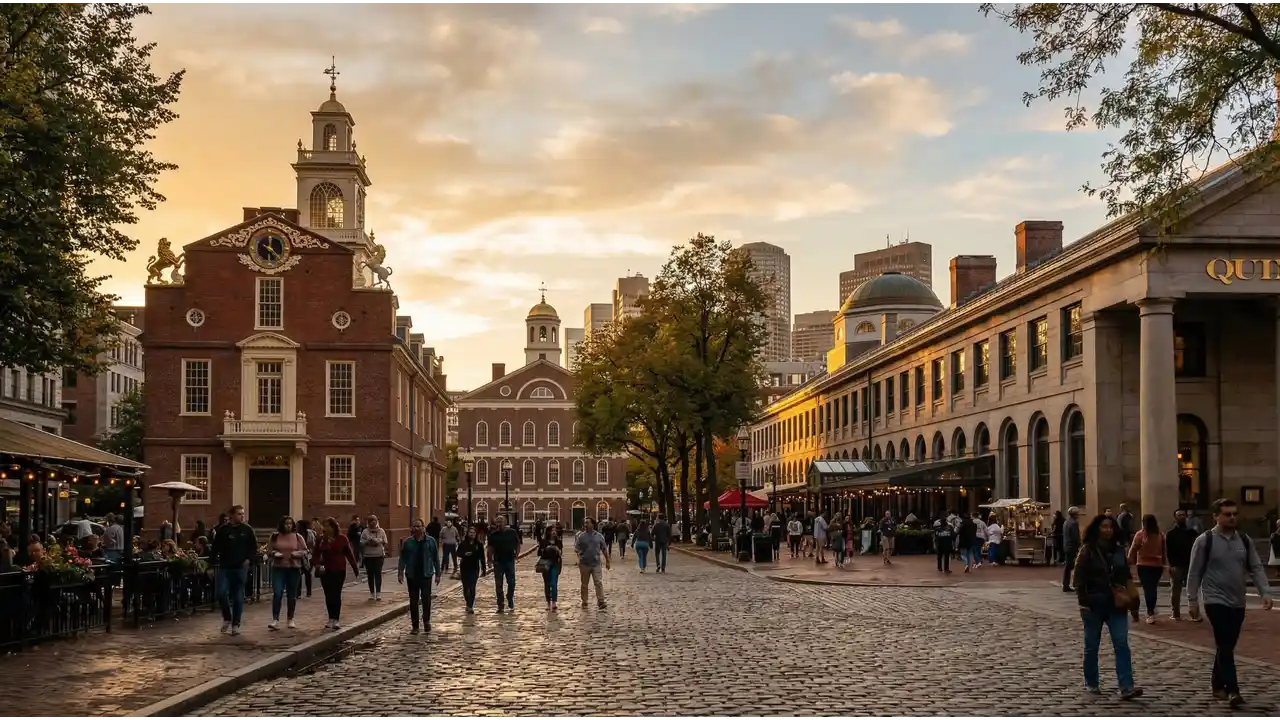
Boston is a dense, walkable city on the Atlantic coast with a strong job market in technology, healthcare, education, and finance. Winters are cold and wet, with snow common from December through March. Summers are warm and humid. The population is highly educated, with a large student presence from universities like Harvard, MIT, and Boston University. Daily life revolves around neighborhoods like Back Bay, the North End, and Somerville, where brownstones and modern apartments sit near coffee shops, transit stations, and waterfront parks. Public transit (the MBTA) connects most areas, though service is inconsistent and crowded during rush hours.
💡 Local Insights
Boston · 2026
Boston's cost of living sits firmly in the upper tier for US cities, driven primarily by constrained housing supply and regional demand. Housing consumes $2,813/month across all neighborhoods, with rents ranging from $1,600 to $3,000 for one-bedroom apartments depending on location and condition. Older buildings lack air conditioning; newer units command premiums. Groceries run $601/month for standard supermarket shopping; independent and organic options cost 20-30 percent more. Public transit is $90/month with a pass, cheaper than parking, which averages $200-300/month. Dining out ranges from $15 (casual) to $60 (dinner) per meal. Expats often underestimate utility costs, especially heating in winter (can add $100-150/month October through April). The budget tier of $2,805/month requires roommates, car-free living, and cooking at home. Most professionals seeking comfortable single living budget $7,246/month or higher.
Frequently Asked Questions
How much does it cost to live in Boston per month?
A moderate lifestyle costs $4,675/month. This includes housing at $2,813/month, groceries at $601/month, utilities around $150/month, local transit at $90/month, and dining and entertainment at roughly $800/month. This covers a one-bedroom apartment or room in a shared place, regular grocery shopping, occasional restaurant visits, and typical entertainment. The budget tier (bare essentials with roommates) runs $2,805/month. A comfortable lifestyle with your own apartment, frequent dining out, and discretionary spending reaches $7,246/month.
What is the average rent in Boston?
Average rent aligns with the housing cost of $2,813/month. A one-bedroom apartment in central neighborhoods like Back Bay, Beacon Hill, or Cambridge runs $2,400-$3,100/month. Outer neighborhoods like Allston, Dorchester, and Somerville offer one-bedrooms for $1,800-$2,300/month, though these still involve MBTA commutes. Studios cost $1,600-$2,200/month. Shared two-bedroom apartments split between two people run $1,400-$1,700 per person. Buildings constructed before 1980 often lack air conditioning and charge lower rents. Lease terms are typically 12 months; first month, last month, and a security deposit equal to one month are standard upfront costs.
Is Boston cheap to live in for expats?
No. Boston ranks among the top 20 most expensive US cities. Compared to London or Toronto, housing costs are similar or lower, but compared to Barcelona, Dublin, or Mexico City, Boston is significantly more expensive. Expats on European or Asian salaries often find it difficult. Those relocating from the US South or Midwest notice a sharp jump, especially in housing. The main advantage is that expat communities are established in neighborhoods like Back Bay and Cambridge, with familiar restaurants and services. Tax-advantaged visa programs (like the EB-5) exist but don't lower daily costs. The trade-off is strong job opportunities and high salaries in tech and finance, which can offset the high cost of living.
How much does food cost per month in Boston?
Groceries run $601/month for a single person buying standard brands at chains like Stop & Shop, Whole Foods, or Trader Joe's. A weekly shop (bread, milk, eggs, cheese, chicken, vegetables, rice, pasta) costs $80-$100. Organic or specialty items add 20-30 percent. Dining out varies: lunch at a casual spot runs $12-$18, dinner $25-$45 at mid-range restaurants, $60-$100+ at upscale venues. Coffee runs $3-$5. Ethnic neighborhoods like Chinatown, East Boston (Italian), and Jamaica Plain (Latin) offer lower grocery and dining costs. Farmer's markets (May through November) provide seasonal vegetables at competitive prices. Food delivery apps add 15-20 percent to restaurant costs.
What salary do you need to live comfortably in Boston?
A comfortable lifestyle costs $7,246/month, or roughly $87,000/year gross. This assumes you want your own one-bedroom apartment, eat out regularly, use paid entertainment, and maintain a car or use transit without restriction. Account for taxes: in Massachusetts, combined federal and state tax on $87,000 gross is about 25-28 percent, leaving roughly $63,000 net annually or $5,250/month. This budget is tight for comfortable living. Most professionals earning $95,000-$120,000 gross report feeling financially secure in Boston. Remote workers should consider that Massachusetts has no remote work exemption; you owe state income tax on earnings regardless of client location.
How does the cost of living in Boston compare to other places?
Boston's moderate lifestyle costs $4,675 per month, with housing making up the largest share at $2,813 monthly. How this stacks up depends on which cities you're considering. Honolulu, Hawaii runs $4,475 overall and $2,214 for housing, making it slightly cheaper than Boston despite its island location. Portland is noticeably more affordable at $3,325 for a moderate lifestyle and $1,590 for housing, giving you real savings if you're willing to trade urban density for a smaller metro. Brooklyn, by contrast, is considerably pricier at $5,975 monthly and $4,295 for housing alone. Most Northeast and West Coast metros fall somewhere in this range. If you're coming from a high-cost coastal city, Boston is middle-ground. If you're relocating from a smaller or Midwestern market, the jump will feel substantial.
Yes, but with real constraints. This budget requires roommates (splitting a two-bedroom keeps housing to $1,300-$1,500/month per person), no car, strict grocery shopping, minimal dining out, and no regular paid entertainment. One-bedroom solo living is not realistic on this budget. Most people at this income level live in outer neighborhoods accessible by MBTA (Allston, Jamaica Plain, Dorchester) or in nearby cities like Medford or Quincy with longer commutes. Food budget drops to $400/month if you cook consistently. This tier works for students, those with very low fixed costs, or households with multiple earners pooling income. Unexpected costs (medical, emergency repair) quickly create shortfalls.