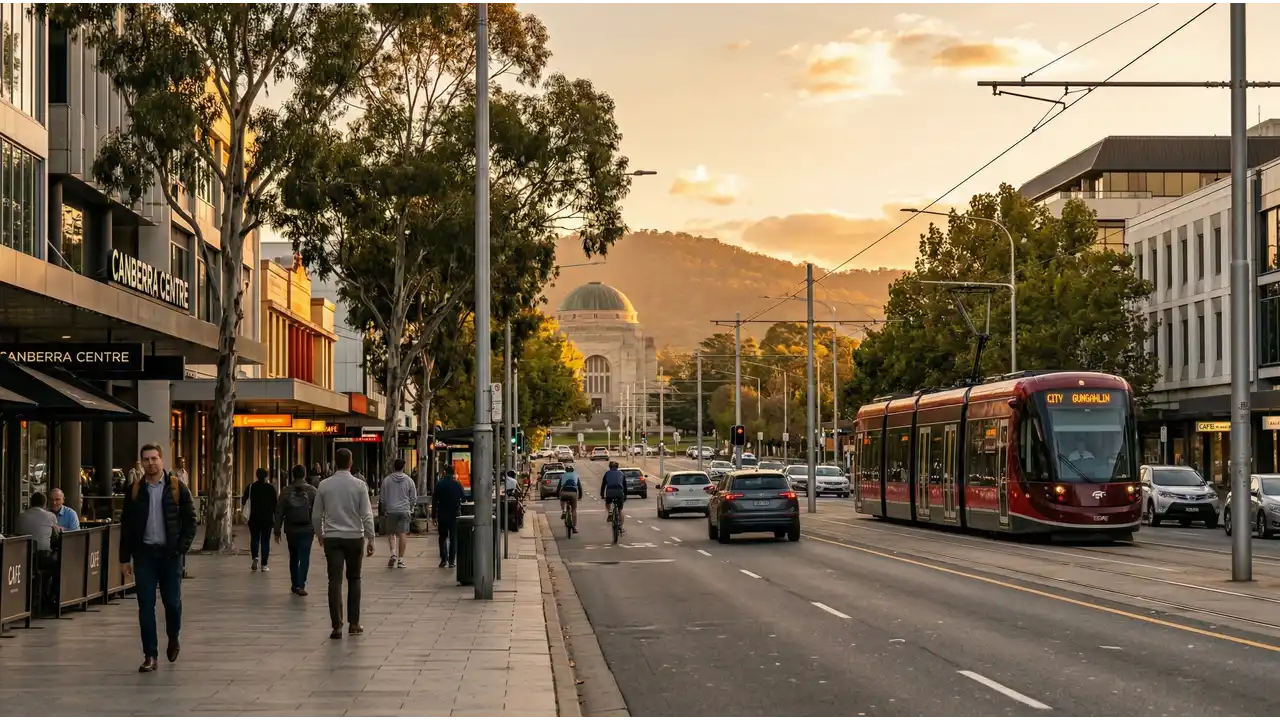
Canberra is Australia's purpose-built capital, designed in the early 1900s with wide avenues, planned neighborhoods, and extensive green space. The city has around 460,000 residents, a mix of government workers, families, and young professionals drawn by stable employment and relatively lower housing costs than Sydney or Melbourne. Daily life revolves around established suburbs like Belconnen, Tuggeranong, and inner-north Canberra, with most errands involving short car or bus trips. Winters are cold (often dropping below 5°C), summers warm but not extreme. The city lacks the density or nightlife of larger Australian capitals but offers good schools, parks, and a quieter professional atmosphere.
💡 Local Insights
Canberra · 2026
Canberra's cost structure is shaped by its role as a government hub and smaller population than Sydney or Melbourne. Housing costs around $1,476/month across most suburbs, with inner areas like Forrest and Reid commanding premiums, while outer suburbs like Gungahlin offer slightly lower rents. Groceries run approximately $411/month for a moderate household, comparable to Australian national averages. Public transport via ACTION buses is reliable but limited; most residents own cars, adding transport costs beyond the moderate budget. Expats typically pay market rates equal to locals; no expatriate pricing premium exists. Dining out costs more than Sydney or Melbourne on a per-meal basis due to lower supply competition. Utilities are a significant variable cost (heating and cooling the wide suburban sprawl). The comfortable tier of $4,263/month assumes private school fees, frequent dining out, or larger housing. A key cost driver is transport dependency; living centrally (Civic, City Walk) reduces driving but increases rent.
Frequently Asked Questions
How much does it cost to live in Canberra per month?
A moderate lifestyle in Canberra costs $2,750/month. Housing accounts for $1,476/month across most neighborhoods. Groceries run around $411/month. The remaining $863/month covers transport (heavily car-dependent), utilities, phone, dining out, and personal expenses. A tighter budget of $1,650/month is possible but means shared housing, cooking at home, and no car ownership. A comfortable lifestyle with private school, frequent dining, and quality accommodation runs $4,263/month.
What is the average rent in Canberra?
Median rent is around $1,476/month for a moderate two-bedroom apartment or house. Inner suburbs like Forrest, Reid, and City Walk rent for $1,600 to $1,900/month. Outer suburbs like Gungahlin, Harrison, and Calwell range from $1,300 to $1,450/month. Three-bedroom houses in established areas run $1,700 to $2,000/month. Shared housing can drop to $700 to $900/month per person. Vacancy rates are typically low; rental demand is steady from government employees and university staff. Leases are usually 12 months, and most landlords require references and rental history.
Is Canberra cheap to live in for expats?
Canberra is moderately priced for expats, cheaper than Sydney or Melbourne but not a bargain destination. At $2,750/month for a moderate lifestyle, costs are similar to smaller Australian capitals like Adelaide. Expats pay the same rent and grocery prices as locals; no expatriate compound pricing exists. The main surprise for expats is high transport costs due to car dependency and distance between suburbs. Utilities for heating and cooling can spike seasonally. Professional expats on government or corporate postings find the cost reasonable for Australian standards, but those on local salaries may find it tight.
How much does food cost per month in Canberra?
Groceries cost approximately $411/month for a moderate household. Staples include eggs ($4 to $5/dozen), milk ($1.20 to $1.50/liter), bread ($2.50 to $3.50/loaf), chicken ($10 to $12/kilogram), and fresh vegetables ($6 to $10/kilogram). Supermarkets (Coles, Woolworths, Aldi) dominate; Aldi is cheapest. Eating out costs more than Sydney: a casual cafe meal runs $15 to $18, a mid-range dinner $25 to $35/person. Organic and specialty foods carry premiums. Farmers markets operate weekly in Civic and suburb centers, often cheaper for seasonal produce.
What salary do you need to live comfortably in Canberra?
A comfortable lifestyle requires $4,263/month, or roughly $51,000/year after tax, depending on personal circumstances. This covers decent housing ($1,500 to $1,800/month), regular dining out, private school fees if applicable, and car ownership with fuel and maintenance. Couples or dual-income households find this threshold easier to reach. Government employees, particularly APS (Australian Public Service) level 5 and above, typically earn sufficient salaries. Remote workers or professionals in finance, IT, and consulting easily exceed this. The budget assumes no debt and modest savings; families with multiple children or mortgage aspirations should target higher income.
How does the cost of living in Canberra compare to other places?
Canberra's moderate lifestyle costs $2,750 per month, with housing taking up $1,476 of that. This puts it roughly in line with Perth, where a moderate lifestyle runs $2,625 monthly and housing costs $1,435. You'll find Canberra notably more expensive than Christchurch, which comes in at $2,050 for a moderate lifestyle and $1,050 for housing. If you're comparing to major global financial centers, Singapore is significantly dearer at $4,125 monthly with housing at $2,649. Within Australia, Canberra sits in the middle range. It's pricier than some regional centers but considerably cheaper than Sydney or Melbourne. Your housing costs will be the largest factor in your overall budget, so the difference between Canberra and Perth is relatively minor there, while the gap to Christchurch is substantial.
Yes, but with constraints. A budget of $1,650/month requires shared housing ($700 to $800/month per person), minimal dining out, and cooking at home. Groceries drop to $300 to $350/month with careful planning. Transport becomes critical; car ownership is nearly impossible, so reliance on buses or cycling is essential. Phone and utilities might total $80 to $100/month. Entertainment and personal spending shrink to $150 to $200/month. This works for students, early-career professionals in shared accommodations, or those with subsidized housing. Most residents find this tight; the moderate budget of $2,750/month is more sustainable long-term.