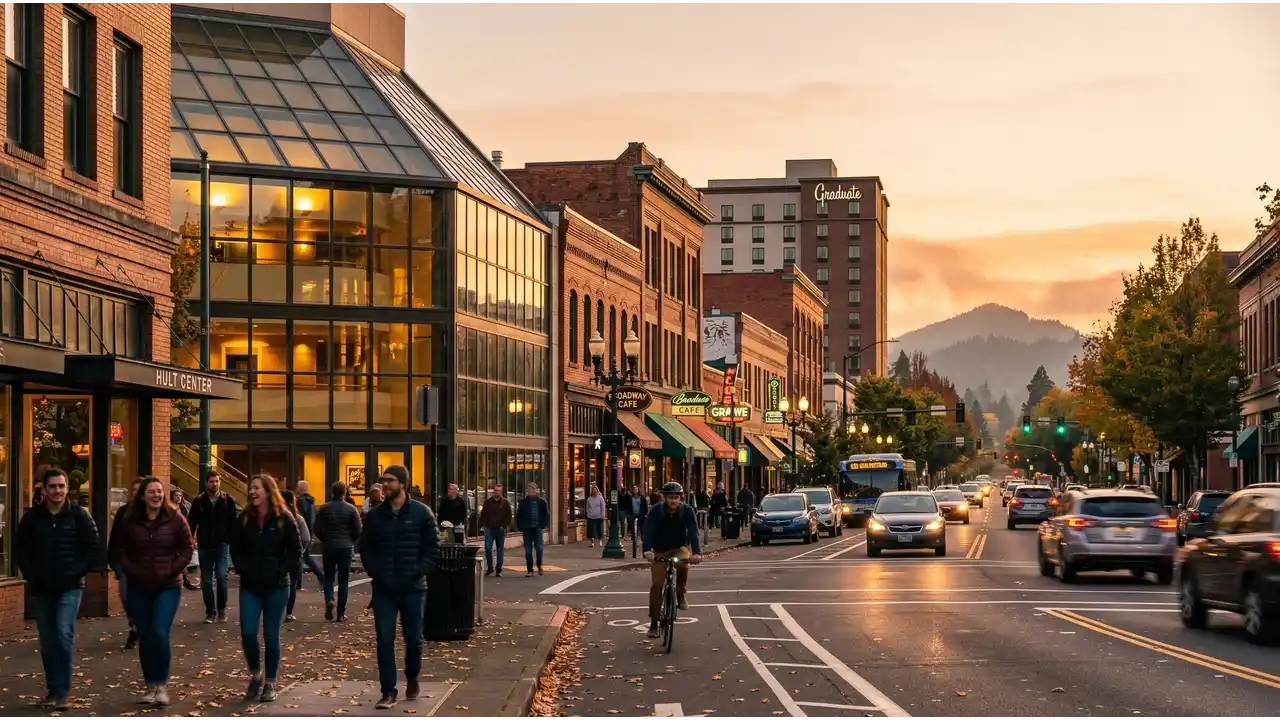
Corvallis is a college town in the Willamette Valley, home to Oregon State University. About 59,000 people live here, with a substantial student population that shapes the local character. The city sits between Portland (90 minutes north) and the Cascade Mountains, with regular rain and mild winters. Downtown has modest commercial activity centered on restaurants, cafes, and university-adjacent businesses. Most residents are students, faculty, staff, or workers in healthcare and light manufacturing. Daily life involves walking or biking on flat terrain, regular campus events, and access to outdoor recreation nearby. Housing stock is mixed: older university-area rentals, suburban single-family homes, and newer apartment complexes.
💡 Local Insights
Corvallis OR · 2026
Corvallis sits in the lower-to-moderate range for Oregon cost of living, mainly because housing is restrained by limited population pressure outside the academic calendar. Rent averages $1,397/month, which reflects a mix of aging student rentals ($900-$1,100 for one-bedroom away from campus) and newer complexes ($1,200-$1,500 closer to downtown and campus). Grocery costs run $565/month for a moderate diet, slightly below national average due to local agriculture and Willamette Valley crop production. Public transit (Corvallis Transit System) costs $27/month for unlimited rides; most residents walk or bike. Eating out is affordable relative to larger metros, with casual meals around $12-$16. The main cost driver is that student population creates tight rental markets in certain neighborhoods (North Corvallis near campus commands premiums), while outer areas remain cheaper. Winter utility costs are moderate; summers need no air conditioning. Expats will find Corvallis quieter and more affordable than Portland or Eugene, with less service diversity.
Frequently Asked Questions
How much does it cost to live in Corvallis OR per month?
A moderate lifestyle costs $3,150/month. This breaks down as: housing $1,397/month, groceries $565/month, utilities $150-$180/month, transportation $80-$120/month (transit pass or occasional car use), and dining out plus entertainment around $400-$500/month. This assumes a one-bedroom apartment, regular grocery shopping, and modest social spending. Budget living runs $1,890/month (smaller rental, minimal dining out, no car). Comfortable living reaches $4,883/month with a two-bedroom, frequent dining out, and more discretionary spending.
What is the average rent in Corvallis OR?
Average rent is $1,397/month. One-bedroom apartments away from campus rent $950-$1,150/month; closer to Oregon State University or downtown, expect $1,200-$1,400/month. Two-bedroom units run $1,350-$1,700/month depending on condition and location. Older converted houses in the 'North Corvallis' student zone offer cheaper rates ($900-$1,100 one-bedroom) but may be less maintained. Newer apartment complexes on the south side cost $1,400-$1,600. Utilities (electric, water, heating) add $120-$180/month. Summer turnover drives vacancies; winter rentals are tighter. Furnished short-term rentals cost 20-30% more.
Is Corvallis OR cheap to live in for expats?
Yes, compared to most US expat hubs. Corvallis is significantly cheaper than Portland, Seattle, or the Bay Area, and modestly cheaper than Eugene. At $3,150/month for moderate living, it's comparable to smaller Midwest cities but less expensive than coastal alternatives. Housing at $1,397/month is genuinely affordable. The tradeoff is limited international dining, fewer consular services, and smaller expat communities (though Oregon State attracts international students). Visa options are limited to student or employment-based categories; there is no digital nomad or retirement visa path in the US. For expats relocating for university work or US employment, Corvallis offers better affordability than larger metros with similar climate.
How much does food cost per month in Corvallis OR?
Groceries average $565/month for moderate eating. Typical basket: eggs $4/dozen, chicken breast $8/pound, ground beef $6/pound, milk $4/gallon, bread $3/loaf, apples $2/pound, rice $1.50/pound, canned beans $1/can. A week of groceries for one person costs $120-$150. Eating out is moderate: casual lunch $12-$16, dinner entree $14-$22, coffee $4-$5. Corvallis has a farmer's market (May-November) with cheaper seasonal produce. Grocery chains include WinCo (budget-friendly), Safeway, and local food co-ops. Budget eating cuts to $350-$400/month; regular dining out adds $300-$500/month depending on frequency.
What salary do you need to live comfortably in Corvallis OR?
A comfortable lifestyle costs $4,883/month, roughly $59,000/year gross income (accounting for taxes and benefits). This supports a two-bedroom apartment, frequent dining out, a car, regular entertainment, and modest travel. For a couple, $75,000-$85,000 combined income provides comfort with savings. Oregon has no sales tax but income tax tops out at 9.9%, which affects net pay relative to wages. On $50,000/year gross, you can live moderate ($3,150/month) with little left over. Oregon State employees and healthcare workers typically earn $40,000-$65,000; tech roles command $70,000-$95,000. Expats on fixed income or international salary should budget $4,000-$5,000/month to live without financial stress in Corvallis.
How does the cost of living in Corvallis OR compare to other places?
Corvallis sits in the moderate range for U.S. cities. A moderate lifestyle costs $3,150 per month here, with housing running $1,397 monthly. That puts it slightly above Louisville, Kentucky, where moderate living is $2,650 total and housing is $1,111. Corvallis is essentially a peer with Charlotte, where a moderate lifestyle is $2,975 and housing is $1,398, nearly identical to Corvallis on the housing front. The real gap appears when comparing to coastal markets: San Diego costs substantially more at $4,450 monthly for a moderate lifestyle, with housing alone at $2,533. If you're coming from a major metro area on either coast, Corvallis will feel noticeably cheaper. Coming from smaller Rust Belt cities, you'll likely find it slightly pricier, though not dramatically so.
Yes, but with real constraints. The budget tier of $1,890/month works if you rent a one-bedroom outside North Corvallis for $1,000-$1,100, spend $400/month on groceries (rice, beans, eggs, bulk basics), skip dining out or limit it to $50/month, use transit or a bike, and avoid car ownership. Utilities run $120-$150. Entertainment is minimal. You cannot afford a car, frequent travel, or flexibility for unexpected costs. This budget suits students, those with side income, or people receiving stipends. It's tight but survivable, not impossible. Most people at this level either have other income sources, subsidized housing (campus dorms), or reduced expenses (free internet, shared housing). For longer stays or families, this budget becomes unworkable.