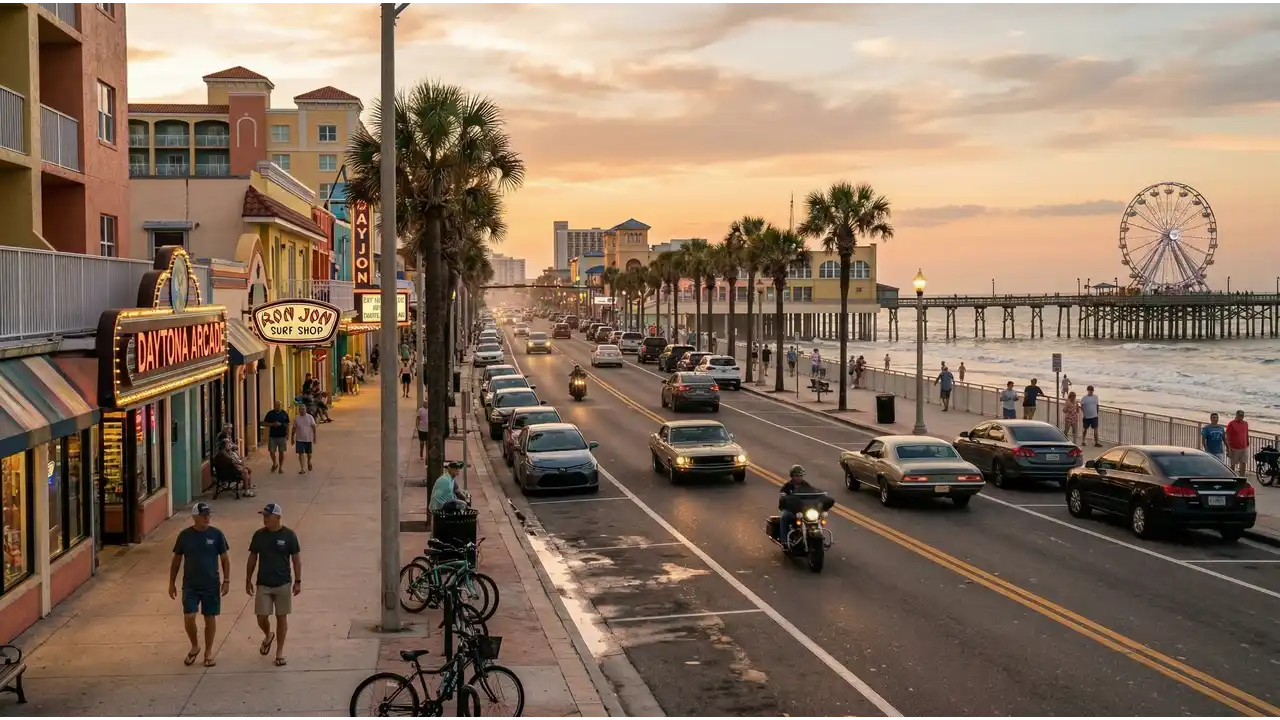
Daytona Beach is a coastal city of roughly 64,000 people in Volusia County, known for its hard-packed beach and motorsports culture (home to Daytona International Speedway). The population includes retirees, working families, service industry employees, and remote workers attracted by the beach and relatively affordable housing compared to Miami or Tampa. Daily life centers on the beach, downtown renovation efforts, and proximity to Orlando (90 minutes inland). Summers are hot and humid with afternoon thunderstorms; winters are mild. The city has a working-class character with tourist infrastructure rather than the polish of upscale coastal towns. Traffic spikes during spring break and major racing events.
💡 Local Insights
Daytona Beach FL · 2026
Daytona's cost structure reflects a mid-tier beach town economy. Housing runs $1,231/month on average, with older inland apartments and condos typically cheaper than beachfront properties. The beach itself commands a premium, though not Miami prices. Utilities are significant in summer due to air conditioning and heat. Groceries average $522/month for self-catering, consistent with broader Florida pricing. Eating out is affordable; casual meals run $12-18. Transportation is car-dependent; most residents drive. Bus service exists but is limited. A used car or reliable transportation is essential. Gas prices track the national average. Expats should expect standard US pricing rather than international bargains. The main cost pressure is seasonal tourism inflation (March-April, holiday weeks). Winter residents and seasonal renters can find short-term deals if booking outside peak dates. Utilities and property insurance are the hidden costs many underestimate.
Frequently Asked Questions
How much does it cost to live in Daytona Beach FL per month?
A moderate lifestyle costs $2,850/month. This covers $1,231/month for housing (rent or mortgage equivalent), $522/month for groceries, $200-250 for utilities and internet, $150-200 for transportation (gas, insurance, maintenance or public transit), and the remainder for dining out, entertainment, healthcare, and personal services. A budget lifestyle runs $1,710/month by cutting back on discretionary spending and choosing shared housing. A comfortable lifestyle is $4,418/month, allowing for dining out regularly, better housing, and more activities.
What is the average rent in Daytona Beach FL?
Average rent is $1,231/month. A one-bedroom apartment inland typically rents for $900-1,200/month. A two-bedroom runs $1,100-1,400/month. Beachside properties are significantly higher, starting at $1,400-1,800/month for a modest one-bedroom. Older buildings and complexes set back from the beach are cheaper; newer developments or oceanfront units command premiums. Seasonal variation is real; winter months (December-February) see short-term rental rates spike 30-50%. Long-term leases offer better value than month-to-month or seasonal rentals. North Beach and Inland areas (near downtown) are the most affordable; Beachside and South Beach properties cost more.
Is Daytona Beach FL cheap to live in for expats?
Daytona is moderately priced for an American beach town, cheaper than Miami, Fort Lauderdale, or Tampa Bay. For expats accustomed to US costs, it offers reasonable housing and food. However, compared to most other countries, the US remains expensive for daily living. Healthcare is pricier than in Europe or parts of Asia. A car is mandatory, adding ongoing costs. Expats relocating from Central America or Southeast Asia may find Daytona noticeably more expensive. Those from Canada, UK, or Northern Europe will find it comparable or slightly cheaper. The trade-off is reliable infrastructure, stable utilities, and English-language services versus lower absolute costs.
How much does food cost per month in Daytona Beach FL?
Groceries average $522/month for one person eating at home. A week of basic groceries (bread, milk, eggs, chicken, rice, vegetables, canned goods) runs $100-130. Eating out is affordable: casual lunch is $12-16, dinner at a local restaurant is $16-25 per entree, fast food is $8-12. Seafood (fresh grouper, shrimp) is cheaper here than inland due to local supply, typically $12-18 per pound at markets. Alcohol and coffee are standard US pricing. Farmers markets and discount grocers (Aldi, Walmart) offer savings. Dining out regularly can easily double food spending; budget $800-1,000/month if you eat out 50% of meals.
What salary do you need to live comfortably in Daytona Beach FL?
A comfortable lifestyle costs $4,418/month, or roughly $53,000/year gross income. This allows for a nicer apartment ($1,400-1,600/month), regular dining out, a reliable car with insurance, healthcare, and discretionary entertainment. Account for federal and state taxes (Florida has no state income tax, a plus); a $60,000 gross salary provides comfortable margins. Remote workers should verify employer tax obligations and visa status if relocating internationally. Couples can live on less per person; shared housing and expenses lower the per-capita requirement. Retirees with fixed incomes of $3,000-3,500/month can manage comfortably if they own housing outright.
How does the cost of living in Daytona Beach FL compare to other places?
Daytona Beach runs $2,850 per month for a moderate lifestyle, with housing at $1,231 per month. This positions it slightly below Baltimore, where a moderate lifestyle costs $2,975 and housing runs $1,264. Compared to Oklahoma City at $2,400 monthly, Daytona Beach is notably more expensive, though Oklahoma City's housing is considerably cheaper at $891 per month. If you're considering the broader Florida market, Miami is substantially dearer at $3,925 per month overall and $2,311 for housing alone, nearly double Daytona Beach's housing costs. For most people relocating from mid-sized American cities, Daytona Beach offers moderate pricing without the premium you'd pay in major metros. Your dollar stretches further here than in comparable coastal markets.
Yes, but with strict discipline. This is the budget tier. Rent must be $800-900/month (shared housing, inland studio, or older complex). Groceries are $400/month (cooking mostly at home, minimal dining out). Utilities are $120-150/month. Transportation is $150-200 (used car, transit, or biking). That leaves $40-160 for all other costs: insurance, phone, medical, entertainment. Dining out is rare. No car ownership means transit reliance, which limits neighborhood options. This budget works for young professionals, students, or remote workers willing to house-hack or live inland. Unexpected costs (car repair, medical bill, dental work) create shortfall risk. It's feasible but leaves almost no margin for error.