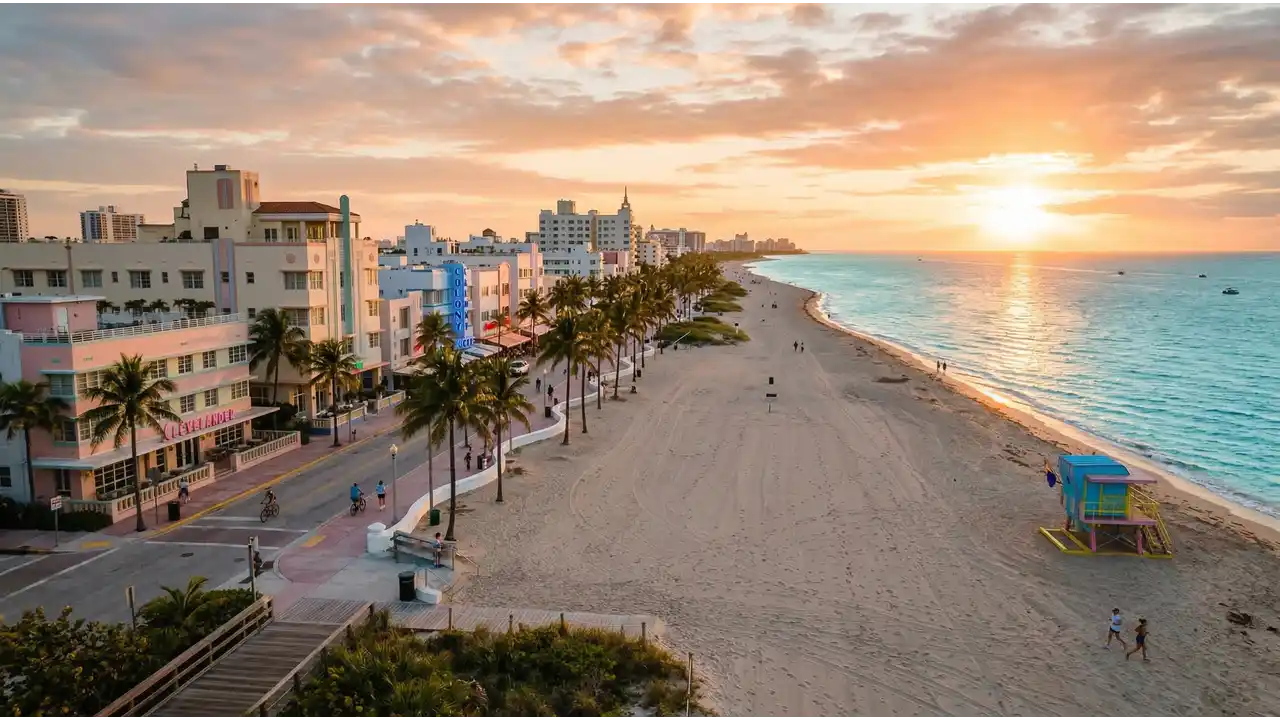
Florida is a large, diverse state where retirees, young professionals, and immigrant communities live side by side. The climate is warm year-round with high humidity and hurricane season from June through November. Daily life centers on car travel in most areas outside Miami and Tampa's downtown cores. Tourism shapes the economy in coastal regions, while inland areas feel more suburban. The state has no income tax, which attracts many relocators. Housing ranges from affordable inland suburbs to expensive waterfront properties. Growth is rapid, and the population is split between long-term residents, recent arrivals, and seasonal visitors.
💡 Local Insights
Florida · 2026
Florida's cost of living is moderate for the US but rising. Housing at $1,887/month is the largest expense and varies sharply by location. Miami Beach and Key West run significantly higher; inland suburbs like Lakeland or Ocala are lower. Groceries cost around $520/month for a single person buying at supermarkets like Publix, Winn-Dixie, or Aldi. Eating out is widespread and cheap in casual chains but adds up fast. Transportation costs depend entirely on location. Miami and Tampa have public transit (Metrorail, bus systems), but most of Florida requires a car. Gas, insurance, and maintenance are routine expenses. No state income tax reduces your overall tax burden compared to northeastern states, which appeals to higher earners. Expats should budget for air conditioning (electric bills spike in summer), hurricane insurance, and flood insurance in coastal counties. Prices for expats and locals are the same in retail, though some neighborhoods have higher concentration of tourism markup.
Frequently Asked Questions
How much does it cost to live in Florida per month?
A moderate lifestyle in Florida costs around $3,500/month. This breaks down roughly as: housing $1,887/month, food (groceries) $520/month, utilities $150-200/month, transportation $400-600/month depending on car ownership, and miscellaneous expenses (dining out, entertainment, personal care) around $400-500/month. Budget tier living runs $2,100/month if you share housing, cook at home, and avoid dining out. Comfortable tier costs $5,425/month with private housing, frequent dining out, and travel within the state.
What is the average rent in Florida?
Average rent is around $1,887/month statewide. This varies widely by region. In Miami, expect $2,100-2,600/month for a one-bedroom apartment in non-beachfront neighborhoods like Allapattah or Wynwood; beachfront adds 50% or more. Tampa and Orlando run $1,400-1,700/month for comparable units. Inland cities like Lakeland or Gainesville average $1,100-1,400/month. Coastal areas outside major metros (Sarasota, Naples, Destin) range $1,600-2,300/month. Single-family home rentals typically run $300-500/month higher than apartments in the same neighborhood.
Is Florida cheap to live in for expats?
Florida is cheaper than major northeastern US cities (New York, Boston) but not drastically cheaper than other southern states. For expats from Europe or Asia, prices feel moderate. Housing is the main expense. No state income tax is a genuine advantage for high earners compared to California or New York. However, healthcare, auto insurance, and hurricane insurance add costs not typical elsewhere. Healthcare costs are high unless you have US insurance. If relocating from countries with low cost of living (Southeast Asia, Eastern Europe), Florida will feel expensive. Compared to other US expat hubs like Texas or North Carolina, Florida is slightly pricier but offers better infrastructure and larger expat networks.
How much does food cost per month in Florida?
Groceries average around $520/month for one person buying at mainstream supermarkets. Typical weekly costs at Publix or Aldi: eggs $3-4/dozen, chicken breast $7-9/lb, ground beef $5-7/lb, milk $3-4/gallon, bread $2-3/loaf, fresh produce $0.80-2 per item. Eating out is cheap in casual chains (McDonald's, Chipotle, local taquerias run $8-12/meal) but adds $400-600/month if done frequently. Mid-range restaurants cost $15-25/entree. Ethnic groceries in Miami's Little Havana or Tampa's Ybor City are often cheaper than chain supermarkets for specific ingredients.
What salary do you need to live comfortably in Florida?
Comfortable living in Florida requires around $5,425/month, or roughly $65,000/year gross (assuming taxes and deductions). This covers private housing, dining out 2-3 times weekly, car ownership with insurance, utilities, and regular entertainment. In high-cost metros (Miami, Tampa), aim for $70,000-80,000/year. In affordable inland areas, $55,000-60,000/year works. No state income tax helps stretch take-home pay. For families of four, add $2,000-3,000/month. Retirees on fixed income should budget $3,500-4,000/month if they own their home outright. Couples can live on $4,500-5,000/month in shared housing outside major metros.
How does the cost of living in Florida compare to other places?
Florida's moderate lifestyle costs $3,500 per month, with housing running $1,887 per month. This positions Florida as slightly more expensive than Oregon, where a moderate lifestyle costs $3,325 per month and housing costs $1,580 per month. Florida is significantly more expensive than Oklahoma, which runs $2,400 per month overall with housing at $884 per month. However, Florida remains considerably cheaper than California, where the same moderate lifestyle costs $4,050 per month and housing reaches $2,146 per month. The difference largely reflects Florida's strong housing demand, particularly in coastal and urban areas. Your actual costs will vary based on which region you choose, your lifestyle preferences, and how much you spend on utilities and transportation rather than just rent or mortgage.
Yes, but with strict discipline. The budget tier of $2,100/month works if you share housing (rent $800-1,000/month), buy groceries carefully ($400-450/month for basic staples), use public transit or carpool instead of owning a car ($150-200/month), and minimize dining out ($150/month maximum). This assumes no major medical costs, no car ownership, and living inland away from tourist areas. Shared housing in Orlando or Tampa makes this feasible. Miami requires $2,400+/month minimum even on a tight budget. The biggest risk: emergencies (car repair, medical bill, hurricane deductible) rapidly deplete this budget. Realistic for temporary stays, difficult long-term.