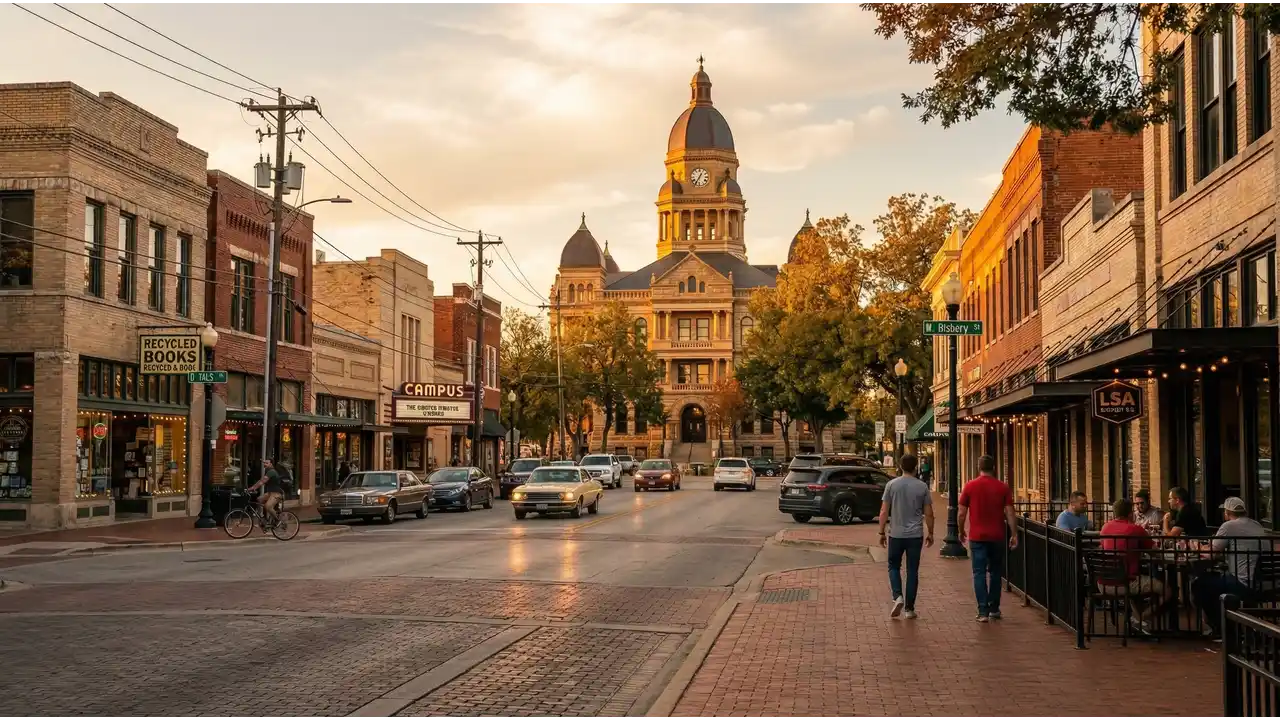
Fort Worth is a sprawling Texas city of about 1 million people, known for its cattle ranching heritage, stockyards district, and modern downtown. The climate is hot and humid in summer, mild in winter. The population is diverse, with strong Hispanic and African American communities alongside newer tech workers and young professionals. Daily life revolves around car travel; public transit exists but is limited. The city has low density outside downtown, with residential neighborhoods spreading across wide areas. Cowboys, cattle auctions, and Western culture remain visible parts of the identity, but Fort Worth is increasingly a modern metro area with growing tech, healthcare, and aerospace sectors.
💡 Local Insights
Fort Worth · 2026
Fort Worth remains genuinely affordable by US standards. A moderate lifestyle runs $2,775/month, with housing at $1,240/month being the largest expense. Most renters find one-bedroom apartments in central areas (Near Southside, Downtown) at $1,200 to $1,400/month, while outer neighborhoods drop to $900 to $1,100/month. Homeownership is realistic on middle-class incomes; median home prices sit well below Dallas or Austin. Groceries cost around $495/month for a household, slightly below the national average. Car ownership is essential; public transit (Trinity Metro bus system) exists but has limited coverage and frequency. Gas, insurance, and maintenance add significantly to monthly costs. Eating out is affordable; tacos and barbecue dominate cheap meal options at $6 to $12 per plate. Utilities run higher in summer due to air conditioning. Property taxes in Texas are high (no state income tax compensates), so long-term cost calculations differ from renters' immediate budgets. Expats often find Fort Worth cheaper than expected, especially those coming from coastal US cities or global financial hubs.
Frequently Asked Questions
How much does it cost to live in Fort Worth per month?
A moderate lifestyle in Fort Worth costs $2,775/month. This covers housing ($1,240/month), food and groceries ($495/month), utilities, transport, entertainment, and personal care. A tighter budget runs about $1,665/month, cutting back on eating out, entertainment, and discretionary spending. A comfortable lifestyle reaches $4,301/month, allowing for more spacious housing, frequent dining out, entertainment, and travel. Individual costs vary by neighborhood, lifestyle, and personal priorities. Downtown and trendy neighborhoods cost more; outer residential areas cost less.
What is the average rent in Fort Worth?
The average rent aligns with $1,240/month for a moderate lifestyle. One-bedroom apartments in central neighborhoods (Near Southside, Downtown, TCU area) typically rent $1,200 to $1,400/month. Outer residential areas offer one-bedrooms for $900 to $1,100/month. Two-bedroom rentals in central areas run $1,400 to $1,700/month, while outer areas drop to $1,100 to $1,350/month. Apartments on the south or west side are cheaper than north Fort Worth. Furnished rentals cost 15 to 20 percent more. Lease terms are typically 12 months; short-term rentals (3 to 6 months) command premium rates.
Is Fort Worth cheap to live in for expats?
Yes, Fort Worth is genuinely affordable for expats, especially those relocating from London, Singapore, Toronto, or coastal US cities. At $2,775/month for a moderate lifestyle, it is cheaper than Austin, Dallas (marginally), or Houston. Expats note that housing, food, and utilities offer real value. Disadvantages include car dependency (transport costs add up), hot summers (cooling bills spike), and limited walkability compared to denser cities. Expats from lower-cost countries (Southeast Asia, Eastern Europe, Latin America) may find it expensive. The lack of state income tax in Texas is a genuine financial benefit for higher earners.
How much does food cost per month in Fort Worth?
Groceries average $495/month for a household. A single person budgets $150 to $200/month; a couple spends $300 to $400/month. Staples are affordable: chicken breasts around $7 to $9 per pound, ground beef $5 to $7, eggs $4 to $5 per dozen, milk $3 to $4 per gallon. Eating out is cheap; tacos cost $1.50 to $3 each at food trucks, barbecue plates run $10 to $15, and casual restaurants (burgers, Tex-Mex) cost $10 to $16 per meal. Grocery stores include HEB (local chain), Kroger, and Walmart. Restaurant meals cluster around downtown and Sundance Square; ethnic food (Vietnamese, Mexican, Indian) offers good value in south and east Fort Worth.
What salary do you need to live comfortably in Fort Worth?
A comfortable lifestyle costs $4,301/month, suggesting a gross monthly salary of $5,300 to $5,700 (assuming 75 to 80 percent goes to living expenses after taxes). For a household, combined gross income of $110,000 to $140,000 annually is realistic. This allows for a nicer apartment or small house ($1,500 to $2,000/month), frequent dining out, entertainment, travel, and savings. Single earners should target $55,000 to $70,000 annually. Couples can achieve comfort at lower individual salaries. Tech and healthcare roles in Fort Worth often pay $60,000 to $90,000 starting salary; management and specialized roles exceed $100,000. Cost of living increases as you move toward downtown or premium neighborhoods.
How does the cost of living in Fort Worth compare to other places?
Fort Worth's moderate lifestyle costs $2,775 per month, with housing running $1,240 of that. You'll find it slightly cheaper than Austin, where a moderate lifestyle costs $2,875 monthly and housing reaches $1,347. If you're coming from the Northeast, expect significant savings: Providence runs $3,925 for a moderate lifestyle with housing at $2,215. The nearest real bargain is Tulsa, which comes in at $2,325 monthly overall and $831 for housing, making it roughly 16 percent cheaper than Fort Worth across the board. Fort Worth sits comfortably in the middle of the Texas market. You're paying for a growing city with decent job prospects and urban amenities, but you're not at coastal prices or major tech hub rates either.
Yes, but with significant constraints. The budget tier of $1,665/month requires careful choices. Rent must stay $800 to $950/month, meaning outer residential neighborhoods or roommates. Groceries budget tightly at $350 to $400/month (no frequent dining out). Transport relies on used car ownership or transit (ongoing expenses $150 to $200/month). Entertainment, travel, and savings shrink. Medical expenses or car repairs create shortfalls. This budget works for students, young professionals sharing housing, or those prioritizing extreme frugality. Healthcare costs are not fully covered at this level. Utilities, phone, and internet need careful management. Many living on this budget share rent, use public assistance programs, or have additional household income. It's viable but leaves little room for emergencies or lifestyle improvements.