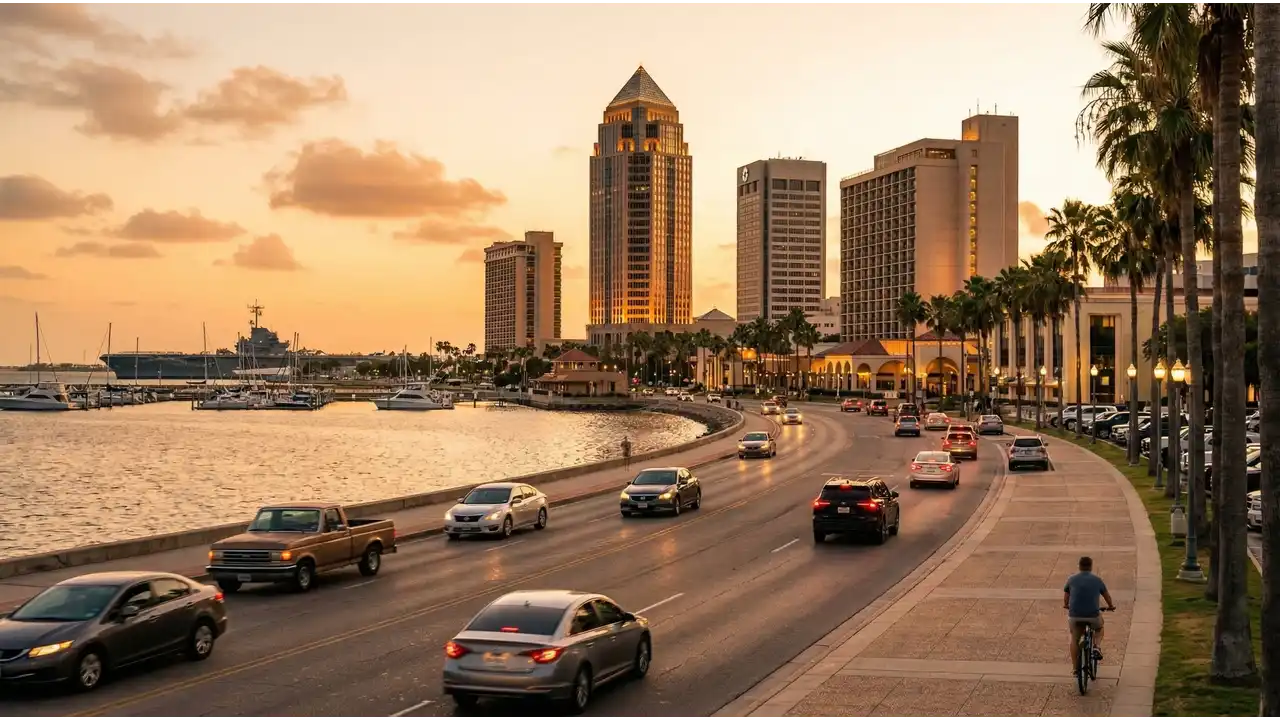
Houston is a sprawling, car-dependent city of about 2.3 million people in Southeast Texas. It is known for its energy industry, diverse immigrant population, and lack of zoning regulations that created its horizontal growth pattern. Summers are hot and humid; winters are mild. The city has no state income tax (Texas advantage). Daily life revolves around driving; public transit exists but is limited. You'll find strong job markets in energy, healthcare, and tech, plus significant expatriate communities from Latin America, Asia, and Europe. Food is affordable and diverse. Weather means air conditioning is non-negotiable.
💡 Local Insights
Houston · 2026
Houston's cost advantage stems from cheap housing and no state income tax. The moderate budget of $2,675/month is realistic for a single person or couple. Housing runs $1,143/month, which covers a one-bedroom apartment in accessible neighborhoods like Midtown, Heights, or Montrose, or a two-bedroom in outer areas like Pearland or Sugar Land. Food at $494/month assumes grocery shopping; restaurant meals are cheap by US standards (casual dining $12-18, ethnic food $8-15). Transportation is the hidden cost: car ownership is nearly essential. Gas, insurance, and maintenance easily add $300-500/month. Public transit (Metro buses, light rail) exists but covers limited routes. Utilities run $150-200/month year-round due to air conditioning demand. Expats find Houston affordable compared to coastal US cities, but more expensive than Central or South America. International groceries are abundant and cheap in areas like Chinatown and Midtown.
Frequently Asked Questions
How much does it cost to live in Houston per month?
A moderate lifestyle costs $2,675/month for one person. This breaks down as housing around $1,143/month, groceries $494/month, and the remainder for utilities, transport, dining out, and entertainment. A tighter budget of $1,605/month is possible if you live far from the center, skip car ownership, and cook at home. A comfortable lifestyle runs $4,146/month and includes a nicer apartment, regular dining out, and more discretionary spending. Texas has no state income tax, which saves working residents money.
What is the average rent in Houston?
Expect $1,143/month for housing on average. A one-bedroom apartment in central neighborhoods (Midtown, Heights, Montrose, Washington Avenue) runs $1,100-1,400/month. Two-bedroom apartments in the same areas run $1,400-1,800/month. Outer suburbs like Pearland, Sugar Land, and Katy are cheaper, with one-bedrooms at $900-1,100/month. Luxury downtown apartments exceed $2,000/month. Prices have risen steadily but remain low compared to Dallas or Austin. Most leases are 12 months. Utilities add another $150-200/month.
Is Houston cheap to live in for expats?
Yes, relative to most Western countries and coastal US cities, but not as cheap as Latin America or Southeast Asia. Housing is affordable; no state income tax is a real advantage for foreign workers. Groceries cost roughly twice what you'd pay in Mexico City or Bangkok, but half what you'd pay in London. The major cost is transportation: you need a car, which adds expense and complexity. Healthcare is excellent but expensive without insurance. For expats from Europe or Canada, Houston feels affordable. For those from Mexico, Central America, or Asia, it's noticeably pricier.
How much does food cost per month in Houston?
Groceries run $494/month for one person eating three home-cooked meals daily. Eggs cost $3-4/dozen, chicken breast $6-8/pound, and milk $3.50-4.50/gallon. International grocers in Chinatown and along Bellaire offer Asian produce and proteins 20-30% cheaper than chain supermarkets. Eating out is affordable: tacos $2-4, Vietnamese pho $8-10, Indian lunch buffets $10-12. Casual dining chains cost $12-18/meal. Grocery stores like Walmart and HEB are cheapest; Whole Foods costs 30-40% more. Hispanic and Asian markets offer better prices on produce and specialty ingredients.
What salary do you need to live comfortably in Houston?
A comfortable lifestyle costs $4,146/month, suggesting an annual income around $50,000-55,000 for a single person (accounting for taxes and irregular expenses). This budget includes living in a nice one or two-bedroom apartment, eating out 2-3 times weekly, owning a reliable car, and maintaining discretionary spending on entertainment and travel. Couples can share housing, reducing the per-person requirement to roughly $35,000-40,000 annual income each. Household incomes of $70,000-80,000+ allow for savings and financial security. Lower salaries require roommates or suburban living.
How does the cost of living in Houston compare to other places?
Houston sits in the middle tier for US cities. A moderate lifestyle runs $2,675 per month, with housing at $1,143 monthly. That's slightly cheaper than Cincinnati, where the same moderate lifestyle costs $2,775 with housing at $1,206. If you're comparing to international options, Bratislava costs considerably less at $1,825 monthly overall and $886 for housing, making it roughly a third cheaper than Houston. On the other end, Anchorage, Alaska is noticeably pricier at $3,375 per month with housing at $1,282. Houston's advantage is clear against high-cost US metros, though it won't seem cheap if you're coming from smaller cities or lower-cost countries. For most American professionals, Houston offers reasonable value without requiring the sacrifice you'd make relocating to the expensive coastal cities.
Yes, but with significant constraints. This budget is the bare minimum tier. You would rent a one-bedroom apartment in distant suburbs (Pearland, Sugar Land, Katy) at $800-950/month, grocery shop carefully at $350-400/month, and eliminate discretionary spending. A roommate situation in central areas makes this more feasible. Car ownership becomes difficult; you'd rely on transit or ride-sharing selectively. Dining out is nearly off the table. Medical emergencies or unexpected repairs break the budget. This works for students or those with very low housing costs, but offers little flexibility. It requires discipline and proximity to public transit or employment.