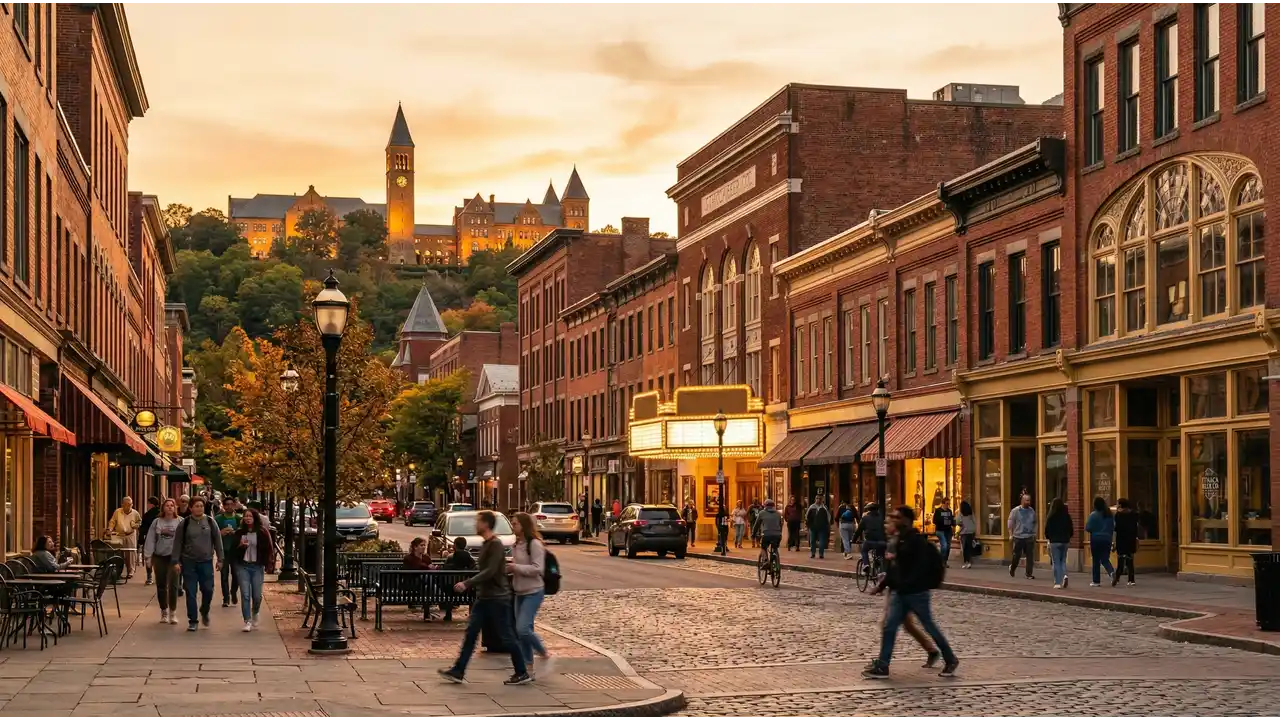
Ithaca is a college town in upstate New York, home to Cornell University and Ithaca College. The city sits at the southern tip of Cayuga Lake, surrounded by gorges and waterfalls. Most residents are students, faculty, or service workers supporting the universities. Winters are long and cold, with significant snowfall. Summers are mild. The downtown centers on The Commons, a pedestrianized street with shops and restaurants. Daily life revolves around the universities and seasonal tourism. The population swells during the academic year and contracts in summer.
💡 Local Insights
Ithaca · 2026
Ithaca's economy depends heavily on the universities, which stabilizes some costs but inflates others. Housing around $1,972/month reflects the student rental market and seasonal demand swings. Landlords often require proof of university affiliation or guarantors. Off-campus student apartments rent cheaper than family homes in residential areas like East Hill or Northside. Summer brings temporary price drops when students leave. Grocery costs run $541/month for moderate eating. Local options include Wegmans and the Farmers Market. Eating out is more expensive than comparable upstate cities due to the student and tourist base. Public transit (TCAT) is free for students but $1.50 per ride for others. Most residents own cars; parking on The Commons costs $1.50/hour. Winter heating bills spike. Internet and utilities are fairly standard. The cost-of-living estimate of $3,650/month assumes moderate spending across housing, food, and transport without major splurges or tight restrictions.
Frequently Asked Questions
How much does it cost to live in Ithaca per month?
A moderate lifestyle in Ithaca costs around $3,650/month. This includes housing at $1,972/month (for a one-bedroom apartment or small house), groceries and dining around $541/month, utilities, transport, and discretionary spending. A tight budget runs $2,190/month if you share housing and minimize eating out. A comfortable lifestyle reaches $5,658/month, allowing for larger housing, frequent dining out, and recreation. The university presence keeps some services affordable but inflates rental demand and tourism-facing costs like restaurants.
What is the average rent in Ithaca?
Average housing costs sit around $1,972/month. One-bedroom apartments in or near downtown run $1,400 to $1,700/month. Two-bedroom units range from $1,600 to $2,200/month depending on condition and location. Student apartments on the South Hill or near campus tend toward the lower end. Residential neighborhoods like East Hill or Northside command higher prices for families seeking more space. Summer sublets drop by 10 to 20 percent as students leave. Landlords frequently require a guarantor or university employment verification. Properties fill quickly in August before the fall semester.
Is Ithaca cheap to live in for expats?
Ithaca is moderately priced for upstate New York but not cheap by broader US standards. Expats from Western Europe or major US cities find it affordable. Expats from lower-cost regions (Eastern Europe, Southeast Asia) may find housing and dining more expensive than home. The main advantage is walkability around downtown and the absence of heavy urban congestion. The main challenge is the seasonal economy, which contracts in summer and around academic breaks. Healthcare access is good through the universities, though non-university expats should verify insurance. Winter weather is a significant adjustment factor.
How much does food cost per month in Ithaca?
Grocery spending averages $541/month for a moderate diet. Wegmans is the main supermarket chain. A week of basics (bread, milk, eggs, produce, meat, pasta) costs $80 to $100 for one person. The Farmers Market (year-round, Saturdays) offers cheaper seasonal produce in summer and fall. Eating out is pricey: lunch runs $12 to $18, dinner entrees $18 to $28. The Commons has student-friendly options and pizza places under $15. Alcohol is standard US pricing. Cafes and bars cater to students and tourists, so prices skew high for a town this size.
What salary do you need to live comfortably in Ithaca?
A comfortable lifestyle requires around $5,658/month, or roughly $68,000 per year before tax. This budget allows for $2,200 to $2,400/month housing (a larger apartment or small house), $700 to $800 on food including regular dining out, and discretionary spending on entertainment, hobbies, and travel. Single earners at this level cover their costs without major strain. Couples can live well on a combined $80,000 to $90,000. Lower salaries work with cost-sharing or budget discipline. Cornell and Ithaca College positions often include housing subsidies or reduced-cost faculty housing, which materially lowers the effective salary needed.
How does the cost of living in Ithaca compare to other places?
Ithaca runs $3,650 for a moderate lifestyle, with housing at $1,972 per month. That puts it squarely in the middle-to-upper range for US cities. For context, Fort Worth costs $2,775 overall and $1,240 for housing, making it notably cheaper. Tampa sits closer to Ithaca at $3,100 for a moderate lifestyle and $1,492 for housing. San Francisco is substantially dearer at $5,200 monthly, with housing alone at $3,302. Ithaca's costs reflect its status as a college town with limited housing supply and a strong service sector. If you're coming from a major coastal city, you'll likely find it affordable. If you're relocating from smaller towns in the South or Plains states, expect to spend more here.
Yes, but with real constraints. A $2,190/month budget requires shared housing at $900 to $1,100/month (a room in a house or shared apartment), tight grocery spending around $300 to $350/month, minimal dining out, and reliance on TCAT transit or biking. Winter heating costs can strain this budget. No buffer for car ownership, regular travel, or medical emergencies. This tier works for students with university support or individuals with other income sources. It demands disciplined spending and proximity to work or campus. Summer is harder because housing costs and fewer service jobs. It is sustainable long-term only with roommates and intentional frugality.