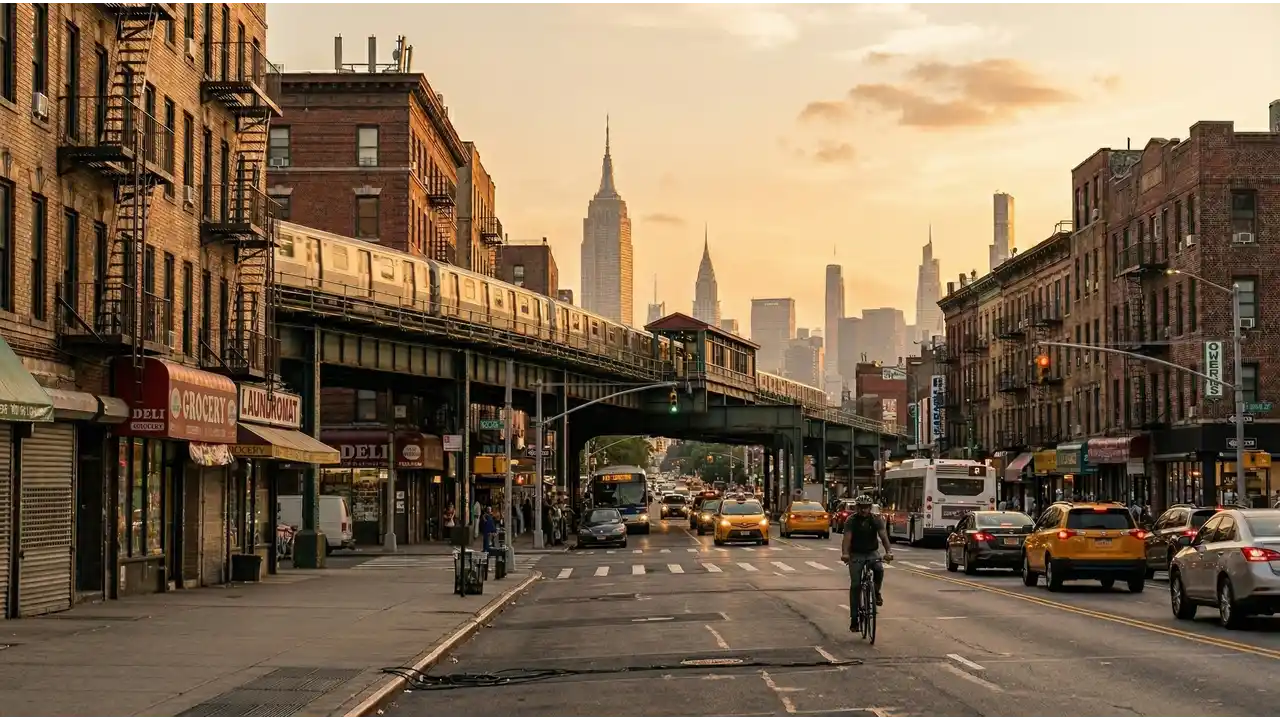
Queens is New York City's largest borough by area and second-largest by population, with roughly 2.3 million residents. It stretches from the East River to Nassau County and contains everything from industrial waterfront to quiet residential blocks. The borough is genuinely diverse: Astoria has Greek and Eastern European populations, Flushing is predominantly Chinese and Korean, Jackson Heights is Latino and South Asian, Forest Hills is middle-class Jewish and Italian. Daily life means using the subway (7, N, Q, F, and other lines crisscross the borough), shopping at neighborhood grocers and big-box stores, eating at thousands of ethnic restaurants. Summer gets hot and humid; winters are cold with occasional snow. Housing ranges from old garden apartments to new condos. Most people commute to Manhattan for work.
💡 Local Insights
Queens NY · 2026
Queens costs less than Manhattan but more than outer boroughs or suburbs. Housing averages $3,508 per month and dominates your budget. A one-bedroom in Astoria or Long Island City runs $2,200-$2,800; Forest Hills or Bayside closer to $2,000-$2,400; Flushing $1,900-$2,300. Newer buildings and proximity to subway hubs command premiums. Food costs $546 monthly for groceries if you shop at supermarkets like Key Food or Compare Foods; ethnic markets (Chinese, Korean, Latin American) often undercut chains. Eating out ranges from $4 lunch specials (local diners, Chinese takeout) to $16-25 for casual sit-down meals. The subway costs $33/month (unlimited pass). Many expats find Queens cheaper than expected but discover that 'affordable' still means budgeting carefully. Local wages don't match Manhattan rates, so a $60,000 salary stretches differently here. Avoid comparing Queens to suburbs; transit access makes it genuinely different.
Frequently Asked Questions
How much does it cost to live in Queens NY per month?
A moderate lifestyle in Queens costs $5,200 per month. This breaks down as: housing $3,508, food (groceries) $546, utilities and internet roughly $250, local transit $33, and the remainder for dining out, entertainment, and incidentals. This assumes a single person or couple sharing an apartment. The budget tier is $3,120/month (tight, roommates likely), while comfortable living (eating out regularly, no roommates, some savings) runs $8,060/month. Most people working in Queens earn between $45,000-$75,000 annually, making the moderate budget realistic but requiring discipline.
What is the average rent in Queens NY?
Average rent is $3,508 per month across the borough. One-bedroom apartments range from $1,900-$2,800 depending on neighborhood. Long Island City and Astoria (closest to Manhattan, best transit) command $2,400-$2,800. Forest Hills and Bayside (quieter, residential) are $2,000-$2,400. Flushing and Corona are $1,900-$2,300. Two-bedroom apartments run $2,500-$3,500. Older walk-ups and garden apartments are cheaper; newer buildings and those within one block of subway stations cost more. Landlords often require income verification (30x monthly rent or guarantor) and first month, last month, plus security deposit upfront.
Is Queens NY cheap to live in for expats?
Queens is cheaper than Manhattan but not cheap by global standards. Expats from Western Europe or other US cities will find it reasonable; those from Southeast Asia or Eastern Europe may find it expensive. Rent is the biggest surprise: $3,508/month average is more than many expats expect. Food costs depend on your habits. Ethnic groceries (Chinese, Korean, Latin American markets) are genuinely affordable. Eating out is cheaper than Manhattan but not cheap. Utilities, transit, and services are reliable. Many expat communities cluster in Astoria, Jackson Heights, and Flushing, which keeps some costs down but also concentrates higher demand. Salary expectations matter; if your employer pays you Bay Area or London rates, Queens feels affordable.
How much does food cost per month in Queens NY?
Groceries average $546 per month for one person buying at supermarkets. Specific prices: milk $3-4/gallon, eggs $2-3/dozen, chicken breasts $6-8/pound, rice $1-2/pound, vegetables $1-3 each depending on season and type. Ethnic markets (Chinese, Korean, Latin American) undercut supermarkets significantly on produce and staples. Eating out costs $4-8 for lunch specials (Chinese, deli sandwiches), $12-18 for casual dinner (pizza, Thai, tacos), $25-40+ for sit-down restaurants. A weekly meal budget of $120-150 (groceries) or $200-300 (mixed eating out and groceries) is typical for moderate living.
What salary do you need to live comfortably in Queens NY?
A comfortable lifestyle costs $8,060 per month, which translates to roughly $97,000 annually before taxes (or $130,000+ gross to account for federal and state taxes). This allows you to rent a one-bedroom without a roommate, eat out several times per week, use car or taxi services occasionally, save money, and have discretionary spending. On $8,060/month comfortable budget, housing takes $3,508, food $546, utilities $250, transit $33, leaving $3,723 for dining out, entertainment, clothing, and savings. Many people earning $80,000-$120,000 live comfortably in Queens. Below $60,000, you need roommates or the budget tier ($3,120/month) to make it work.
How does the cost of living in Queens NY compare to other places?
Queens ranks in the middle tier for major U.S. cities. A moderate lifestyle costs $5,200 per month here, with housing running $3,508 monthly. That makes Queens noticeably pricier than Chicago, where a moderate lifestyle runs $3,550 per month and housing costs $1,955. Boston is a closer peer, at $4,675 for a moderate lifestyle and $2,813 for housing, so Queens edges out Boston by several hundred dollars monthly. On the high end, Aspen, Colorado sits at $10,425 for a moderate lifestyle, roughly double Queens' cost. If you're moving from a cheaper Midwest city, expect a real jump in expenses. If you're comparing Queens to other New York City boroughs or similar dense metros on the coasts, the costs here are actually among the more affordable options available.
Yes, but it requires discipline and trade-offs. The budget tier of $3,120 per month assumes: rent $1,800-$2,200 (roommates or outer neighborhoods like Corona or Elmhurst), groceries $400-$450/month (cooking at home, ethnic markets), minimal dining out, no car, transit pass $33, and cutting entertainment and discretionary spending. You have roughly $300-400 for utilities, phone, and emergencies. Many students and junior workers live this way. It's sustainable but leaves little cushion. Unexpected expenses (medical, car repair, moving) become crises. This budget works if you have a roommate, very low rent, and discipline around food. Without roommates, $3,120 is not realistic in Queens.