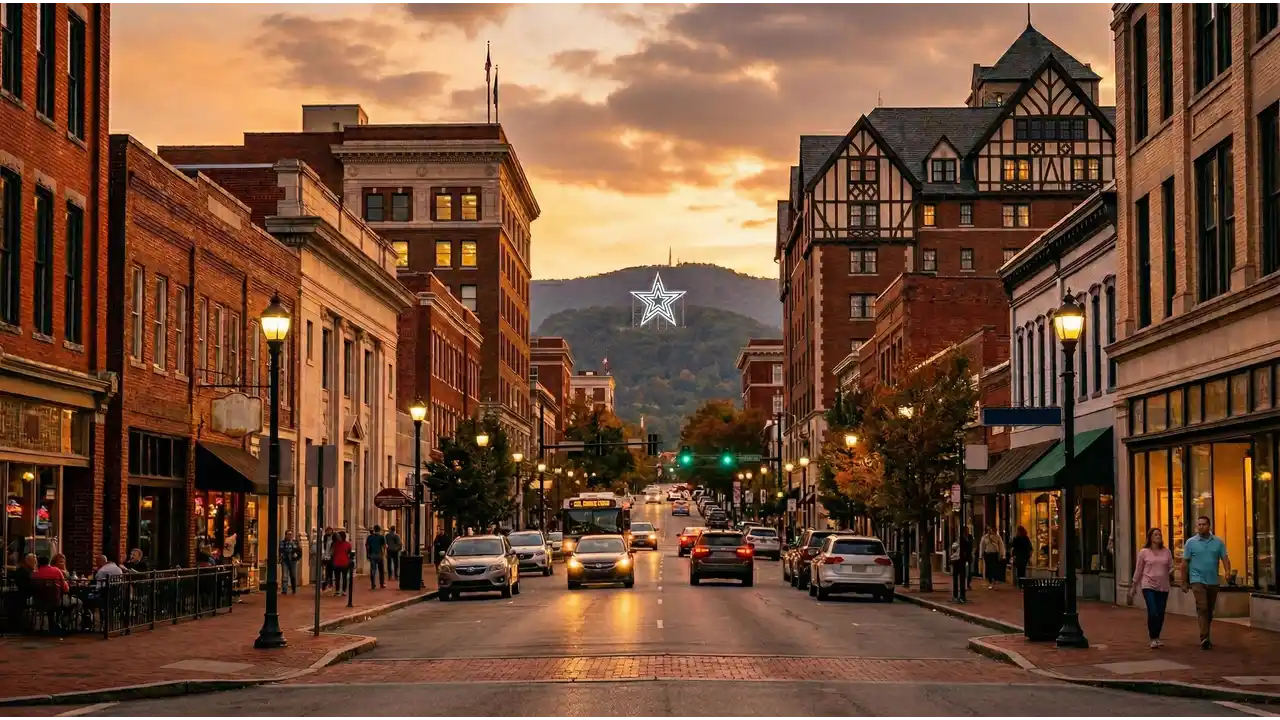
Roanoke is a mid-size city of roughly 100,000 people in Southwest Virginia's Blue Ridge Mountains. The downtown sits along the Roanoke River, with a mix of older industrial architecture and newer commercial districts. Most residents are working professionals, families, and retirees attracted by lower costs and outdoor access. Winters are mild (30s-40s Fahrenheit), summers warm and humid (80s). The city has a functional rather than flashy character: you'll find decent restaurants, a growing maker scene, and straightforward neighborhood life. Public transit exists but is limited, so a car is practical for daily living. Four distinct seasons and proximity to hiking make the area appealing to people who prioritize outdoors and affordability over urban density.
💡 Local Insights
Roanoke VA · 2026
Roanoke's low cost of living stems from its size and location. Housing averages $1,181 per month, which typically means a one-bedroom apartment downtown around $850-950, or a two-bedroom in nearby neighborhoods like South Roanoke or Grandin Village closer to $1,100-1,200. Homeownership is affordable; single-family homes in working-class areas run $180,000-250,000. Groceries run about $514 monthly for a single person eating basic meals at stores like Food Lion, Harris Teeter, or Walmart. Local restaurants are reasonably priced: casual lunch under $12, dinner entrees $14-20. Public transit (Valley Metro) costs $1.75 per ride; most residents own cars and gas is standard US pricing. Healthcare is cheaper than national averages because labor costs are lower. Utilities run $100-150 monthly depending on season. The main cost driver remains your transport and housing decisions. Unlike tourism-driven mountain towns, Roanoke doesn't have expat-specific markup pricing. Your dollar stretches furthest in working-class neighborhoods north and east of downtown; South Roanoke and areas near Hollins University command modest premiums but stay reasonable.
Frequently Asked Questions
How much does it cost to live in Roanoke VA per month?
A moderate lifestyle costs around $2,775 per month. Housing accounts for $1,181 of that, groceries $514. The remaining budget covers transport, utilities, dining out, entertainment, and personal services. A budget lifestyle (cutting discretionary spending) runs approximately $1,665 monthly, while a comfortable lifestyle with dining out regularly, hobbies, and travel savings costs roughly $4,301. These figures represent a single adult; couples can share housing and utilities but spend more on groceries and transport. Most residents fall in the $2,000-3,500 range depending on neighborhood choice and lifestyle.
What is the average rent in Roanoke VA?
Average rent is approximately $1,181 per month. A one-bedroom apartment downtown or in popular areas like South Roanoke runs $850-1,000. Two-bedroom units average $1,100-1,300. Older neighborhoods north of downtown offer units around $750-900. Newer complexes near retail (Colonial Avenue, Orange Avenue) command $1,200-1,350. Single-family rental homes range $1,200-1,600 depending on condition and neighborhood. Prices have risen modestly over recent years but remain well below comparable Southeast cities. Landlords typically require first month, last month, and deposit. Finding rentals under $800 is possible in less central areas but means longer commutes.
Is Roanoke VA cheap to live in for expats?
Yes, Roanoke is genuinely affordable by US and international standards. Expats accustomed to Western Europe, Australia, or major US metros find significant savings. Housing, food, and transport all undercut national averages. The tradeoff is limited public transit and fewer international amenities like diverse grocery stores or international restaurants, though these exist in small measure. The city attracts remote workers and digital nomads specifically for cost efficiency. You will not find the walkability of larger cities or the cultural density of coastal areas. For expats prioritizing financial efficiency over cosmopolitan lifestyle, Roanoke delivers value. Language is English. Healthcare quality is solid but less specialized than major medical centers.
How much does food cost per month in Roanoke VA?
Groceries for one person average $514 monthly, roughly $17 daily. Common costs: chicken breasts $2.50/lb, ground beef $5-6/lb, eggs $3-4/dozen, milk $3-3.50/gallon, bread $2-2.50, apples $1.50-2/lb. Mid-range supermarkets like Food Lion and Harris Teeter set prices slightly higher than Walmart. Farmers markets operate seasonally (spring through fall) with competitive produce pricing. Eating out: casual sandwiches $8-10, diner breakfast $8-12, dinner entrees at independent restaurants $14-22, chains $12-16. Fast food runs $7-9. Alcohol is cheaper than many states; wine $7-12, craft beer $5-7. Groceries cost slightly less than national BLS averages, especially for meat and eggs.
What salary do you need to live comfortably in Roanoke VA?
A comfortable lifestyle costs around $4,301 monthly, which translates to a gross annual salary of $52,000-55,000 accounting for taxes. This budget assumes renting a pleasant two-bedroom apartment, eating out twice weekly, maintaining a car, covering health insurance, and saving modestly. With a $60,000 salary, you can comfortably cover all major expenses and build emergency savings. Homeownership on a $50,000-60,000 salary is feasible but tight; you'd target affordable neighborhoods and require a substantial down payment. Dual-income households at $80,000+ combined have considerable financial cushion. Local wages trail national averages, so compare against Virginia job postings rather than national figures when considering relocation.
How does the cost of living in Roanoke VA compare to other places?
Roanoke sits in the middle of the cost-of-living spectrum for mid-sized American cities. A moderate lifestyle costs $2,775 per month here, with housing running $1,181 monthly. That makes it noticeably cheaper than Raleigh, where the same moderate lifestyle reaches $2,900 monthly and housing alone costs $1,317. Compared to Miami, Roanoke is substantially less expensive. A moderate lifestyle in Miami runs $3,925 monthly with housing at $2,311, nearly double Roanoke's housing costs. If you're budget-conscious, Tulsa offers lower expenses still, at $2,325 monthly with housing at $831. For most people relocating from coastal or larger metropolitan areas, Roanoke provides real savings without sacrificing urban amenities or job markets.
Yes, but with tight constraints. This budget tier requires sharing housing (rent $700-800 for your share), minimal car expenses or reliance on transit, and cooking nearly all meals. You'd skip dining out, entertainment spending, and discretionary purchases. Utilities, phone, and internet consume $80-120. Groceries require careful shopping and bulk buying to stay under $300 monthly. This budget works if you have stable housing and no dependents, or if you're comfortable in a working-class neighborhood. It's sustainable long-term but leaves minimal financial buffer for unexpected costs. Medical emergencies, car repairs, or emergencies become problematic. This is genuine subsistence living, not comfortable budget living. People do it, typically as students, recent arrivals saving aggressively, or those receiving supplementary income or support.