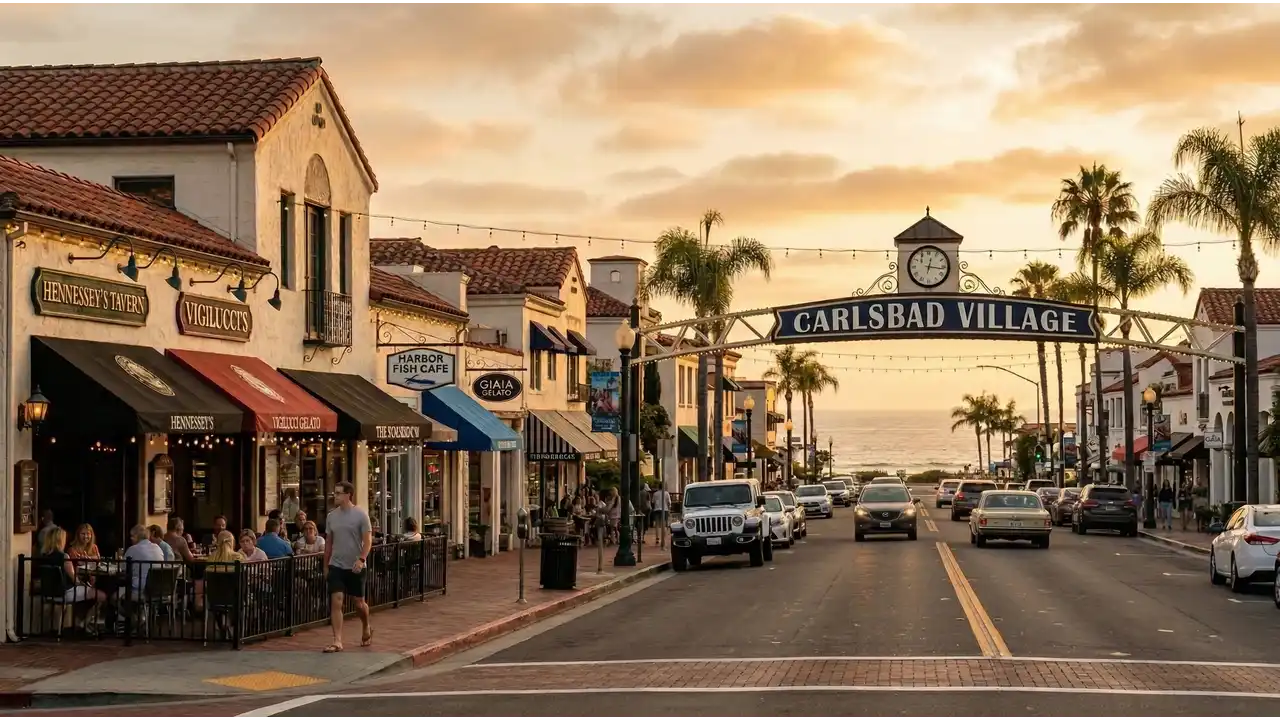
San Diego is a sprawling coastal city of 1.4 million people known for year-round mild weather, military presence, and a laid-back character that attracts families, young professionals, and retirees. Daily life centers on neighborhoods from downtown's urban core to suburban communities inland. The city has strong Mexican cultural influence, active beach culture, and a growing tech sector. Traffic is significant; most people drive. Summer temperatures rarely exceed 80 degrees Fahrenheit, winter rarely dips below 50. The cost of living reflects California's housing pressure and proximity to the ocean, though San Diego remains cheaper than Los Angeles or the San Francisco Bay Area.
💡 Local Insights
San Diego · 2026
San Diego's cost structure is driven primarily by housing scarcity and California regulations. Rent averages $2,533 per month for a moderate lifestyle, with variation by neighborhood: closer to downtown and coastal areas command premiums, while inland suburbs like El Cajon or Chula Vista run lower. Detached homes and condos with yard space cost significantly more. Groceries run about $618 per month for a single person buying at chain supermarkets like Vons or Ralphs; farmers markets and ethnic markets (especially in neighborhoods like North Park or Chicano Park) offer cheaper produce. Transportation costs depend on car ownership. Public transit (MTS bus and trolley) is limited outside downtown; most residents drive and budget for parking, fuel, and insurance. Expats accustomed to East Asian or Latin American cost bases will find San Diego expensive; those from Europe or other US coastal cities may find it moderate. Dining out ranges from $12 for casual tacos to $50 plus for restaurants in Gaslamp Quarter or Pacific Beach.
Frequently Asked Questions
How much does it cost to live in San Diego per month?
A moderate lifestyle costs $4,450 per month. This breaks down roughly to $2,533 for housing (rent or mortgage equivalent), $618 for groceries, and the remainder for transport, utilities, dining, and discretionary spending. A budget tier lifestyle runs $2,670 per month (minimal housing, no dining out, shared accommodation); a comfortable tier with more space, dining flexibility, and leisure spending reaches $6,898 per month. Individual costs vary significantly by neighborhood choice and lifestyle preferences.
What is the average rent in San Diego?
Average rent is approximately $2,533 per month for a moderate lifestyle. A one-bedroom apartment in central neighborhoods like North Park or Hillcrest ranges from $2,200 to $2,800; beachfront and downtown locations (Pacific Beach, Downtown San Diego) run $2,800 to $3,500. Inland suburbs like El Cajon, La Mesa, or Chula Vista offer one-bedrooms from $1,900 to $2,400. Two-bedroom apartments range from $2,800 to $3,500 depending on location. Detached homes and condos with yards typically exceed $3,200. These figures reflect rental market conditions and are consistent with moderate lifestyle budgeting.
Is San Diego cheap to live in for expats?
San Diego is moderately expensive for expats, depending on origin. Those from London, Sydney, or Toronto will find it comparable or slightly cheaper. Expats from Southeast Asia, Mexico, or Eastern Europe will find it significantly expensive, particularly for housing. The $2,533 monthly rent baseline is high in global terms. However, San Diego offers several advantages: strong expat networks, efficient English-language services, established communities from Mexico and Asia, and California's legal and financial stability. International schools exist but cost $15,000 to $30,000 annually. The moderate tier of $4,450 per month is realistic for a single expat with modest housing.
How much does food cost per month in San Diego?
Groceries average $618 per month for one person shopping at standard supermarkets (Vons, Ralphs, Sprouts). Specific prices: a dozen eggs cost $3 to $4, ground beef $6 to $8 per pound, chicken $2.50 to $4 per pound, milk $4 to $5 per gallon. Farmers markets and ethnic markets in neighborhoods like North Park, City Heights, and Chicano Park offer cheaper produce, 15 to 30 percent below chain prices. Dining out costs $12 to $18 for casual meals (tacos, pho, pizza), $20 to $35 for mid-range restaurants, $50 plus at Gaslamp Quarter venues. Monthly dining out adds $200 to $400 depending on frequency.
What salary do you need to live comfortably in San Diego?
A comfortable lifestyle costs $6,898 per month, requiring an annual income around $83,000 to $86,000 before taxes, or roughly $110,000 to $130,000 depending on tax brackets and deductions. This tier supports a one-bedroom or modest two-bedroom apartment, regular dining out, gym membership, entertainment, and travel. For a couple or family, add $3,000 to $4,000 monthly for each additional person. Self-employed individuals should budget 25 to 30 percent above these figures for taxes and benefits. San Diego's median household income is approximately $90,000, suggesting many households live at or near the budget tier.
How does the cost of living in San Diego compare to other places?
San Diego's moderate lifestyle costs $4,450 per month, with housing taking up $2,533 of that. You'll find it sits in the middle tier of major US cities. Boston runs $4,675 monthly overall and $2,813 for housing, making it slightly pricier across the board. New York City is substantially more expensive at $5,775 for a moderate lifestyle and $4,100 for housing alone. On the other end, Boise costs $3,100 monthly with housing at $1,523, offering real savings if you're willing to move inland. San Diego's cost reflects its status as a major coastal city with strong job markets and desirable weather. If you're coming from a smaller metro or the Midwest, you'll notice the jump. If you're relocating from the Northeast or New York specifically, San Diego will feel like relief on your budget.
Yes, but with strict choices. The budget tier supports living in shared housing (studio or one-bedroom split), minimal dining out, no car ownership, and limited entertainment. Realistic breakdown: $1,200 to $1,500 for a shared bedroom or studio in inland areas like El Cajon; $400 to $500 for groceries; $300 for transit passes and bike; $200 for utilities and phone; $70 remaining for everything else. This requires no car, cooking most meals, no regular dining out, and heavy use of free activities (beaches, parks, libraries). It is feasible for students, very young professionals, or those with additional non-cash support. Most working adults find this tier unsustainable beyond 6 to 12 months.