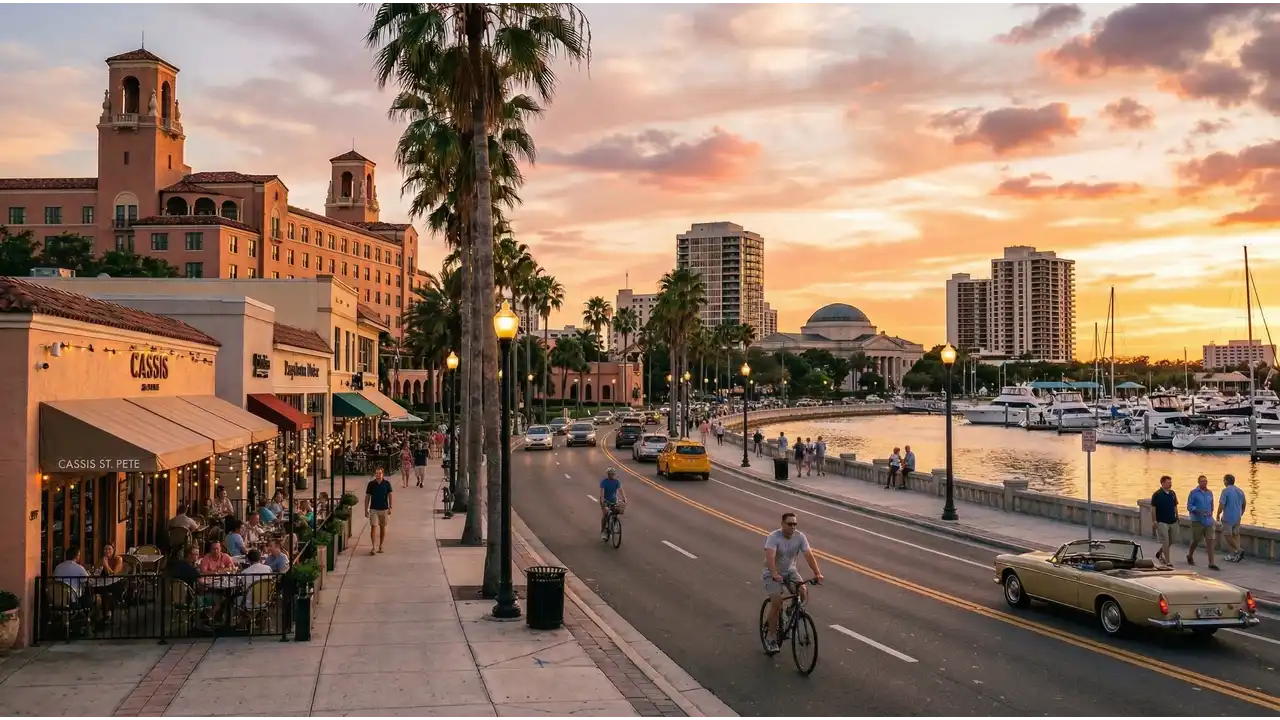
St. Petersburg is a mid-sized waterfront city on Florida's Gulf Coast with roughly 260,000 residents. The downtown has a functioning arts district, working marinas, and weekday foot traffic from office workers and retirees. The climate is subtropical and humid, with summer thunderstorms and a hurricane season from June through November. The population is mixed: working families, retirees on fixed incomes, service industry workers, and a growing number of remote workers. Daily life centers on car travel, though the downtown core is walkable. The beach is minutes from most neighborhoods. Housing costs have risen sharply over the past five years, and inventory remains competitive.
💡 Local Insights
St. Petersburg FL · 2026
St. Petersburg's cost structure is shaped by its waterfront location, limited land, and appeal to remote workers relocating from higher-cost metros. Housing runs around $1,739/month, making it expensive relative to inland Florida but cheaper than Tampa or Miami. Rental inventory is tight; expect competitive markets for standard units under $1,600/month and premium options (downtown, waterfront views) exceeding $2,000/month. Groceries average $520/month for a household, roughly in line with national figures, though produce prices spike during summer due to limited local growing. Eating out costs more than many inland towns. Car ownership is essential; there is limited public transit (PSTA bus system exists but coverage is sparse). A used Honda or Toyota runs $8,000 to $12,000 depending on mileage. Utilities for a one-bedroom apartment run $120 to $180/month. Parking downtown is metered but reasonably priced. Insurance, childcare, and healthcare follow Florida state norms. Expat networks exist but are smaller than in Miami or Tampa. Prices are consistent year-round; no seasonal variance in rent.
Frequently Asked Questions
How much does it cost to live in St. Petersburg FL per month?
A moderate lifestyle in St. Petersburg costs $3,350/month. This covers housing around $1,739/month, groceries roughly $520/month, utilities ($120 to $180), car-related expenses, and discretionary spending. A tighter budget works at $2,010/month, cutting out dining out, entertainment, and requiring roommates or frugal housing choices. A comfortable lifestyle with dining out regularly, hobbies, and travel runs closer to $5,193/month. These figures assume car ownership, which is standard here.
What is the average rent in St. Petersburg FL?
Monthly housing costs average $1,739. A one-bedroom apartment in a standard neighborhood rents for $1,400 to $1,800/month. Two-bedroom units run $1,700 to $2,100/month. Downtown and waterfront properties command premiums, often $1,900 to $2,400+/month for comparable space. Neighborhoods like Old Northeast and Vinoy Park trend toward the higher end. More affordable areas include Azalea-Pinewood and Johns Pass, where one-bedrooms can be found in the $1,300 to $1,500 range. Most leases require first month, last month, and security deposit upfront.
Is St. Petersburg FL cheap to live in for expats?
St. Petersburg is moderately priced for expats, cheaper than Miami or South Florida's coastal areas but costlier than inland Florida. For expats arriving from Latin America or Western Europe, housing is generally reasonable. For those from lower-cost regions, expect sticker shock. The main advantage is an established expat population, accessible healthcare, English-language infrastructure, and proximity to Tampa. The downsides: car dependency, competitive rental markets, and rising costs over the past five years. It's a practical choice for expats working remotely on North American or Western salaries, less so for those on developing-market incomes.
How much does food cost per month in St. Petersburg FL?
Groceries for one person average $520/month. A week of basic groceries (chicken, rice, vegetables, eggs, dairy) costs $40 to $60 at Publix or Winn-Dixie. Eating out is more expensive: casual lunch runs $12 to $16, dinner at a mid-range restaurant $18 to $28 per entree. The downtown and waterfront districts have pricier spots ($25 to $40+ per entree). Ethnic markets (Latin, Asian) in surrounding areas offer lower prices on their specialty items. Farmers markets operate year-round, offering produce at competitive prices.
What salary do you need to live comfortably in St. Petersburg FL?
A comfortable lifestyle costs $5,193/month, suggesting a gross monthly income of around $6,500 to $7,000 (accounting for taxes and savings). Annualized, that's roughly $78,000 to $84,000 before tax. This budget accommodates dining out, hobbies, travel a few times per year, and savings. For a household with two earners or remote work paying market rates, this is achievable. For single earners or those on service industry wages, comfortable living becomes harder. The moderate figure of $3,350/month requires roughly $4,200 to $4,500 gross monthly income.
How does the cost of living in St. Petersburg FL compare to other places?
St. Petersburg sits in the moderate tier for Florida coastal cities. A moderate lifestyle runs $3,350 per month, with housing at $1,739 per month.
Against comparable peers, St. Petersburg is slightly pricier than Savannah, Georgia, where a moderate lifestyle costs $3,075 monthly and housing runs $1,504. If you're coming from a lower cost-of-living region, Omaha offers substantially lower expenses at $2,650 per month overall and $1,111 for housing, though you're trading coastal Florida for the Midwest.
Conversely, if you're relocating from Boston, St. Petersburg will feel like genuine relief. Boston's moderate lifestyle reaches $4,675 monthly with housing at $2,813, nearly double St. Petersburg's housing costs.
The housing difference is the real story: St. Petersburg's $1,739 monthly rent or mortgage payment sits well below major Northeastern metros while remaining higher than inland alternatives.
Can you live in St. Petersburg FL on $2,010/month?
Yes, but with significant trade-offs. This budget tier requires shared housing (roommates or a studio outside downtown), minimal dining out, and public transit or a paid-off used car. Groceries stay at $450 to $500/month on a strict diet. Utilities, insurance, and phone add $200 to $250. Entertainment and travel are near zero. This works for students, young workers saving aggressively, or those with low housing costs. Many residents on this budget supplement income with side work or depend on assistance. It's sustainable short-term but limits quality of life for most.