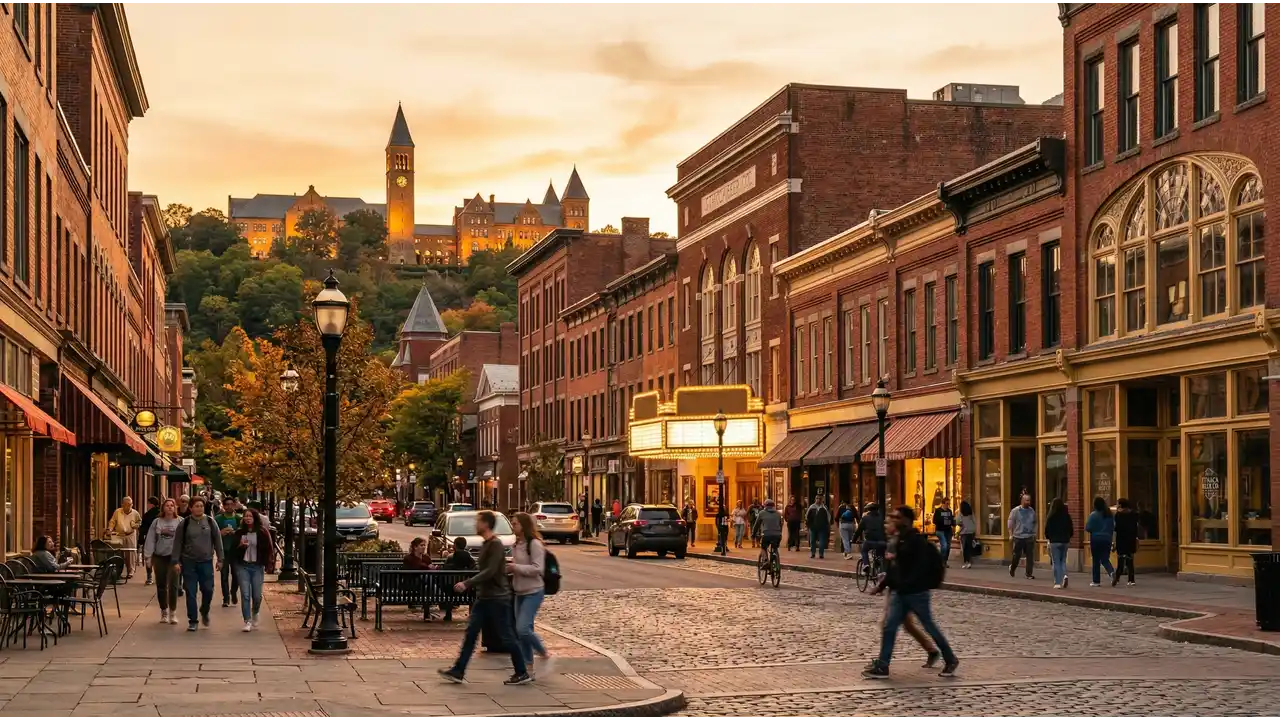
Syracuse is a post-industrial city in central New York with a population around 150,000. The economy centers on healthcare, education (Syracuse University), and technology. Winters are long and snowy; summers are mild. The city has a working-class character with visible disinvestment in some neighborhoods alongside ongoing downtown revitalization. Daily life revolves around car travel outside the center, affordable dining, and access to Finger Lakes recreation within an hour's drive. Housing stock is older, predominantly single-family homes and small apartment buildings.
💡 Local Insights
Syracuse · 2026
Syracuse's affordability stems from post-recession economic patterns and lower regional wages compared to coastal metros. Housing costs around $1,228/month reflect the glut of older housing stock and subdued demand. Monthly groceries run approximately $547/month for a moderate diet. Neighborhoods vary sharply: downtown and the University Hill area command higher rents and attract younger residents; South Side and West Side offer cheaper housing but fewer services. Public transit (Centro buses) exists but is limited; a car is essential for most residents. Utilities run high in winter due to heating demand. Eating out is genuinely cheap, with good ethnic restaurants (Italian, Chinese, Puerto Rican) under $15 per meal. Local wages are low, so expat remote workers with outside income have substantial purchasing power. Property taxes are moderately high for New York State.
Frequently Asked Questions
How much does it cost to live in Syracuse per month?
A moderate lifestyle costs $2,925/month. This breaks down to housing around $1,228/month, groceries approximately $547/month, and the remainder covering utilities, transport, insurance, and discretionary spending. A tight budget runs $1,755/month (housing, food, essentials only with no car ownership or minimal dining out). A comfortable lifestyle with dining out, entertainment, and savings runs $4,534/month. These figures reflect a single adult; families will spend more on food and housing.
What is the average rent in Syracuse?
Average rent is around $1,228/month, though this varies by neighborhood and property condition. A studio or one-bedroom in walkable downtown or near the university runs $800-$1,100/month. Older two-bedroom houses rent for $900-$1,300/month. Three-bedroom houses range $1,000-$1,500/month. Neighborhoods like University Hill and Westcott command premiums; South Side and outer West Side are 20-30 percent cheaper. Most housing is older with variable maintenance. Furnished short-term rentals run higher, $1,200-$1,600/month.
Is Syracuse cheap to live in for expats?
Yes, for expats with remote income earning US or Western European salaries. $2,925/month covers moderate living easily. Rent is low enough to live alone affordably or share a house cheaply. Groceries are inexpensive. However, Syracuse is isolated without a major airport, transit is car-dependent, and the climate is harsh. The job market for newcomers is weak. Expat communities are small, so those seeking built-in social networks will struggle. It appeals to remote workers prioritizing cost and quiet over cultural amenities.
How much does food cost per month in Syracuse?
Groceries average $547/month for a moderate single-adult diet. Ground beef runs $4-$5/pound; chicken breast $3-$4/pound; eggs $2-$3/dozen. Milk is $3.50-$4/gallon. Local produce at farmers markets (summer-fall) is competitive. Eating out is cheap: casual meals $10-$15, ethnic restaurants (Italian, Puerto Rican, Chinese) $12-$18 for dinner. A moderate budget assumes cooking most meals with occasional restaurant visits. Drinking coffee and alcohol daily adds $100-$150/month.
What salary do you need to live comfortably in Syracuse?
A comfortable lifestyle runs $4,534/month, suggesting a gross salary around $55,000/year ($4,583/month) for a single person before taxes. For households, both earners working at modest incomes ($28,000-$32,000 each) achieves this comfortably. This budget includes dining out 2-3 times weekly, entertainment, savings, and car ownership. Many residents earn less and live frugally. Remote workers earning outside New York often find $3,000-$3,500/month sufficient for comfort. Local median household income is approximately $38,000.
How does the cost of living in Syracuse compare to other places?
Syracuse sits in the middle of the American cost-of-living spectrum. A moderate lifestyle costs $2,925 per month, with housing running $1,228 per month.
To put that in context, Tulsa is genuinely cheaper across the board, with a moderate lifestyle at $2,325 per month and housing at $831 per month. Nashville, a peer city, runs slightly higher at $3,075 per month overall, though its housing costs $1,589 per month, making it noticeably pricier for rent or mortgage. Seattle operates in a different tier entirely, where a moderate lifestyle reaches $3,950 per month and housing alone costs $2,177 per month.
Syracuse works well if you want reasonable affordability without sacrificing urban amenities. Your money stretches further here than in most major metros, but you're not getting the rock-bottom prices of smaller regional centers.
Yes, but with severe constraints. This budget allows $1,228/month for housing (shared housing or older rental), $400/month for groceries (basics only, minimal dining out), $80/month for utilities, and almost nothing for transport, entertainment, or medical unexpected costs. Public transit is unreliable; owning a car is difficult on this budget. No cable, limited phone plan, no gym membership. Winter heating bills can spike beyond budget. It's survival-level, workable for short-term, but unsustainable long-term without supplemental income or significant lifestyle compromises.