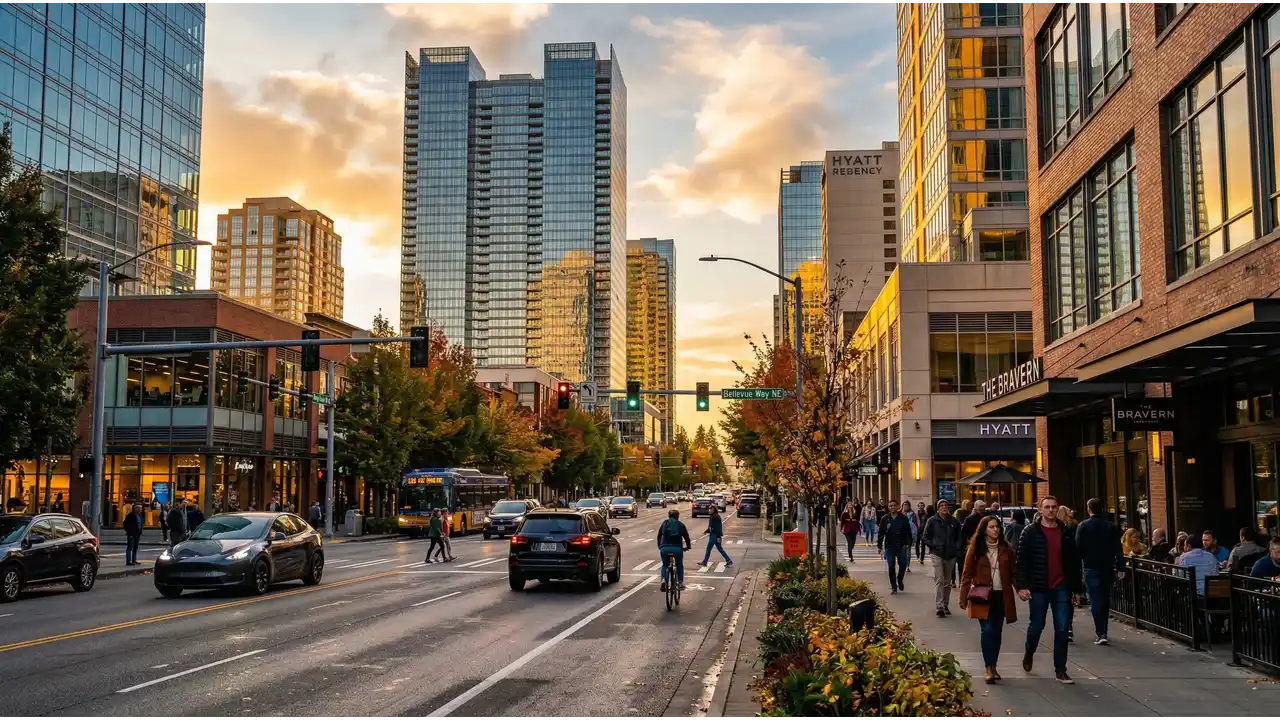
Tacoma is a working port city 30 miles south of Seattle on Puget Sound. It has a mix of industrial waterfront, older residential neighborhoods, and a downtown that has seen recent investment. The climate is Pacific Northwest standard: mild, wet winters and dry summers. The population is around 220,000, with a lower cost base than Seattle but similar job opportunities, especially in logistics, manufacturing, and government (Joint Base Lewis-McChord is nearby). Daily life means access to water recreation, a functional transit system, and a fairly direct commute to Seattle if needed.
💡 Local Insights
Tacoma WA · 2026
Tacoma costs less than Seattle partly because it lacks Seattle's tech-driven wage premium. Housing at $1,571/month reflects this gap. Neighborhoods like Hilltop and North End offer older rentals between $1,300 and $1,650 for a one-bedroom. Waterfront areas and newer construction (near downtown or UW Tacoma) run higher, $1,700 to $2,000+. Groceries run $566/month for basic cooking, slightly less than Seattle. Eating out is cheaper than Seattle's scene. Transit via Pierce Transit costs around $85/month for unlimited rides; most people drive. The I-5 corridor can be congested during commute hours. Water and utilities add roughly $150-180/month. No state income tax helps offset higher property taxes. Expats find Tacoma more affordable for a similar Pacific Northwest lifestyle than Vancouver BC or Seattle proper, though less diverse in dining and nightlife.
Frequently Asked Questions
How much does it cost to live in Tacoma WA per month?
A moderate lifestyle in Tacoma costs $3,325/month. This breaks down roughly as: housing $1,571, groceries $566, utilities and transport around $300-350, and remaining discretionary spending on dining, entertainment, and personal care. The budget tier runs $1,995/month (no car, minimal dining out, shared housing). The comfortable tier is $5,154/month, which allows private housing, dining flexibility, and regular entertainment. Actual costs vary by neighborhood and personal habits.
What is the average rent in Tacoma WA?
Average rent aligns with $1,571/month for a moderate-lifestyle baseline. A one-bedroom apartment in central neighborhoods (Hilltop, North End, Downtown) typically runs $1,350 to $1,650/month. Two-bedroom apartments range $1,550 to $1,950. Older buildings and further-out neighborhoods lean toward the lower end. Newer construction or waterfront proximity pushes toward $2,000+. Single-family homes for rent start around $1,800 and climb quickly with size. Pierce County assessor and rental listing sites show these ranges consistently. Landlords typically require income 2.5 to 3 times the rent and first/last/deposit.
Is Tacoma WA cheap to live in for expats?
Yes, relative to major tech hubs and expensive Pacific Northwest cities. Tacoma undercuts Seattle by roughly 15-20% on rent and is meaningfully cheaper than Vancouver BC. For expats accustomed to London, Toronto, or Sydney, Tacoma feels genuinely affordable. However, it is not cheap compared to much of the US interior or developing countries. You pay for proximity to water, mountains, and Seattle job markets. Expat communities exist but are smaller than in Seattle; international food variety is more limited. Transit is car-dependent outside downtown, which adds hidden costs. Most expats find the trade-off (lower rent, smaller social scene) worthwhile.
How much does food cost per month in Tacoma WA?
Groceries average $566/month for one person cooking at home. Specific prices: ground beef around $5.50/lb, chicken breasts $3.50-4.50/lb, eggs $2.50-3.50/dozen, milk $3-3.50/gallon, fresh produce seasonal (apples $1.50-2/lb, tomatoes $2.50-3/lb). Eating out runs cheaper than Seattle but higher than inland Washington. A casual meal averages $13-16, nicer restaurant entrees $20-28. Grocery chains (Safeway, QFC, Costco) have competitive prices. No sales tax on groceries helps slightly. Monthly dining-out budget on a moderate lifestyle leaves room for 8-10 restaurant meals.
What salary do you need to live comfortably in Tacoma WA?
A comfortable lifestyle costs $5,154/month, implying a gross salary around $75,000-80,000/year (assuming 35% housing cost ratio and local tax burden). This covers private housing ($1,800-2,100), flexible dining and entertainment, car ownership or robust transit use, and regular travel. Couples often share costs effectively at $120,000+ combined. The moderate lifestyle ($3,325/month) requires roughly $48,000-50,000/year. Budget tier ($1,995/month) is achievable on $30,000+, though tight. Tacoma salaries trend lower than Seattle by 10-15%, so job choice matters more than raw affordability.
How does the cost of living in Tacoma WA compare to other places?
Tacoma sits in the middle of the pack for Pacific Northwest affordability. A moderate lifestyle here runs $3,325 per month, with housing at $1,571 per month. That makes it slightly pricier than Pittsburgh, where a moderate lifestyle costs $3,200 per month, though Tacoma's housing is comparable to Pittsburgh's $1,583. You'll find Tacoma substantially more expensive than Knoxville, Tennessee, where the same moderate lifestyle runs $2,800 per month and housing is $1,313 per month. The real gap opens up when you look west toward San Diego, where a moderate lifestyle jumps to $4,450 per month with housing at $2,533 per month. If you're coming from a major coastal city, Tacoma offers noticeable relief on both rent and overall expenses. If you're relocating from the Southeast or Midwest, expect to pay a premium for the Pacific Northwest trade-off.
Yes, but with clear trade-offs. The budget tier requires roommates or shared housing (studio/one-bedroom under $1,000), minimal car use or reliance on Pierce Transit ($85/month), cooking nearly all meals, and minimal entertainment spending. Groceries drop to $450-500/month through careful shopping. You cut dining out entirely, skip travel, and rely on free activities (parks, water access, libraries). This works for students, early-career workers, or those relocating temporarily. It is workable but leaves little cushion for emergencies or lifestyle variation. Most long-term residents move to the $3,325 range once established in jobs.