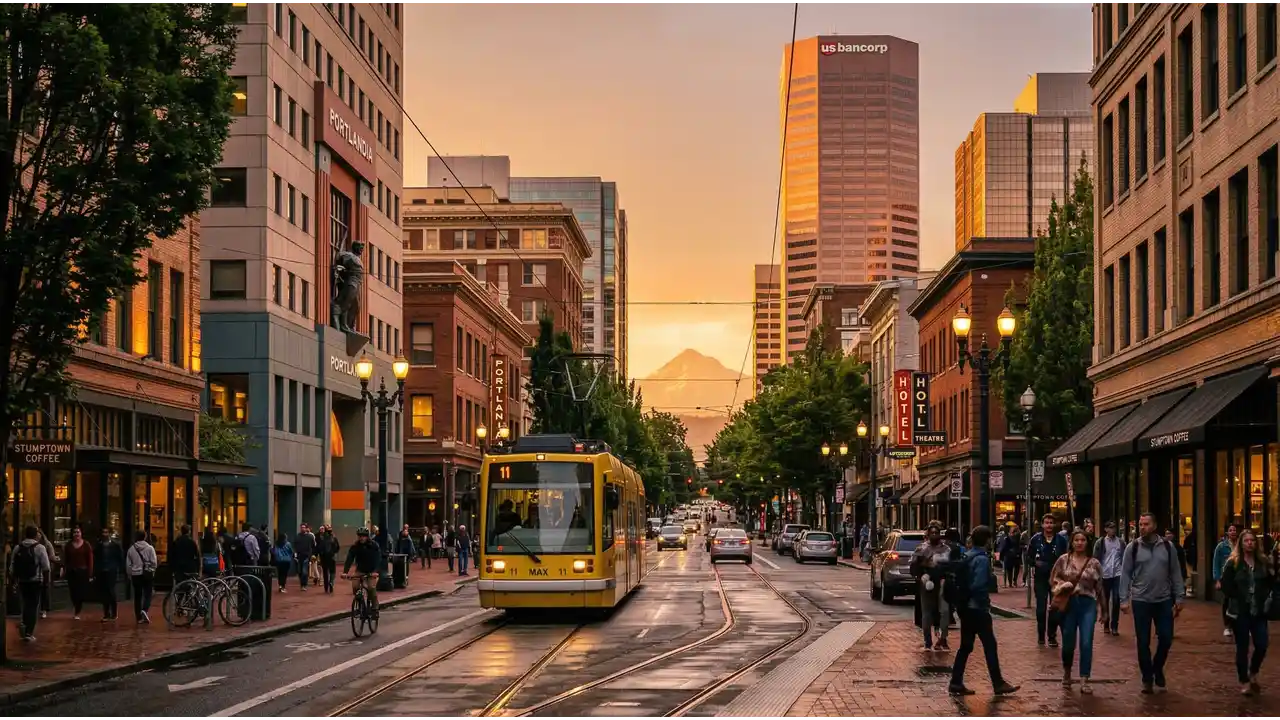
Washington state is defined by its two economic poles: Seattle dominates the west with tech jobs and urban density, while eastern Washington around Spokane offers lower costs and agricultural character. The Puget Sound region experiences frequent cloud and rain, while the east side is drier. Population clusters around Seattle-Tacoma-Bellevue, but smaller cities and towns remain affordable. Daily life in Seattle means walkability, coffee culture, and traffic; in Spokane and smaller towns, it means car dependency and quieter neighborhoods. Most residents work in tech, healthcare, aerospace, or agriculture. Winters are mild and wet on the coast, cold and dry inland.
💡 Local Insights
Washington · 2026
Washington has no state income tax, which helps offset some cost pressures. However, housing dominates the budget at $1,959 per month across the state, though this masks regional splits. Seattle-Bellevue rents run $2,200-$2,800 for a one-bedroom apartment; Spokane and Olympia average $1,200-$1,600. Outside metro areas, rents drop further. Groceries average $570 monthly, slightly above US median, driven by limited competition in rural areas and higher distribution costs. Public transportation is solid in Seattle (King County Metro) and decent in Tacoma, but car ownership is essential outside these corridors. A vehicle typically costs $200-$400 monthly (fuel, insurance, maintenance). Gas prices track national averages. Expats should expect Seattle salaries to be 10-15 percent higher than comparable roles elsewhere, partially offset by housing costs. Sales tax is 6.5-10 percent statewide, with no tax on groceries. Eating out costs $12-$18 for casual dining, $25-$40 for mid-range restaurants.
Frequently Asked Questions
How much does it cost to live in Washington per month?
A moderate lifestyle in Washington costs $3,725 per month. Housing runs $1,959 monthly, food $570. The remaining budget covers utilities ($150-$180), transportation ($200-$350), phone and internet ($80-$120), and discretionary spending. On a tighter budget, $2,235 per month is possible by choosing less central neighborhoods, cooking at home, and using transit where available. A comfortable lifestyle requires $5,774 monthly, allowing for dining out, entertainment, and newer housing in desirable neighborhoods.
What is the average rent in Washington?
Average rent in Washington is $1,959 per month. In Seattle and Bellevue, one-bedroom apartments range $2,200-$2,800; two-bedroom units run $2,700-$3,500. Tacoma and Olympia offer one-bedrooms at $1,300-$1,600. Outside metro areas (Spokane, Tri-Cities, Bellingham), rent drops to $1,100-$1,400 for a one-bedroom. Shared housing runs $800-$1,200. House rentals outside Seattle average $1,800-$2,400. Prices have been steady, though availability fluctuates seasonally. Most landlords require income verification and credit checks.
Is Washington cheap to live in for expats?
Washington is moderately priced for expats. Seattle attracts international workers with competitive salaries that often exceed comparable roles globally, but housing costs consume much of that premium. The state's lack of income tax is a genuine advantage compared to California or New York. Spokane and smaller cities are genuinely affordable. For expats relocating from the UK, Canada, or Scandinavia, costs feel reasonable; those from Southeast Asia or Eastern Europe will find it expensive. Healthcare, though good, requires insurance. Visa sponsorship is concentrated in tech, which skews the real cost picture upward.
How much does food cost per month in Washington?
Groceries average $570 per month for one person. A gallon of milk costs $4, a dozen eggs $3.50, chicken breast $8 per pound, and vegetables range $2-$4 each depending on season. Dining out runs $12-$18 for casual meals, $25-$40 for mid-range restaurants. Coffee is cultural; expect $5-$6 for specialty drinks. Rural areas pay slightly more due to transportation costs and less competition. Farmers markets operate spring through fall and offer competitive produce pricing. Costco and Safeway are common; Asian and Latin markets offer lower prices on specialty items.
What salary do you need to live comfortably in Washington?
A comfortable lifestyle in Washington requires $5,774 per month, or roughly $69,300 annually. This budget supports $2,300-$2,500 for housing, $750 for groceries and dining, $200+ for transportation, $150+ for utilities, and $1,500+ for discretionary spending on travel, entertainment, and savings. In Seattle, tech professionals earning $85,000-$120,000 live comfortably; in Spokane or smaller cities, $55,000-$70,000 is sufficient. Consider that no state income tax keeps take-home pay higher than many comparable states. Families should add $600-$1,000 monthly per child for childcare and education.
How does the cost of living in Washington compare to other places?
Washington's moderate lifestyle costs $3,725 per month, with housing running $1,959 monthly. This positions Washington roughly in the middle of the US cost spectrum.
You'll spend less here than in Massachusetts, where a moderate lifestyle costs $3,575 monthly, though Massachusetts housing is cheaper at $1,715. Michigan is noticeably more affordable overall at $2,625 per month with housing at $1,055, making it a solid option if budget is your primary concern. Bermuda, by contrast, is substantially dearer at $4,900 monthly for a moderate lifestyle.
Washington's costs reflect its dual character: strong job markets and urban amenities in Seattle drive up prices, while smaller cities and rural areas remain genuinely affordable. Your actual spending will depend heavily on whether you're based in the Puget Sound region or elsewhere in the state.
Yes, but with real constraints. This budget is the minimum for a moderate lifestyle, requiring careful choices. Rent in this range means sharing a two-bedroom ($1,000-$1,200 per room) or renting alone outside metro areas ($1,200-$1,500). Groceries and eating in dominate at $450-$500 monthly; dining out is rare. Car ownership is difficult; transit passes cost $100-$120 monthly. You'll cut back on entertainment, travel, and savings. This works in Spokane, Olympia, or small towns but is tight in Seattle. You need either free parking, no car, or lower-cost housing. One unexpected expense (car repair, medical bill) strains the budget significantly.