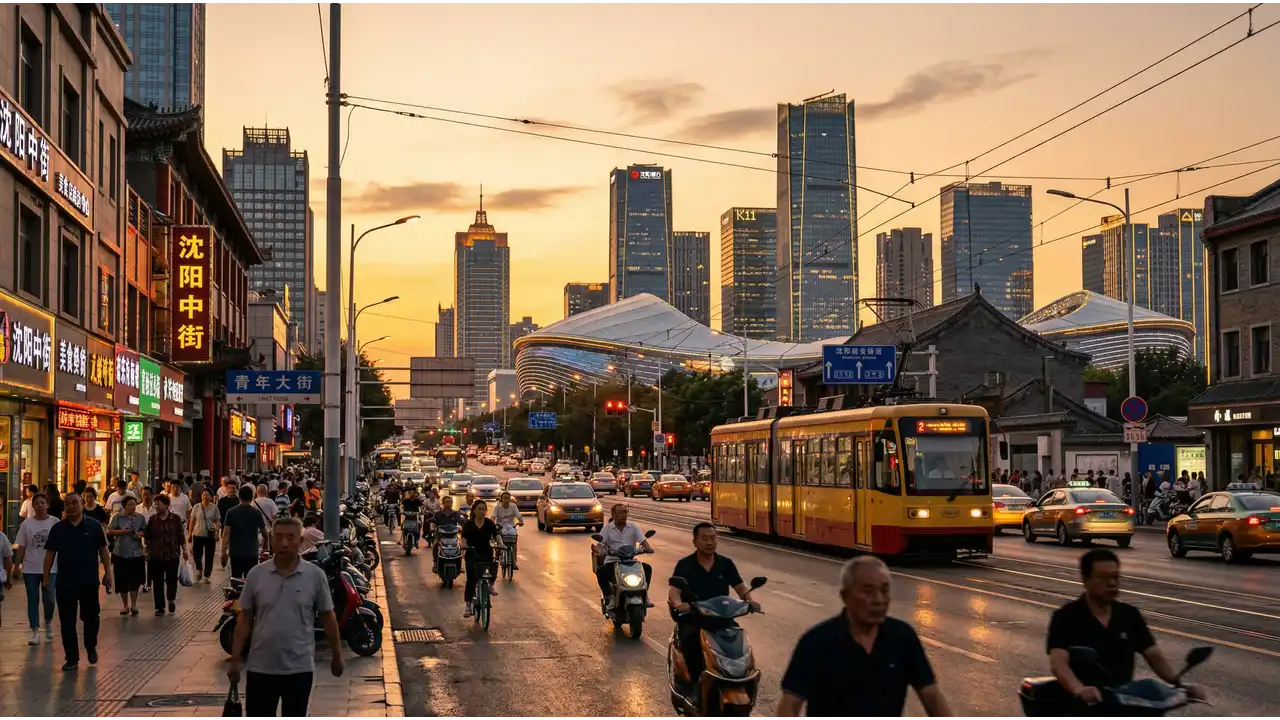
Shenyang is a post-industrial city in northeastern China's Liaoning province with a population over 8 million. The old manufacturing core has given way to new development zones, shopping districts, and residential neighborhoods. Winters are harsh, dropping to minus 10 degrees Celsius. The city draws migrant workers, young professionals, and families seeking cheaper living than coastal cities. Daily life centers on metro lines, street markets, and small restaurants. Mandarin is the working language. Air quality varies seasonally. Most residents are Chinese; foreign expat communities exist but are small. The pace is practical rather than tourist-oriented.
💡 Local Insights
Shenyang · 2026
Shenyang costs significantly less than Beijing, Shanghai, or Guangzhou, making it a realistic option for budget-conscious expats and remote workers. The $975/month moderate lifestyle assumes modest independent housing, regular restaurant meals, public transport, and basic entertainment. Housing costs are held at $371/month, the China-wide figure, because Shenyang lacks separate rent measurement in major databases. Locally, a one-bedroom apartment outside the city center rents for roughly $200-400/month, and shared housing runs lower. Groceries cost around $195/month if you shop at wet markets and chain supermarkets, avoiding imported goods. Street food and small restaurants cost $1-3 per meal. Public metro fares are under $0.50 per trip. Expats often pay slightly more for housing in central areas and imported groceries, but baseline costs remain low. Phone plans and utilities add $20-40 monthly. Winter heating bills can spike. Bargaining is normal in markets but not in shops.
Frequently Asked Questions
How much does it cost to live in Shenyang per month?
A moderate lifestyle in Shenyang costs $975/month. This covers independent housing at $371/month (the China baseline figure), groceries at $195/month, transport, and discretionary spending. A budget tier costs $585/month if you share housing, minimize eating out, and use public transport exclusively. Comfortable living runs $1,511/month with private housing in a good neighborhood, frequent dining out, and more entertainment. Individual needs vary; a couple might live on less by sharing rent, while solo travelers spend more on accommodation.
What is the average rent in Shenyang?
The housing figure CostLiving shows ($371/month) is the China-wide baseline that Shenyang inherits, not a separate measurement of Shenyang rents. Actual Shenyang rental market data is limited. Locally, a one-bedroom apartment in developing neighborhoods runs $200-350/month; central districts and newer complexes range $350-500/month. Shared housing with roommates costs $100-200/month. Studio apartments are less common than one-bedrooms. Furnished expat-targeted apartments run higher. Long-term leases (one year or longer) are standard and negotiable. Deposits typically equal one month's rent.
Is Shenyang cheap to live in for expats?
Yes, Shenyang is significantly cheaper than major expat hubs like Beijing or Shanghai. Your purchasing power is higher; a month's salary that feels tight in coastal cities stretches further here. However, expat expectations matter. If you use only expat restaurants and import Western goods, costs rise. If you shop local, eat street food, and use public services, costs drop substantially. Many expats working remotely find $1,200-1,500/month provides comfortable independent living. The trade-off is a smaller English-speaking community and less international infrastructure than larger cities.
How much does food cost per month in Shenyang?
Groceries cost approximately $195/month if you shop at wet markets, chain supermarkets (Carrefour, Walmart), and discount stores. Eggs run $0.60/dozen, rice $0.30/pound, and fresh vegetables $0.50-1.00/pound. Imported goods cost triple or more. Street food and small noodle restaurants cost $1-3 per meal. Mid-range restaurants (pizza, Japanese, hotpot) cost $4-8/meal. Convenience store snacks are cheap. Alcohol is inexpensive; local beer costs $0.50-1.50/can. Eating exclusively at local restaurants and markets keeps food well under $200/month; Western diet preferences push costs higher.
What salary do you need to live comfortably in Shenyang?
A comfortable lifestyle costs $1,511/month, suggesting a monthly income of $1,800-2,000 (accounting for taxes and buffer). This budget allows private housing $450-550/month, regular dining out, entertainment, and modest travel. Annual income around $22,000-24,000 USD is a practical baseline. Couples can live comfortably on less by combining income and sharing housing. Remote workers and entrepreneurs can live well on this figure while saving. Local wages are lower (manufacturing and service jobs pay $300-600/month), so most expats are either foreign-employed, freelance, or using prior savings.
How does the cost of living in Shenyang compare to other places?
Shenyang sits in the middle tier for cost of living in Asia. A moderate lifestyle runs $975 per month here, with housing at $371 per month. This puts it slightly cheaper than Cebu, which costs $1,050 monthly with housing at $488. By contrast, Islamabad is significantly less expensive at $625 per month, though housing there is only $221. On the higher end, Muscat runs $1,350 per month with housing at $578, making it substantially dearer than Shenyang. For most expats and remote workers, Shenyang offers reasonable value for a northeastern Chinese city, particularly when housing costs are factored in. You'll find it comfortable on a modest budget but more expensive than some South Asian alternatives.
Yes, but with significant tradeoffs. This budget requires shared housing ($120-180/month), minimal eating out (mostly street food and wet market cooking), public transport only, and no travel. You'll need to speak enough Mandarin to navigate daily life independently. No gym memberships, little entertainment spending, and planned purchases only. Chinese nationals live on this amount routinely; expats can too if they adopt local habits fully and accept a spartan lifestyle. Most expats report this budget feels unsustainably tight for comfort or social life; $750-900/month is the practical floor for independent living without constant stress.